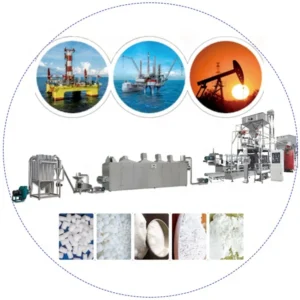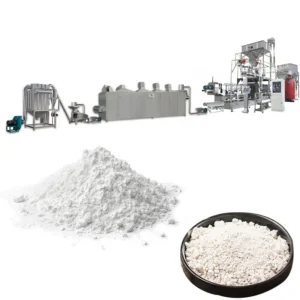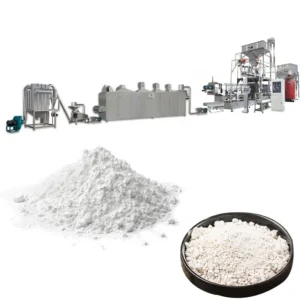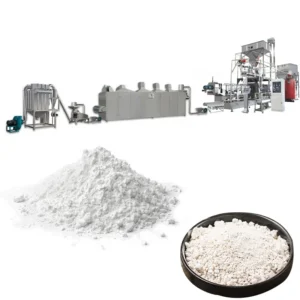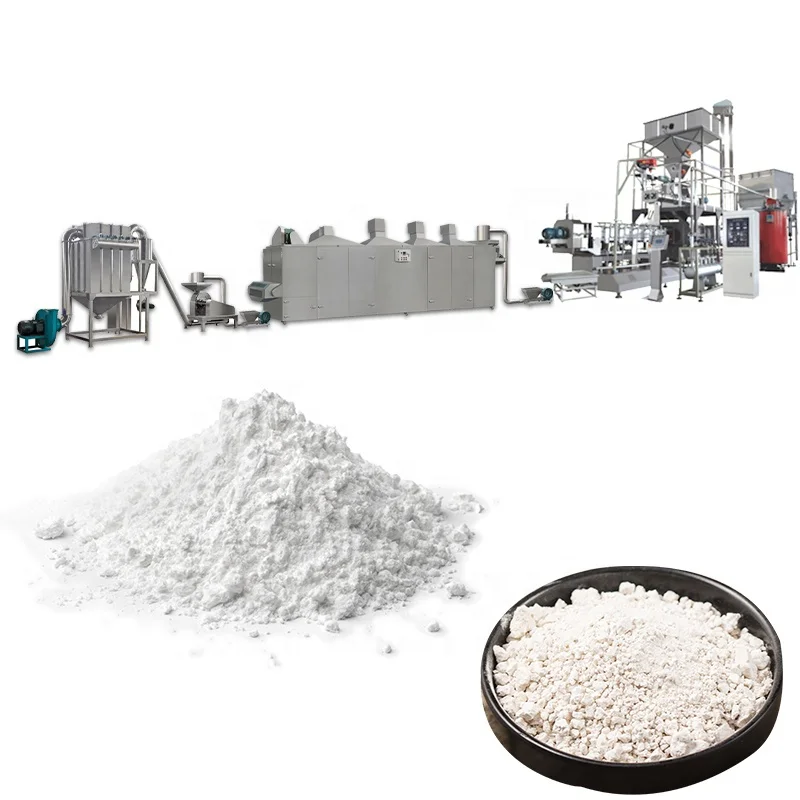
Matched Throughput Across Stations — every mixer, conveyor, extruder and dryer in this modified starch processing line is specified against the same raw material and target output, eliminating the bottleneck effect when downstream equipment cannot keep pace with the extruder.
Technical Specifications
| Parameter | Value |
|---|---|
| Product Type | Modified Starch Extrusion Processing Line |
| Capacity Range | 80–500 kg/h (basis not stated in source — confirm raw material type, moisture content and degree of modification) |
| Extruder Screw Type | Twin screw |
| Process Flow | Mixer → Screw Conveyor → Twin Screw Extruder → Shift → Air Conveyor → Dryer → Air Conveyor → Conditioning → Conveyor → Grinder |
| Frame Material | Stainless steel 201 |
| Contact Material | Food grade stainless steel 304 |
| Mixer Motor | 4.0 kW |
| Mixer Dimensions | 1.2 × 0.9 × 1.4 m |
| Mixer Batch Output | 3.0–4.0 kg per batch (basis not stated in source — confirm batch cycle time) |
| Screw Conveyor Motor | 1.1 kW |
| Screw Conveyor Dimensions | 2.5 × 0.6 × 2.3 m |
| Screw Conveyor Throughput | 0–150 kg/h (basis not stated in source — confirm material density and incline angle) |
| Voltage & Frequency | Three-phase 380 V / 50 Hz; Single-phase 220 V / 50 Hz (configurable to local supply) |
| Total Electrical Power | approx. 100 kW (electric heating); approx. 50–60 kW (gas or diesel heating) |
| Energy Options | Electricity, Gas, Diesel, Steam |
| Control Components | Siemens or China top-brand motors; Delixi or Delta inverters |
| Die Configuration | Adjustable dies for different product forms |
| Assembly State | Complete line with supporting equipment |
| Certification | CE |
Application Suitability
| Application | Material or Output |
|---|---|
| Food-grade modified starch production | Wheat flour, corn starch, potato starch |
| Starch gelatinisation and denaturation | Pre-gelatinised starch for food processing raw materials |
| Industrial modified starch | Paper adhesive and corrugated board bonding applications |
| Corn pellet adhesive manufacturing | Corn-based starch modified for industrial adhesive use |
What "80–500 kg/h" Leaves Out on a Modified Starch Processing Line Full Equipment Range
The number means nothing until the raw material, moisture level, and modification target are defined.
A capacity figure on a brochure rarely matches what you see on the factory floor once your specific starch source enters the extruder barrel. Corn starch behaves differently from potato starch under shear and heat; moisture content shifts gelatinisation onset temperature and expansion behaviour. A modified starch processing line full equipment range quoted on a generic basis can easily overstate sustainable output when your actual raw material demands longer barrel residence time or a tighter temperature profile. This is why the first conversation should be about your flour or starch specification, not the nameplate capacity [NEED_CITE: starch gelatinisation behaviour relative to moisture and shear in twin-screw extrusion].
Sizing Every Station to the Same Output Target
The extruder is only one part of the modified starch processing line. The dryer must remove the exact moisture load that the extruder adds; the conditioning station must stabilise the material before grinding. When these stations are specified independently or sourced from different vendors, a mismatch appears within the first week of production. Each station in this line is configured so that the air conveyor throughput, dryer evaporation rate, and grinder capacity align with the extruder’s actual output on your chosen starch source.
Matching Screw Configuration to Starch Modification Degree
Different modification targets demand different screw element arrangements and die geometries. Producing a lightly pregelatinised starch for food thickening requires a gentler shear profile than producing a highly denatured starch for paper adhesive bonding. The screw configuration and die selection are specified to the buyer’s raw material and target product property, not copied from a generic build [NEED_CITE: twin-screw element arrangement for varying starch modification degrees]. This means the barrel temperature zones and shear intensity are mapped to the degree of gelatinisation you need.
Why the Dryer and Conditioning Station Matter More Than You Think
In modified starch extrusion, the extruder does the chemical work but the dryer determines whether that work survives into the finished product. Undried starch retrogrades; over-dried starch loses functional viscosity. The dryer in this line is sized relative to the extruder’s moisture output, and the conditioning station downstream provides the equilibration time needed before grinding. Energy source flexibility — electricity, gas, diesel, or steam — means the dryer can be matched to whatever utility is available and economical at your facility.
Reading the Specification Sheet with a Critical Eye
The 4.0 kW mixer motor and 3.0–4.0 kg batch output define the batching rhythm; if your target throughput sits at the upper end of the range, you need to confirm batch cycle time against that number. The 0–150 kg/h screw conveyor throughput is dependent on material density and incline angle, so a heavier starch blend or a steeper installation footprint will shift that figure. The total electrical power of approximately 100 kW under electric heating drops to 50–60 kW with gas or diesel — a meaningful difference for your utility planning and transformer sizing. Contact materials in food-grade stainless steel 304 ensure the product path meets hygiene requirements for food-grade starch output, while the stainless steel 201 frame provides structural durability without unnecessary cost on non-contact surfaces.
The Hidden Cost of Skipping Throughput Matching
When the dryer is undersized relative to the extruder, gelatinised starch piles up between stations. That material cools, retrogrades, and in warm climates begins to ferment — I have seen this shut down an entire line for days while operators cleared caked starch from conveyors and dryer inlets. The grinder then receives inconsistent feed and produces uneven particle size, which your downstream customer notices immediately. Every station mismatch compounds the problem further down the line [NEED_CITE: consequences of throughput imbalance in starch extrusion lines].
Why Source the Complete Line from One Equipment Range
Having all stations — mixer, conveyor, extruder, dryer, conditioner, grinder — specified under one supplier means the throughput calculations are done as a system, not assembled from separate quotations. The screw configuration record is written against your specific starch source. The in-house testing workshop allows a trial run on your raw material before the line ships, so you see the actual output and product quality before committing to installation. Electrical schematics are confirmed to your destination voltage and frequency before production starts, avoiding the commissioning delays that happen when a 380 V machine arrives at a 440 V facility. CE documentation supports import compliance in markets that require it.
Documentation & Verification
- Line layout and capacity calculation showing throughput matching across every station
- Screw and die configuration record specific to your starch source and modification target
- Electrical schematic with voltage and frequency confirmed for your destination country
- Trial run report on your raw material conducted in the testing workshop before shipment
- CE declaration of conformity supporting customs and import compliance
- Wear parts list with screw, die, and conveyor component specifications
Installation, Commissioning & Support
- Foundation requirements based on the full line footprint including mixer, extruder, and dryer station spacing
- Dedicated circuit planning for the 100 kW electric heating load or gas supply for the 50–60 kW alternative
- Assembled station delivery with on-site positioning and inter-station conveyor alignment
- First-run parameter setting using the screw and die configuration record from your trial run
- Operator training covering batch cycling, extruder barrel temperature zones, and dryer adjustment
- Spare screw elements, dies, and conveyor components listed for first replacement ordering
What to Prepare Before Requesting a Quotation
To configure a modified starch processing line full equipment range that matches your production target, provide the specific starch source you will be running — corn, wheat, or potato — along with its typical moisture content and the modification degree or functional property you need in the finished product. Confirm your local three-phase voltage and frequency, and whether electric, gas, diesel, or steam heating suits your utility infrastructure. If you have existing upstream batching or downstream packing equipment, share those specifications so the line can be integrated rather than duplicated.
Frequently Asked Questions
Q: What throughput can this line sustain on my specific starch raw material?
A: The stated range depends on raw material type, moisture content, and the degree of modification required. A capacity calculation is prepared after reviewing your starch specification, matching each station — extruder, dryer, conditioner, grinder — to the same validated output figure rather than quoting a generic nameplate number.
Q: How are the dryer and conditioning stations sized relative to the extruder?
A: The dryer evaporation capacity is calculated from the moisture added during extrusion, and the conditioning station provides equilibration time before grinding. Each is specified so that material flow remains continuous without accumulation between stations at the confirmed production rate.
Q: Which voltage, frequency, and control language will be confirmed before production?
A: Your destination electrical standard is confirmed during the quotation stage. The electrical schematic, motor specifications, and inverter settings are then built to that standard, and the PLC or control interface language is set to your operator requirement before the line enters production.
Q: Can a trial run be performed on my raw material before shipment?
A: Yes. The in-house testing workshop conducts a trial run using your supplied starch source and target modification parameters. The resulting trial report documents actual output, product properties, and screw configuration, giving you verified data before the line is packed for dispatch.