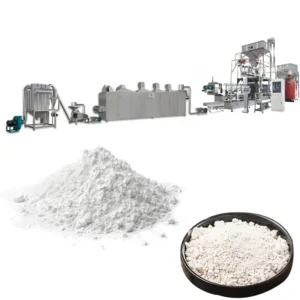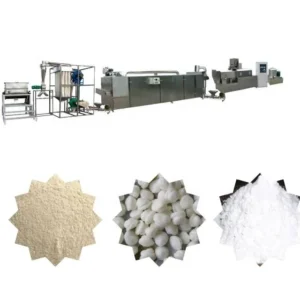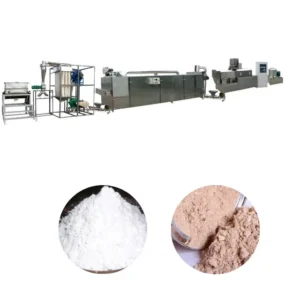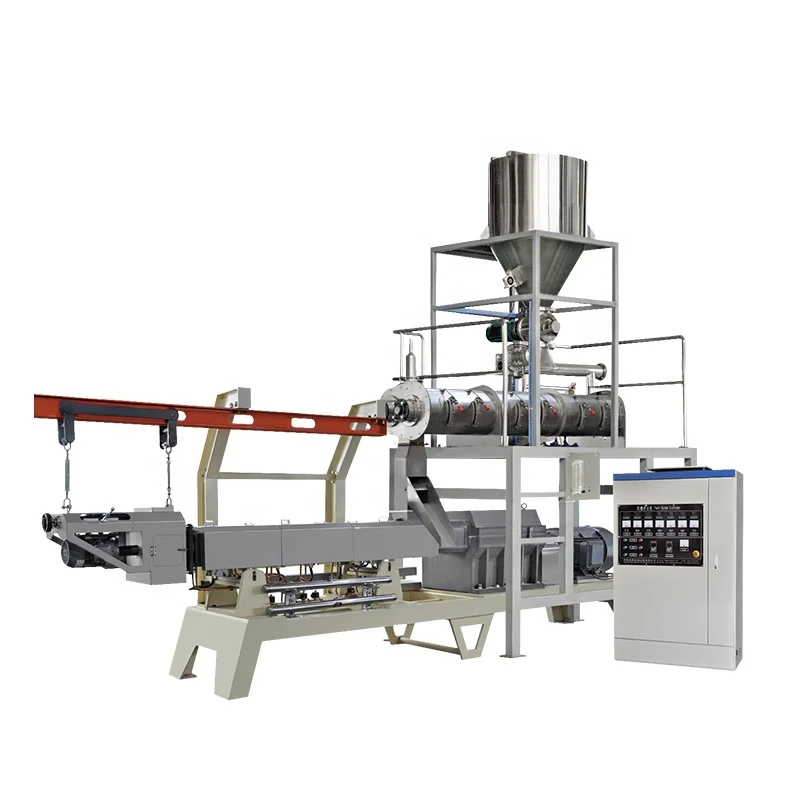
Matched station throughput — every mixer, extruder, dryer, and grinder in this modified starch processing line equipment range is sized so output flows without bottlenecking between stages.
Technical Specifications
| Parameter | Value |
|---|---|
| Product Type | Modified Starch Processing Line |
| Models Available | MT65, MT70, MT75 |
| Screw Type | Twin-screw |
| Installed Power (MT65) | 110 kW |
| Installed Power (MT70) | 160 kW |
| Installed Power (MT75) | 190 kW |
| Power Consumption (MT65) | 90 kW |
| Power Consumption (MT70) | 140 kW |
| Power Consumption (MT75) | 150 kW |
| Output Capacity (MT65) | 100–150 kg/h (basis not stated in source — confirm raw material and moisture content) |
| Output Capacity (MT70) | 150–200 kg/h (basis not stated in source — confirm raw material and moisture content) |
| Output Capacity (MT75) | 300–350 kg/h (basis not stated in source — confirm raw material and moisture content) |
| Overall Dimensions (MT65) | 40000 × 1500 × 2200 mm |
| Overall Dimensions (MT70) | 41000 × 1500 × 2200 mm |
| Overall Dimensions (MT75) | 43000 × 1500 × 3200 mm |
| Voltage | 380V 50Hz Three Phase |
| Control System | Cabinet with frequency conversion for feeding, rotary cutting, and spindle |
| Contact Material | Stainless steel (201 S.S. or 304 S.S. options) |
| Mixer Power Options | 4 kW / 7.5 kW / 15 kW |
| Mixer Batch Capacity | 20–30 kg / 70–80 kg / 170–180 kg per batch |
| Dryer Heating Options | Fuel, gas, or electric heating; multi-layer; double pitch roller chain drive |
| Pulse Grinder Drive Motor | 15 kW |
| Pulse Grinder Air Circulating Motor | 1.5 kW |
| Pulse Grinder Impeller Fan | 1.1 kW |
| Pulse Grinder Mesh | 100–120 mesh |
| Grinder Contact Material | Stainless steel |
| Certification | CE |
Application Suitability
| Application | Material or Output |
|---|---|
| Pregelatinised starch for food processing | Corn, rice, cassava starch |
| Modified starch for textile sizing | Corn and cassava derivatives |
| Modified starch for oil drilling fluids | Denatured starch blends |
| Modified starch for paper and construction | Corn and grain-based starch |
| Nutrition powder processing | Baby rice powder, sesame paste, multi-grain blends |
Why "Rated Capacity" Alone Can Mislead Your Starch Line Decision
The number on the quote sheet only matters when tied to the exact raw material and moisture level you will run.
I once worked with a buyer producing pregelatinised starch who ordered an extruder based on a sample output figure. Their actual recipe used a high proportion of cassava starch, which behaves differently under shear and heat than corn starch. The gelatinisation window shifted, the material did not expand as expected, and the real throughput fell far below what the nameplate suggested. When you survey a modified starch processing line equipment range, the capacity figure must be validated against your specific flour blend, moisture target, and desired degree of modification [NEED_CITE: starch gelatinisation behaviour under twin-screw extrusion].
How Frequency-Conversion Control Shapes Starch Gelatinisation
Starch modification inside a twin-screw barrel depends on the balance between shear force, residence time, and temperature. The control cabinet on MT65, MT70, and MT75 models provides independent frequency conversion for the feeding mechanism, rotary cutter, and main spindle. This separation lets operators adjust feed rate without altering screw speed, or change cutting frequency without disturbing the barrel’s thermal profile. For cassava-based pregelatinised starch, which requires a narrow temperature band to achieve full gelatinisation without scorching, that independent control becomes essential for maintaining consistent batch quality across long production runs.
Matching Dryer Residence Time to Extruder Output Moisture
The modified starch processing line equipment range includes multi-layer dryers with selectable heating sources — fuel, gas, or electric — and a double pitch roller chain drive that governs material travel speed through the drying chamber. If the dryer is undersized relative to extruder output, partially dried starch accumulates, creating lumps that the downstream pulse grinder cannot reduce to the target 100–120 mesh. Conversely, an oversized dryer wastes energy and can over-dry the starch, reducing its functional viscosity. Proper throughput matching across the modified starch processing line equipment range ensures the dryer handles the exact moisture load leaving the extruder die [NEED_CITE: industrial starch drying parameters and moisture equilibrium].
Reading the Specification Sheet Against Your Actual Production Needs
Installed power figures across the MT65 (110 kW), MT70 (160 kW), and MT75 (190 kW) reflect motor capacity, while actual power consumption runs lower at 90 kW, 140 kW, and 150 kW respectively — the gap accounts for startup surges and load variation during barrel conditioning. The twin-screw configuration provides the shear intensity required to disrupt starch granule structure, a task that single-screw designs struggle with when handling high-viscosity cassava or waxy corn blends. Stainless steel contact materials, available in 201 or 304 grades, resist the mild acidity that some modified starch recipes introduce during conditioning. The pulse grinder’s 15 kW drive motor and integrated air circulation system pull finished powder through 100–120 mesh screens while the 1.1 kW impeller fan manages dedusting — a combination that keeps the milling station aligned with upstream extruder throughput.
The Cost of Overlooking Station-to-Station Balance
Buyers who focus only on extruder capacity sometimes discover that an unmatched dryer or grinder quietly restricts the entire line. The extruder may be capable of higher output, but if the dryer cannot remove moisture fast enough, material backs up and operators are forced to slow the feed rate. In other cases, the grinder becomes the constraint — when starch enters the milling chamber faster than the 100–120 mesh screens can pass it, the recirculation load climbs and powder quality degrades. These mismatches rarely appear on a single-machine quotation; they surface only after installation, when the line runs as a system [NEED_CITE: throughput bottleneck analysis in continuous food processing lines].
Why Sourcing the Full Line from One Supplier Matters
Every station in the modified starch processing line equipment range — from the flour mixer through the screw conveyor, twin-screw extruder, air conveyor, roasting oven, and pulse grinder — is specified together so throughput aligns at each handoff point. Screw configuration and die design are selected based on the buyer’s raw material and target starch modification rather than copied from a generic build. An in-house testing workshop allows trial runs on customer-supplied flour blends before the line ships, catching gelatinisation or expansion issues early. Pre-sales consultation covers line layout and utility planning, and the same engineering team handles on-site installation, commissioning, and operator training through ongoing maintenance support.
Documentation & Verification
- Line layout and capacity calculation confirming station-to-station throughput balance for your starch recipe
- Screw and die configuration record matched to your specific corn, cassava, or rice starch source
- Electrical schematic with voltage and frequency confirmation aligned to your facility supply
- Trial run report produced on your actual raw material before equipment dispatch
- CE declaration of conformity and ISO certificate for export compliance documentation
- Wear parts list covering screws, dies, and grinder screens with replacement sourcing details
Installation, Commissioning & Support
- Foundation requirements account for the MT75 line’s 43-metre length and 3200 mm height clearance
- Dedicated power circuit sized for 190 kW installed capacity on the MT75 model
- Equipment ships in modular sections for reassembly aligned to your workshop layout
- First-run parameter setting covers extruder frequency conversion, dryer temperature, and grinder mesh selection
- Operator training addresses starch recipe adjustments and troubleshooting gelatinisation inconsistencies
- Spare screws, dies, and 100–120 mesh grinder screens included with initial shipment
What to Prepare Before Requesting a Quotation
To configure the right modified starch processing line equipment range for your facility, share your primary starch source and any blend ratios, your target daily output, and the degree of modification or gelatinisation your end market requires. Include your workshop dimensions and ceiling height, local voltage and frequency standards, and preferred control language. If you have existing upstream batching or downstream packing equipment, note the interface points so the line layout accounts for them.
Frequently Asked Questions
Q: How is the output capacity verified, and what raw material basis is it measured on?
A: Capacity figures for MT65, MT70, and MT75 models are confirmed through trial runs using your actual starch source and moisture content. Because cassava, corn, and rice starches gelatinise differently under twin-screw shear, the validated throughput on your material may differ from generic sample figures. A trial run report documents the verified output before shipment.
Q: What voltage, frequency, and control language options are confirmed before shipment?
A: The standard configuration is 380V 50Hz three-phase, but voltage and frequency must be verified against your facility supply before production begins. The control cabinet language is set to your operator preference. An electrical schematic with confirmed specifications is provided for your approval before the equipment enters final assembly.
Q: How are screw configuration and die design matched to different starch sources?
A: Each starch type — corn, cassava, rice, or blends — responds differently to barrel shear and temperature. Screw element arrangement and die aperture are selected based on your raw material and the target modification level. The configuration record is documented and can be replicated for future replacement screw orders.
Q: Could a bottleneck form between the extruder and downstream dryer or grinder?
A: Line stations are specified together so that dryer capacity and pulse grinder throughput match extruder output at the confirmed moisture level. The multi-layer dryer’s residence time and the grinder’s 100–120 mesh screening rate are both calculated against the extruder’s verified output to prevent material accumulation at any transfer point.
Q: What spare wear parts are included, and how are replacements sourced?
A: Initial shipments include spare screw elements, dies, and grinder screens. The wear parts list identifies each component by specification so replacements can be ordered directly. Screens for the pulse grinder are available in the standard 100–120 mesh range, and screw elements match the documented configuration for your starch application.