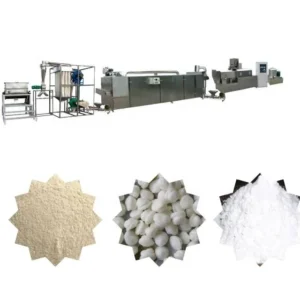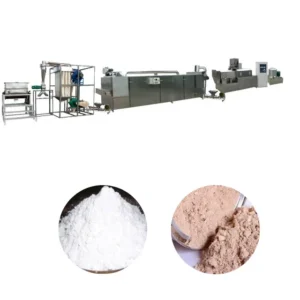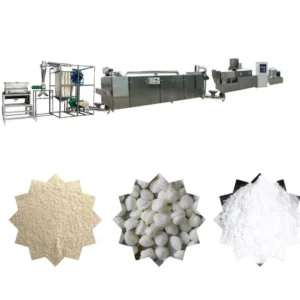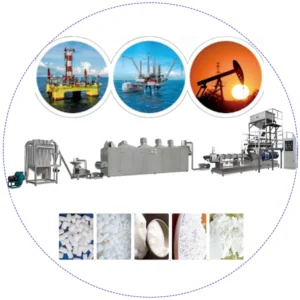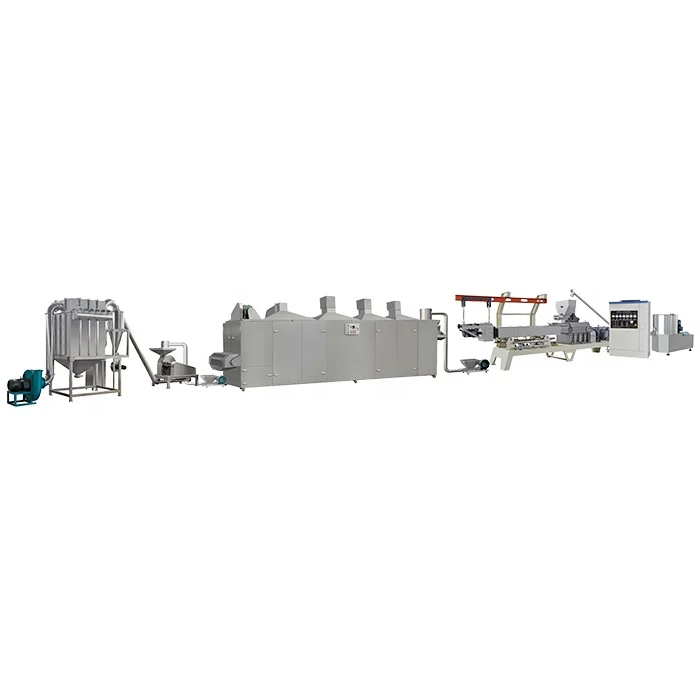
Throughput Matched Across Every Station — Every section of this line, from the mixer through the twin-screw extruder to the pulse grinder, is specified together so capacity at one station does not choke the next.
Technical Specifications
| Parameter | Value |
|---|---|
| Product Type | Modified Starch Extrusion Processing Line |
| Model Options | MT70 / MT85 / MT75 |
| Output Capacity (MT70) | 150–200 kg/h (basis not stated in source — confirm raw material type, moisture content, and target E-number variant) |
| Output Capacity (MT85) | 300–400 kg/h (basis not stated in source — confirm raw material type, moisture content, and target E-number variant) |
| Output Capacity (MT75) | 300–500 kg/h (basis not stated in source — confirm raw material type, moisture content, and target E-number variant) |
| Installed Power (MT70) | 160 kW |
| Installed Power (MT85) | 190 kW |
| Installed Power (MT75) | 210 kW |
| Screw Type | Twin-screw |
| Screw Material | 38CrMoAl |
| Barrel Temperature Control | Integrated cooling system |
| Dryer Type | 5-layer baking oven, gas or diesel heating options |
| Grinder Type | Pulse grinder with cyclone discharge and dust collector |
| Voltage & Frequency | 380V 50Hz Three Phase (customizable to 380V 60Hz, 415V 60Hz, 220V 60Hz) |
| Contact Materials | Stainless steel throughout product contact zones |
| CE Certified | Yes (since 2014) |
Application Suitability
| Application | Material or Output |
|---|---|
| Food-grade thickener and emulsifier (e.g., E1422) | Corn starch or wheat flour base |
| Textile sizing and papermaking binder | Modified industrial starch variants |
| Building materials and casting additives | Starch-based binders for dry-mix applications |
| Oil drilling fluid stabilizer | High-viscosity modified starch grades |
What "300–500 kg/h" Actually Means for Your Starch Line
A nominal output rating is only valid when the raw material, moisture level, and target E-number are locked in.
A modified starch processing line full equipment range might show a high output figure on the brochure, but if that number was measured on standard corn grits and your feedstock has a different amylose content, the extruder will not hold that rate while achieving the gelatinisation required for variants like E1422. We have seen processors sign for a line based on a single capacity number, only to discover during commissioning that the dryer cannot keep up with the extruder at peak feed rates, or that the grinder bottlenecks the final powder discharge. [NEED_CITE: factors affecting starch gelatinisation in twin-screw extruders]
Matching Extruder Output to Dryer and Grinder Capacity
When evaluating a modified starch processing line full equipment range, the critical factor is whether the downstream stations can absorb the extruder’s peak output. A twin-screw extruder processing 300–500 kg/h of modified starch generates a continuous flow of moist, expanded material that must enter the dryer immediately to prevent clumping and degradation. If the 5-layer dryer belt speed or thermal capacity is undersized, material backs up at the extruder die, forcing operators to reduce feed rates and lose the rated throughput.
The pulse grinder at the end of the line must also handle the dried product volume. Cyclone discharge with an integrated dust collector keeps the final powder moving without blockages, but the grinder motor and screen size must be specified against the target particle distribution for your application. When all three stations are quoted as a matched set rather than assembled from separate vendors, the throughput numbers on the specification sheet reflect what the line will actually sustain in your facility.
How Screw Configuration Drives Starch Modification
The twin-screw design in this modified starch processing line full equipment range allows operators to adjust screw element sequencing for different modification targets. Acetylated distarch adipate (E1422) requires a specific combination of shear, residence time, and barrel temperature to achieve the cross-linking and substitution reactions that give the starch its emulsifying properties. [NEED_CITE: screw configuration for reactive extrusion of starch]
Using 38CrMoAl screw elements provides wear resistance against the abrasive nature of starch feedstocks over extended production runs. The integrated barrel cooling system prevents localized overheating that would degrade the starch before the chemical modification is complete. A generic screw build copied from a snack extrusion line will not produce the correct degree of substitution for food-grade modified starch applications.
Reading the Specification Sheet for Starch-Specific Parameters
The screw diameter and length determine the L/D ratio, which directly controls residence time inside the barrel — longer residence gives the reagents more time to react with the starch granules but reduces throughput. The installed power figures across the MT70, MT85, and MT75 models reflect different motor sizes needed to maintain torque at higher feed rates with viscous starch melts. Mixer capacity options from 20 kg/time up to 180 kg/time allow batch sizing that matches the extruder’s continuous feed requirement without material sitting too long and absorbing ambient moisture. The voltage configurability — 380V 50Hz standard with 60Hz and alternative voltage options — ensures the motors and heating elements draw correct current in your local grid without derating.
The Cost of Undersized Supporting Stations
When a buyer assembles a modified starch line from separate equipment vendors, the extruder supplier quotes one capacity, the dryer supplier quotes another, and no single party guarantees the end-to-end throughput. The result is a line that runs at a fraction of the rated output because one station is always the bottleneck. [NEED_CITE: throughput matching in multi-station processing lines] Operators end up manually throttling the extruder feed to prevent material overflow at the dryer infeed, which wastes the installed motor power and extends production shifts to meet daily targets. Wear on screws and dies also increases when the extruder runs at partial load with frequent starts and stops to clear downstream blockages.
Why Specifying the Full Line Under One Supplier Matters
Every station from the mixer through the pulse grinder is configured together so that the MT70, MT85, or MT75 extruder output feeds directly into a dryer and grinder rated for the same continuous volume. Screw configuration and die design are specified to your raw starch type and target E-number rather than copied from a generic build. An in-house testing workshop runs trial extrusion on your actual feedstock before shipment, confirming that the gelatinisation and modification targets are achievable at the quoted capacity. Line layout documentation shows the physical arrangement and utility connections for each station, reducing installation surprises. Pre-sales consultation covers voltage confirmation, control language, and utility planning so that commissioning proceeds without electrical or communication delays.
Documentation & Verification
- Line layout drawing showing throughput matching between mixer, extruder, dryer, and grinder
- Screw and die configuration record specified to your starch type and target E-number
- Electrical schematic with confirmed voltage, frequency, and control language
- Trial run report on your raw material from the in-house testing workshop
- CE declaration of conformity for the complete line assembly
- Factory test record documenting each station’s output before dispatch
Installation, Commissioning & Support
- Foundation requirements based on the 41–45 m line length and dryer weight of 1800 kg
- Dedicated electrical circuits sized to the 160–210 kW installed power across all stations
- Twin-screw extruder barrel cooling system checked and charged during on-site commissioning
- Dryer belt speed and temperature profile set for your specific modified starch moisture target
- Operator training on screw element changes and pulse grinder screen replacement procedures
- Wear parts list covering 38CrMoAl screws, dies, and grinder screens for first replacement planning
What We Need to Configure Your Line
To match the correct extruder model and supporting stations to your project, we need the base starch material and its amylose content, the target modification type such as E1422 or another E-number, and your daily production target in kilograms. Your facility voltage and frequency, preferred control panel language, and available floor space with ceiling height determine the line layout and electrical configuration. If you can send a sample of your raw feedstock, we run a trial in our testing workshop before finalizing the screw configuration and quotation.
Frequently Asked Questions
Q: How is the output capacity of the line verified, and on which raw starch is it based?
A: The output figures in the specification table are measured under specific conditions that must be confirmed against your feedstock. We run your actual raw starch through our testing workshop to validate throughput at your target modification level, and the trial run report documents the achievable rate with your material and moisture content.
Q: Can the voltage, frequency, and control panel language be configured for my market?
A: The line is available in 380V 50Hz three-phase as standard, with 380V 60Hz, 415V 60Hz, and 220V 60Hz options. The electrical schematic is finalized and confirmed with you before production begins, and the control panel language is set to match your operator requirements.
Q: How are the mixer, extruder, dryer, and grinder matched to prevent bottlenecks?
A: Each station is selected as part of a matched set rather than sourced independently. The mixer batch cycle time, extruder continuous feed rate, dryer belt capacity, and grinder throughput are all calculated against the same target output so that no single station limits the others during sustained production.
Q: What screw configuration is used for different modified starch types such as E1422?
A: Screw element sequencing and die design are specified after reviewing your target E-number and raw material properties. The 38CrMoAl screw elements can be arranged in different kneading block and conveying sequences to achieve the residence time and shear profile required for acetylation, cross-linking, or other modification chemistries.
Q: Is a trial run on my raw material performed before shipment?
A: Yes. We run your feedstock through the configured line in our testing workshop and produce a trial run report showing the gelatinisation degree, modification results, and achievable throughput. This report is included in the documentation package before the equipment is packed for shipment.