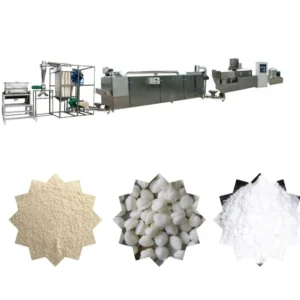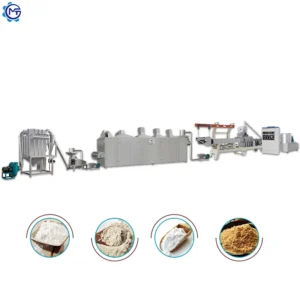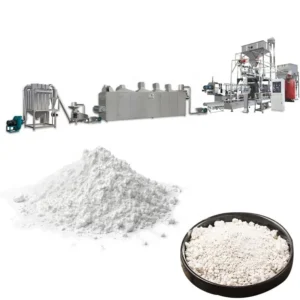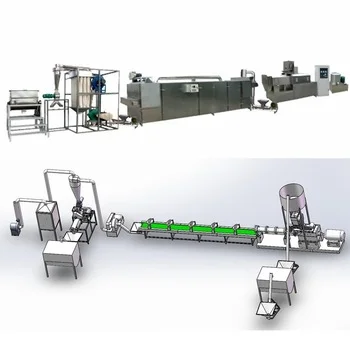
Screw and die geometry matched to your starch source — every modified starch processing line we ship starts with a configuration record built around the buyer’s actual raw material report, not a generic template.
Technical Specifications
| Parameter | Value |
|---|---|
| Product Type | Modified Starch Processing Line |
| Main Extruder | Twin Screw Extruder |
| Installed Power Range | 45–200 kW |
| Throughput Range | 100–1500 kg/h (basis not stated in source — capacity confirmed against buyer’s raw material moisture and modification target) |
| Voltage | 220–440V, tri-phase |
| Control Architecture | PLC & MCC |
| Line Stations | Mixing/Batching, Extrusion, Cooling Conveyor, Pulse Grinder, Cyclone Discharge, Dust Collector |
| Contact Material | Food-grade stainless steel (except PVC conveyors) |
| Fuel Options | Gas / Diesel / Electricity / Steam (confirmed at quotation) |
| Assembly State | Complete production line with supporting equipment |
| Standards | CE, ISO |
Application Suitability
| Application | Material or Output |
|---|---|
| Food-grade modified starch for thickening and stabilising | Corn starch, wheat flour, rice flour with additive materials |
| Industrial starch for oil drilling fluids | Corn starch, potato starch with cross-linking agents |
| Paper-making additives and binders | Cassava starch, wheat flour with chemical modifiers |
| Pre-gelatinised starch for instant food bases | Rice flour, corn starch with moisture and shear adjustment |
Why Nominal Capacity Numbers Fail on Real Starch Batches
A modified starch processing line equipment rated at 1000 kg/h on paper often delivers far less when the buyer’s actual raw material enters the barrel.
I spent years on installation sites across Latin America before moving into sales, and the most frustrating calls always came two weeks after startup. One Colombian customer ran a pregelatinised cassava line where the amylose content in their local tuber was higher than the standard test sample we used during configuration. The gelatinisation degree never reached spec, and the plant sat idle while we machined a new screw set and shipped it. [NEED_CITE: raw material variability in starch extrusion processing] That gap between quoted throughput and real output is what forces buyers into unplanned downtime and contract penalties.
How Barrel Temperature Profile Controls Gelatinisation Degree
The twin-screw extruder in this modified starch processing line equipment operates across independently heated barrel zones. Each zone holds a specific temperature band that governs how completely starch granules rupture and absorb water during transit. When the profile is set too low, partial gelatinisation leaves unreacted granule cores that show up as white specks in the final powder. When set too high, thermal degradation breaks the polymer chains and reduces the viscosity that downstream users depend on.
Matching Screw Elements to Starch Modification Chemistry
Different modification targets demand different shear histories inside the barrel. Producing a lightly cross-linked starch for food thickening requires gentle conveying elements that give reagents time to diffuse into the granule without destroying its structure. Oxidised starch for paper coating, by contrast, needs higher shear to open the granule surface so the oxidant can penetrate. The screw configuration record we document before production specifies element type, pitch and stagger angle for each section of the screw shaft, matched to the buyer’s exact reagent and target degree of substitution. [NEED_CITE: screw element selection for starch modification]
Reading the Parameter Sheet for Production Impact
The 45–200 kW power range across the line reflects the motor load on the extruder and grinder together. Higher modification degrees typically require longer barrel residence, which means slower screw speed and higher torque draw — the installed power must cover that peak without tripping the MCC. Voltage options from 220 to 440V tri-phase exist because export sites vary widely; a plant in Brazil running 380V/60Hz needs a different transformer ratio than one in Indonesia on 380V/50Hz, and getting this wrong delays commissioning. The PLC and MCC control architecture separates logic from power, so an operator can adjust barrel temperature and feeder rate on the touchscreen without accessing the main power cabinet. Food-grade stainless steel on every contact surface prevents iron contamination that would discolour white starch powder and fail heavy-metal testing.
The Hidden Cost of Skipping Raw Material Trials
Buyers who accept a modified starch processing line equipment without insisting on a pre-shipment trial on their own raw material frequently discover problems only after installation. The most common failures are off-spec gelatinisation degree, incorrect powder colour from thermal browning, and particle size distribution that misses the mesh count the buyer’s customers require. Correcting these issues on site means re-machining screws, replacing die plates and adjusting dryer airflow — work that should have been finished in the factory workshop. [NEED_CITE: pre-shipment trial requirements for extrusion lines]
What Sets This Supply Approach Apart
Every station on the line is sized so throughput matches from the batching mixer through the extruder, the cooling conveyor, and into the pulse grinder — no single machine creates a bottleneck. Screw and die configuration is not copied from a previous build; it is specified from the buyer’s raw material analysis and the target modification degree, then recorded in the configuration document. A trial run using the buyer’s actual starch is conducted in the testing workshop before the line ships, generating a report that documents temperature profile, screw speed, moisture addition and final product test results. Electrical schematics and voltage are confirmed against the buyer’s local supply before the control cabinet is wired, so the MCC and PLC arrive ready for the site grid.
Documentation & Verification
- Line layout drawing with throughput matched across every station
- Screw and die configuration record built on your raw material report
- Trial run report from testing workshop on your starch batch
- Electrical schematic with voltage and frequency confirmed for your site
- Factory test record before dispatch
- Operation and maintenance manual with wear parts list
Installation, Commissioning & Support
- Foundation plan accounts for extruder vibration and pulse grinder load
- Dedicated power circuit sized to the 45–200 kW total installed range
- Line arrives in sectioned modules for workshop-door clearance
- First-run parameter setting covers barrel zones, feeder rate and grinder screen
- Operator training on PLC interface language confirmed at order stage
- Wear parts list covers screws, dies and grinder blades with reorder codes
Information Needed to Configure Your Line
To build an accurate proposal for a modified starch processing line equipment, we need to know the starch source you will run — corn, cassava, wheat, potato or a blend — along with the modification chemistry and target degree of substitution. Share your local voltage, frequency and the control language your operators prefer. If you have an existing mixer or packing station upstream or downstream, send us the throughput data so the new line matches without over- or under-sizing.
Frequently Asked Questions
Q: How is line capacity verified against my specific starch source and modification formula?
A: Capacity is confirmed through a trial run in our testing workshop using your raw material and reagents. The extruder runs at the target screw speed and barrel temperature, and the output is measured over a sustained period. Results are documented in a trial report before shipment so you know the throughput your formula will actually deliver.
Q: What voltage, frequency and control language options are confirmed before production?
A: The line supports 220–440V tri-phase. Before the control cabinet is wired, we confirm your site voltage, frequency and the PLC interface language your operators need. The electrical schematic is then finalised to match your local grid, preventing commissioning delays.
Q: How is screw and die configuration chosen for different starch sources and modification targets?
A: Each screw section uses elements selected for the shear and residence time your modification chemistry requires. Die geometry controls the expansion and density of the extrudate before grinding. The configuration is documented against your raw material report so the setup is repeatable.
Q: Can a trial run be done on my raw material before the line ships?
A: Yes. We run your starch and reagents in the testing workshop and record barrel temperature, screw speed, moisture addition and product test results. The trial report accompanies the shipment, giving your team a verified starting point for commissioning.
Q: What spare wear parts are supplied and how are replacements sourced?
A: The initial spare set covers screws, dies and pulse grinder blades. Each part carries a reorder code listed in the wear parts manual. Replacement components are manufactured to the same configuration record so they fit without re-commissioning the line.