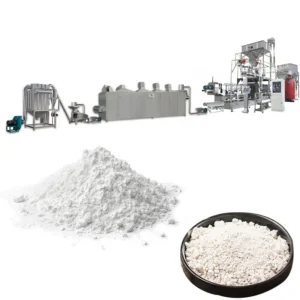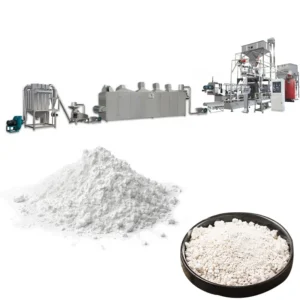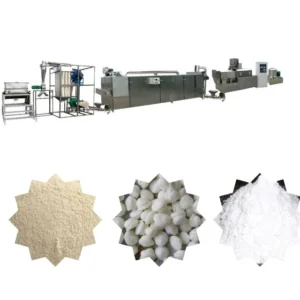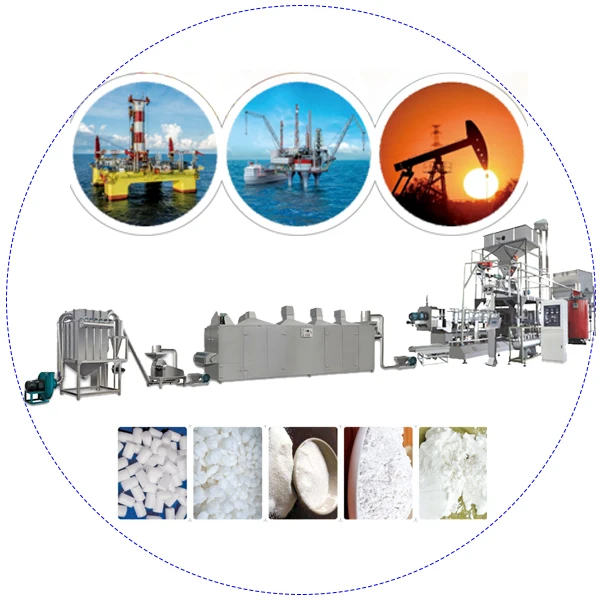
Full Equipment Coverage — Every station from mixer to grinder specified with individual motor ratings, dimensions, and throughput ranges so buyers can survey the complete modified starch processing line before committing.
Technical Specifications
| Parameter | Value |
|---|---|
| Product Type | Modified Starch Processing Line |
| Raw Materials | Wheat flour, corn starch, potato starch |
| Capacity Range | 80–500 kg/h (basis not stated in source — confirm raw material, moisture content, and product specification) |
| Extruder Type | Twin screw extruder |
| Process Flow | Mixer → Screw Conveyor → Twin Screw Extruder → Shifter → Air Conveyor → Dryer → Air Conveyor → Conditioning → Conveyor → Grinder |
| Mixer Motor Power | 4.0 kW |
| Mixer Dimensions (L×W×H) | 1.2 × 0.9 × 1.4 m |
| Mixer Batch Output | 3.0–4.0 kg/time (basis not stated in source — confirm raw material density and moisture) |
| Screw Conveyor Motor Power | 1.1 kW |
| Screw Conveyor Dimensions (L×W×H) | 2.5 × 0.6 × 2.3 m |
| Screw Conveyor Output | 0–150 kg/h (basis not stated in source — confirm material type and moisture) |
| Voltage & Frequency | Three phase 380V/50Hz; Single phase 220V/50Hz (configurable to local site supply) |
| Line Power Consumption | Approx. 100 kW (electric heating); 50–60 kW (gas or diesel heating) — rated or peak not specified |
| Frame Material | Stainless steel 201 |
| Contact Material | Food grade stainless steel 304 |
| Energy Options | Electricity, gas, diesel, or steam |
| Die Configuration | Interchangeable dies for different product forms |
| Standards | CE |
| Warranty | One year |
Application Suitability
| Application | Material or Output |
|---|---|
| Pregelatinized starch production | Corn starch and potato starch gelatinized through twin-screw extrusion for cold-water solubility |
| Modified starch for food processing | Wheat flour and corn starch treated for improved viscosity and gelling properties |
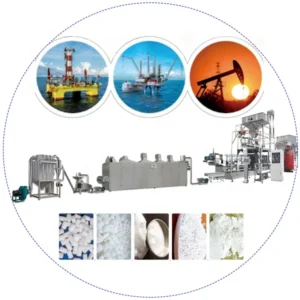
| Industrial starch modification | Starch hydrolysis, saccharification, and denaturation for adhesive and paper coating applications |
| Starch paste expansion processing | Corn or potato starch expanded to increase molecular weight and stability |
What the Quoted Capacity Figure Actually Depends On
A line rated at 500 kg/h on corn starch may not hold that output once potato starch enters the barrel.
When I first started configuring extrusion lines, I watched a Southeast Asian starch processor run trial parameters on cassava starch with excellent results. The machines shipped, the crew arrived on site, and the actual raw material turned out to be potato starch — completely different viscosity profile, different gelatinisation temperature, different expansion behaviour. We spent a full week adjusting screw speed, barrel temperature, and moisture feed before the line stabilised. That modified starch processing line full equipment range only delivers its quoted throughput when every station is matched to the specific raw material and moisture content the buyer will actually use.
Capacity figures for starch extrusion depend on factors that generic catalogues rarely disclose: raw material amylose-to-amylopectin ratio, incoming moisture percentage, target degree of gelatinisation, and the die geometry selected for the desired particle size [NEED_CITE: starch gelatinisation parameters by raw material source]. An extruder running corn starch at one moisture level may produce acceptable pregelatinized starch, while the same screw configuration fed with potato starch at a different moisture level produces under-expanded material that fails downstream viscosity tests. The mixer batch output, screw conveyor feed rate, and dryer residence time must all be recalculated when the raw material changes.
Every Station in the Catalogue, Separately Specified
Surveying individual machines before assembling a complete line prevents the most common bottleneck: an extruder that outputs faster than the dryer can handle, or a grinder that cannot keep up with the conditioned material arriving on the conveyor. This modified starch processing line full equipment range lists each station with its own motor power rating, physical dimensions, and output range, allowing process engineers to verify throughput matching at every transfer point.
Energy Source Selection and Line Power Consumption
Starch processing facilities in different regions have vastly different utility infrastructure. The line supports electric heating at approximately 100 kW total consumption, or gas and diesel heating options that reduce electrical load to 50–60 kW [NEED_CITE: industrial energy source selection for food processing facilities]. Steam heating is also available for sites that already operate a boiler plant. Confirming the available voltage, frequency, and preferred energy source before production begins avoids commissioning delays that arise when a 380V/50Hz machine arrives at a site wired for a different supply standard.
How Screw Configuration and Die Selection Shape Starch Properties
The twin-screw extruder sits at the centre of the modified starch processing line full equipment range because it controls the degree of starch gelatinisation through shear force, barrel temperature profile, and residence time. Interchangeable dies allow the same extruder platform to produce different particle forms — fine pregelatinized powder requires a different die geometry than expanded starch granules intended for adhesive applications. The screw configuration must match the raw material’s behaviour under heat and pressure: corn starch, wheat flour, and potato starch each demand distinct screw element arrangements to achieve consistent molecular weight modification and viscosity targets.
The Hidden Cost of Mismatched Station Capacity
An extruder running at full output feeding a dryer sized for a lower throughput creates a backlog that forces the entire line to slow down. I have seen processors accept a line where the dryer was undersized relative to the extruder, resulting in partially dried starch that clumped in the grinder and produced off-spec particle sizes. The grinder then required more frequent screen changes and the final product failed viscosity specifications. These problems do not appear in a quotation that lists only the extruder capacity — they emerge during the first production run when every station must perform simultaneously [NEED_CITE: throughput balancing across food processing line stations].
Why Source the Full Range from One Equipment Supplier
Every station in this modified starch processing line full equipment range is designed to operate at matched throughput, eliminating the integration gaps that arise when machines are assembled from separate vendors. Food grade stainless steel 304 is used throughout the product contact path, from the mixer bowl through the extruder barrel to the grinder chamber, maintaining hygiene compliance across every transfer point. Screw configuration and die design are specified to the buyer’s actual raw material and target starch product rather than copied from a generic build. An in-house testing workshop allows trial runs on the buyer’s raw material before shipment, so process parameters are verified before the line leaves the factory. Pre-sales consultation covers line layout, utility planning, and electrical schematic confirmation, followed by on-site installation, commissioning, and operator training.
Documentation & Verification
- Machine specification sheet listing per-station motor power, dimensions, and output range
- Screw and die configuration record matched to buyer’s raw material and target starch product
- Electrical schematic with voltage and frequency confirmation for the destination market
- Line layout drawing showing throughput matching between every station
- Factory test record from trial run on buyer’s actual raw material before dispatch
- CE declaration of conformity covering the complete line assembly
Installation, Commissioning & Support
- Foundation requirements calculated from the combined footprint of mixer, extruder, dryer, and grinder stations
- Dedicated electrical circuit sized for the 100 kW electric heating load or gas supply connection for reduced electrical demand
- Modular station layout allowing phased installation if workshop access limits simultaneous delivery
- First-run parameter setting covering screw speed, barrel temperature zones, and die pressure for the confirmed raw material
- Operator training on die changeover procedures and screw element replacement intervals
- Wear parts list covering screws, dies, and grinder screens with recommended stock quantities
What to Include in Your Inquiry
To receive an accurate line configuration, provide the specific starch type you will process — corn, potato, wheat, or another source — along with the incoming moisture content and the target product specification such as viscosity range or particle size. Confirm the available voltage and frequency at your facility, your preferred energy source for the dryer, and whether you require PLC or MCC control. If you have existing upstream or downstream equipment that this line must integrate with, share those specifications so throughput matching can be verified before quotation.
Frequently Asked Questions
Q: What capacity range does each station cover, and on what raw material basis?
A: The line covers a range from 80 to 500 kg/h, but the actual achievable throughput depends on the specific raw material, its moisture content, and the target product specification. Corn starch, potato starch, and wheat flour each behave differently under extrusion, so the capacity figure must be confirmed against the buyer’s actual material through a trial run before the final quotation is issued.
Q: Can the line be specified with gas or steam heating instead of electric?
A: Yes. The dryer and conditioning stations support electricity, gas, diesel, or steam as energy sources. Electric heating draws approximately 100 kW across the full line, while gas or diesel options reduce electrical consumption to between 50 and 60 kW. The selection depends on site utility availability and local energy cost structures.
Q: Which stainless steel grade is used for product-contact versus structural parts?
A: All surfaces that contact the starch material — including the mixer bowl, extruder barrel, screw elements, die, and grinder chamber — are constructed from food grade stainless steel 304. The structural frame uses stainless steel 201, which provides adequate corrosion resistance for non-contact components while keeping the overall line cost controlled.
Q: How is the twin-screw extruder die selected for pregelatinized versus modified starch output?
A: Die selection depends on the target particle form and the degree of expansion required. Pregelatinized starch intended for cold-water solubility typically uses a die geometry that produces uniform granules, while modified starch for industrial applications may require a different die to achieve the desired density. The die is matched to the raw material and confirmed during the pre-shipment trial run.
Q: What voltage and frequency options are available, and how are they confirmed before shipment?
A: The standard configuration is three-phase 380V/50Hz with single-phase 220V/50Hz for auxiliary circuits, but the line can be built to match the buyer’s local supply standard. Voltage and frequency are confirmed during the specification stage, and the electrical schematic is reviewed and approved before production begins to prevent commissioning delays at the installation site.