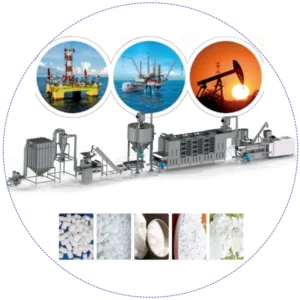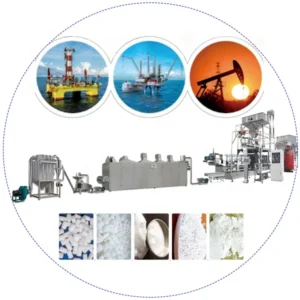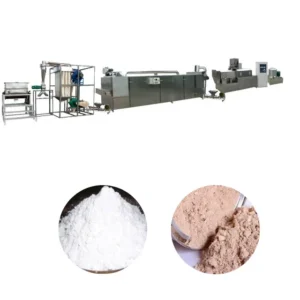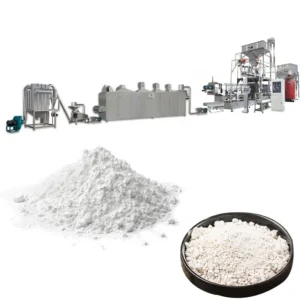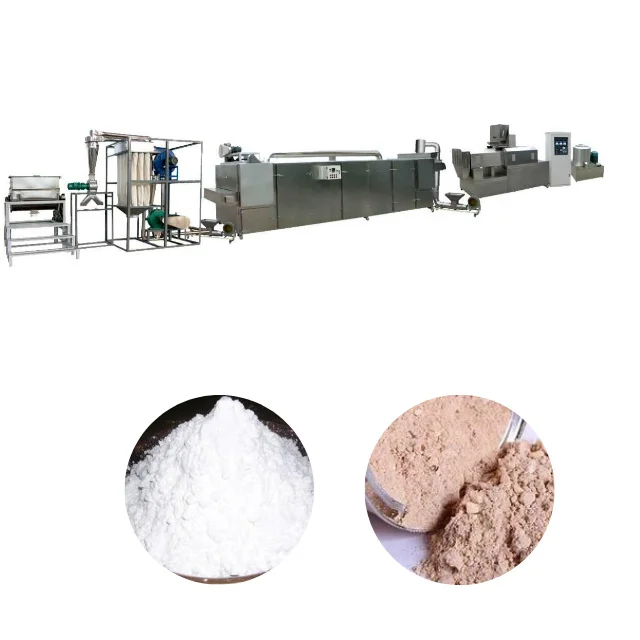
Integrated Line Throughput Matching — every station from the batching hopper to the packing scale is capacity-calculated against the extruder’s real output on your specific starch type, preventing bottlenecks before the first bolt is tightened.
Technical Specifications
| Parameter | Value |
|---|---|
| Product Type | Modified Starch Processing Line |
| Model Range | MT85, MT100, MT110, MT135 |
| Screw Type | Twin-screw |
| Raw Material Compatibility | Corn starch, tapioca starch, potato starch |
| Output Capacity | 100–1500 kg/hr (basis not stated in source — confirm moisture content and raw material type) |
| Installed Power | 90–240 kW (varies by model) |
| Real Power Consumption | 63–165 kW (varies by model) |
| Barrel & Screw Configuration | Customizable for denatured and pre-gelatinized starch production |
| Heating Source Options (Dryer/Roaster) | Electric, steam, or gas |
| Grinding Machine Material | Stainless steel 304 on food contact parts |
| Grinding Particle Fineness | Less than 10 mm |
| Control System | Frequency speed controlling system |
| Lubrication | Automatic lubricating and cooling |
| Line Stations | Material preparation → blending → mixing → extruding → drying → grinding → packing |
| Assembly State | Turnkey production line |
| Standards | CE certified, ISO certified |
Application Suitability
| Application | Material or Output |
|---|---|
| Pre-gelatinized (α-form) starch for textile sizing | Corn or potato starch with controlled gelatinisation degree |
| Modified starch for food processing (thickeners, stabilizers) | Corn starch, tapioca starch under thermal or enzymatic modification |
| Pre-gelatinized starch for oil drilling fluid | Tapioca or corn starch with high cold-water swelling capacity |
| Modified starch for paper coating and construction additives | Potato or corn starch requiring enhanced film-forming and gel strength |
| Physical or chemical starch modification | Natural starch processed through barrel temperature and shear profile adjustment |
Why "Nameplate Capacity" Fails on Modified Starch Lines
An extruder rated at 1,000 kg/hr on generic parameters can drop to half that when run on high-amylose corn starch without screw and barrel reconfiguration.
I have watched a line stall because the dryer could not keep pace with an extruder that was pushing wetter-than-expected pregelatinized starch. The operator kept reducing feed rate until the whole modified starch processing line equipment range was running at a fraction of what the quotation promised. Capacity numbers on paper mean little when the actual raw material — whether tapioca, potato, or corn — behaves differently under shear and heat than the test conditions assumed [NEED_CITE: starch gelatinisation temperature ranges across botanical sources]. Sizing the extruder, dryer, and grinder as isolated units rather than a throughput-matched chain is where most starch plant projects lose time and margin.
How Screw Configuration Determines Starch Modification Outcome
The twin-screw extruder at the heart of this modified starch processing line equipment range allows the barrel and screw elements to be rearranged for different modification targets. Denatured starch requires a different shear and residence-time profile than pre-gelatinized α-starch, and the screw combination must reflect that. When the wrong configuration is installed — one copied from a snack food build, for instance — the starch either fails to gelatinize fully or degrades past the target viscosity.
Matching the Dryer and Grinder to Extruder Throughput
A common failure on starch lines is oversizing the extruder relative to downstream stations. The drying section must handle the moisture load that exits the die; if the dryer runs on electric heating in a region where steam is cheaper and more consistent, operating costs climb and temperature uniformity suffers. The grinding station must then reduce the dried sheet or pellet to the target particle fineness — less than 10 mm — without overheating the starch and destroying the modification achieved upstream [NEED_CITE: thermal degradation thresholds for pre-gelatinized starch during milling]. Frequency speed controlling on each station lets the operator fine-tune feed rates to keep material flow balanced across the full line.
What the Spec Sheet Numbers Mean for Your Production
The installed power range of 90–240 kW across the MT85 through MT135 models reflects the mechanical and thermal energy needed to push starch through varying screw lengths and die geometries. Real power consumption at 63–165 kW is what you will see on the meter during steady-state operation, and the gap between the two figures represents the thermal headroom available for start-up surges and heavier formulations. Stainless steel 304 contact parts on the grinding station meet food-grade requirements and resist the mildly acidic residues that some chemically modified starches leave behind. Automatic lubricating and cooling on the extruder gearbox reduces unplanned stops during the continuous runs that starch modification demands, where even a short interruption can allow material to set inside the barrel.
The Hidden Cost of Skipping a Pre-Shipment Trial Run
When a line ships without a trial run on the buyer’s actual starch, the first weeks on site become a costly experiment. Screw elements are swapped, barrel temperatures are adjusted, and entire batches of raw material are wasted while the team searches for the right parameters. I spent four days in a Southeast Asian plant because the client had applied tapioca starch settings directly to corn starch — the expansion never developed and the die clogged repeatedly. A pre-shipment trial on the customer’s own raw material eliminates this risk, confirming the modified starch processing line equipment range can hold its target output before the containers leave the factory [NEED_CITE: common commissioning delays in starch extrusion projects].
Why Source the Full Equipment Range from One Supplier
Every station — material preparation, blending, mixing, extruding, drying, grinding, packing — is designed to pass its output to the next without manual buffering or re-handling. Screw configuration and die design are specified against your raw material and modification target rather than copied from a generic catalogue. An in-house testing workshop allows trial runs on your starch before the line ships, so the parameters are documented and ready on day one. Twin-screw expertise spans denatured, pre-gelatinized, and chemically modified starch applications, meaning the engineering team speaks the language of your process. Pre-sales consultation through installation, commissioning, and operator training keeps responsibility in a single chain from layout drawing to steady-state production.
Documentation & Verification
- Line layout and capacity calculation confirming throughput matching across every station on your starch type
- Machine specification sheet with screw and die configuration record matched to corn, tapioca, or potato starch
- Electrical schematic with voltage and frequency confirmation for the target market
- Factory test record and trial run report on customer raw material before dispatch
- CE declaration of conformity and ISO certificate included with shipment documentation
Installation, Commissioning & Support
- Foundation plan accounts for the 90–240 kW installed power range and vibration isolation under the twin-screw extruder
- Dedicated electrical circuit sized for the frequency speed controlling system and automatic lubrication pump
- Drying station configured on site for electric, steam, or gas heating based on local utility availability
- First-run parameter setting performed on your raw material with screw and barrel adjustments documented
- Operator training covers die cleaning intervals and starch residue removal to prevent cross-contamination between batches
- Wear parts list identifies screws, dies, and grinder blades with reorder lead times for continuous operation
What to Include in Your Inquiry
Share the botanical source of your starch (corn, tapioca, or potato), the modification target (pre-gelatinized, denatured, chemically modified), and the hourly throughput you need. Confirm the local voltage and frequency, the available heating source for the drying station, and whether any existing upstream or downstream equipment must be integrated into the new line.
Frequently Asked Questions
Q: What stations are included in a complete modified starch processing line and where does each machine fit?
A: The line covers material preparation, blending, mixing, twin-screw extruding, drying or roasting, grinding, and packing. Each station is throughput-matched so material flows without buffering. The extruder handles the core modification, the dryer removes moisture to a stable level, and the grinder reduces the output to the target particle fineness before packing.
Q: How do I match dryer and grinder capacity to the extruder to avoid line bottlenecks?
A: The dryer must handle the full moisture load exiting the die at the extruder’s confirmed output on your starch type. The grinder must then process the dried material at the same rate without overheating. Capacity calculations across all three stations are provided before order confirmation to confirm balance.
Q: Which heating source should I specify for the drying station?
A: Electric heating offers precise temperature control and suits regions with stable grid power. Steam is more economical where a boiler is already available on site. Gas firing is common in areas with abundant natural gas supply. The choice affects both operating cost and temperature uniformity across the drying bed.
Q: How do I select the right extruder model for my target capacity?
A: Models range from MT85 to MT135, covering an output capacity span that depends on raw material type and moisture content. The selection is based on your confirmed throughput requirement and the modification target, not on a generic nameplate figure. A trial run on your starch validates the choice before production.
Q: Can the barrel and screw configuration be customized for different starch types?
A: Yes. Screw elements and die geometry are arranged to match the gelatinisation temperature, shear sensitivity, and target modification of corn, tapioca, or potato starch. The configuration record is documented and provided with the machine so future reorders of wear parts maintain the same process result.