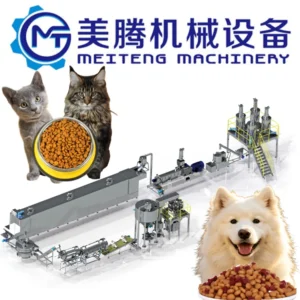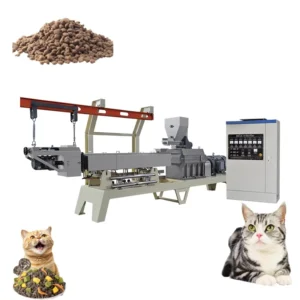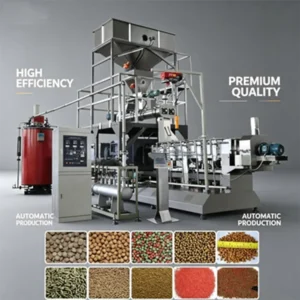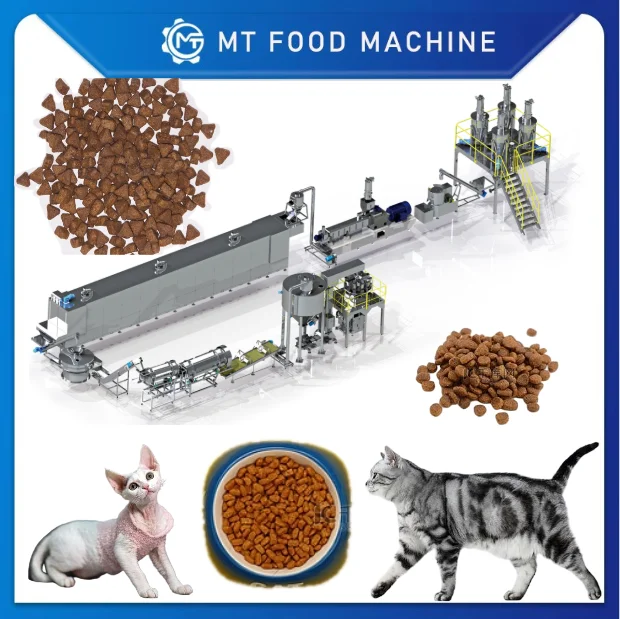
Complete Line Matching — every station from mixing to packing is specified to the extruder’s throughput, so the pet food making machine for sale avoids downstream bottlenecks.
Technical Specifications
| Parameter | Value |
|---|---|
| Model | MT100 |
| Product Type | Pet Food Extrusion Production Line |
| Extruder Type | Twin-screw |
| Output Capacity | up to 550 kg/h (basis not stated in source — confirm raw material formulation, moisture content, kibble size and density) |
| Nominal Line Capacity | 1.5–2.0 t/h (basis not stated in source — confirm shift duration, product format and raw material) |
| Control System | PLC controlled |
| Applicable Species | Cat, dog, fish, bird, cattle feed |
| Line Stations | Mixing, extrusion, drying, flavouring, coating, cooling, packing |
| Assembly State | Complete production line |
| Standards | CE, ISO |
| Technical Support | Video technical support and online after-sales service |
Application Suitability
| Application | Material or Output |
|---|---|
| Dry cat and dog kibble | Poultry meal, corn, rice, wheat, fish meal with target density and size |
| Floating aquatic feed | Soy, corn, starch blends formulated for buoyancy in catfish and tilapia ponds |
| Sinking aquatic feed | High-protein shrimp and bottom-feeder formulations requiring controlled density |
| Bird and cattle feed | Grain and protein blends processed into uniform pellet or extruded formats |
What "550 kg/h" Actually Means for Your Formula
Capacity figures on a pet food making machine for sale only matter when tied to your exact raw material formulation and kibble specification.
I once watched a buyer sign off on a line based on a brochure number, only to find his high-protein recipe cut actual output nearly in half once the extruder ran on his real premix. The screw profile and die geometry that work for a starch-heavy dog kibble will choke on a 40% meat-meal cat formula. That gap between nameplate and reality is where most pet food projects stall [NEED_CITE: typical extrusion output variance across raw material formulations]. Before any number goes into a contract, the raw material sheet, target moisture, and kibble density need to be locked in and tested.
Matching Every Station to the Extruder Output
A common failure on multi-vendor lines is a dryer or coating drum that cannot keep pace with the extruder, forcing the entire pet food making machine for sale to idle while downstream stations catch up. On this platform, mixing capacity, drying belt length, flavouring drum volume, and packing speed are all calculated against the confirmed extruder throughput so material flows continuously. The result is a line where no single station dictates the bottleneck.
Why Screw and Die Selection Precedes Everything Else
The twin-screw configuration determines shear intensity, residence time, and the degree of starch gelatinisation your recipe will achieve. A die plate designed for a 12 mm kibble will not simply produce a smaller piece if swapped — the pressure profile, expansion ratio, and surface texture all shift. Every target product requires its own screw element arrangement and die geometry, recorded in the configuration sheet so reorders and future product development start from a known baseline [NEED_CITE: twin-screw extrusion screw configuration impact on product density].
Reading the Specs That Matter
The PLC control system stores barrel temperature zones, screw speed, and feeder rates as repeatable recipes, so a Monday morning batch matches a Friday afternoon run without manual guesswork. The twin-screw design handles a wider range of ingredient particle sizes and fat levels compared to single-screw platforms, which is critical when recipes include meat meals or high-moisture slurries. CE and ISO compliance means the electrical enclosure, safety guarding, and food-grade contact materials meet export-market machinery directives, reducing the documentation burden at customs [NEED_CITE: CE machinery directive requirements for food processing equipment]. Nominal line capacity of 1.5–2.0 t/h and output of up to 550 kg/h both require raw material confirmation before they can be treated as planning figures.
The Hidden Cost of Skipping a Trial Run
When a line ships without a factory trial on the buyer’s actual premix, product development begins after installation — burning raw material, delaying first shipment, and sometimes requiring screw or die replacements before the first commercial batch runs. The cost of those lost weeks compounds through missed retailer delivery windows and penalty clauses in supply contracts [NEED_CITE: commissioning delays caused by untested extrusion configurations]. A pre-shipment trial run on your formula collapses that risk into the factory phase, where adjustments cost hours instead of weeks.
Why Buyers Source the Full Catalogue Here
The entire pet food making machine for sale range — from batching silos through extrusion, drying, coating, and packing — comes from a single manufacturer, eliminating interface disputes between vendors. Screw configurations and die designs are specified to your raw material and target product rather than copied from a generic build. The in-house testing workshop runs your formula before the line ships, so commissioning on-site is verification rather than experimentation. PLC and MCC control options are matched to your local voltage, frequency, and operator language. Documentation, spare wear parts lists, and maintenance schedules ship with the line, so the first replacement of screws or dies does not trigger an emergency air-freight order.
Documentation & Verification
- Line layout and capacity calculation matched to your target kibble size and hourly throughput
- Screw and die configuration record specific to your raw material formulation
- Electrical schematic confirming voltage, frequency, and PLC language for the destination market
- Trial run report produced on your actual premix before the line leaves the factory
- CE declaration of conformity and ISO certificate for customs and regulatory clearance
- Wear parts list with part numbers for screws, dies, and barrel sections
Installation, Commissioning & Support
- Foundation plan and floor-space drawing aligned to the MT100 line footprint and utility drops
- Dedicated circuit sizing for the PLC-controlled extruder motor and dryer heating zones
- Mechanical and electrical assembly supervised on-site from crate opening to first run
- Recipe parameter setting for barrel temperatures, screw speed, and feeder rates during commissioning
- Operator training covering HMI navigation, screw changeover, and daily cleaning routines
- Initial stock of screws, dies, and seals shipped with the line to cover the first replacement cycle
What to Include in Your First Inquiry
Send your raw material formulation sheet, target kibble dimensions and density, and daily production volume so the line can be sized accurately. Confirm your workshop’s available floor area, ceiling height, and local voltage and frequency — these determine motor selection and control panel build. If you have existing upstream mixers or downstream packing equipment, note the make and capacity so integration points can be planned from the start.
Frequently Asked Questions
Q: How is the 550 kg/h output capacity verified, and on which raw material formulation?
A: That figure is a reference point, not a blanket guarantee. Actual throughput depends on your recipe’s protein and starch ratio, moisture content, and the target kibble size and density. We run your exact premix in the testing workshop and record the verified output in the trial run report before the line ships, so the number in your contract reflects your real production conditions.
Q: Which supporting stations are included and how are they matched to extruder throughput?
A: The line covers mixing, extrusion, drying, flavouring, coating, cooling, and packing. Each station’s capacity — dryer belt length, coating drum volume, cooler airflow — is calculated against the confirmed extruder output so material flows without queuing or starvation. The layout document shows the throughput match at every transfer point.
Q: What PLC language and HMI interface options are available for the destination market?
A: The PLC and HMI are configured to your local operator language before shipment, and the electrical schematic confirms voltage, frequency, and control language. This avoids on-site reprogramming and ensures the maintenance team can read alarms and recipe screens from day one.
Q: Can the screw configuration and die design be tailored to a specific kibble size and density?
A: Yes. Screw element arrangement, compression ratio, and die hole geometry are all specified to your target product. The configuration is recorded in a document that ships with the line, so future product development or reorders start from a known, repeatable baseline rather than trial and error.
Q: What spare wear parts ship with the line, and what is the reorder lead time?
A: An initial set of screws, dies, and barrel sections is included based on your production volume and ingredient abrasiveness. The wear parts list with part numbers ships in the documentation pack, and reorder lead times are confirmed at the time of purchase so you can plan inventory around your maintenance schedule.