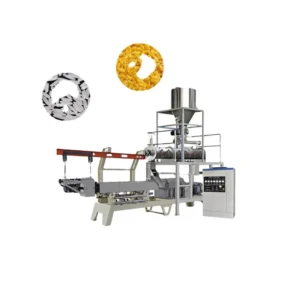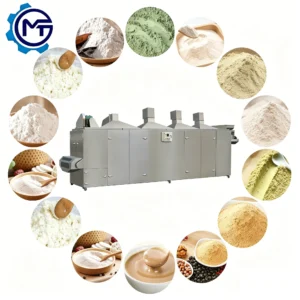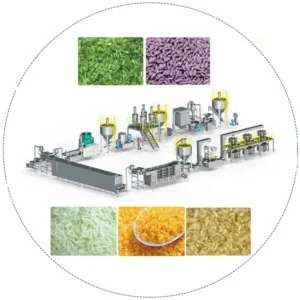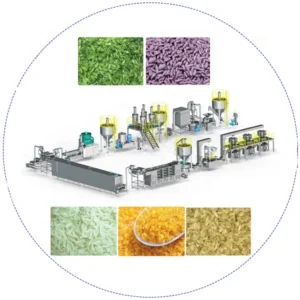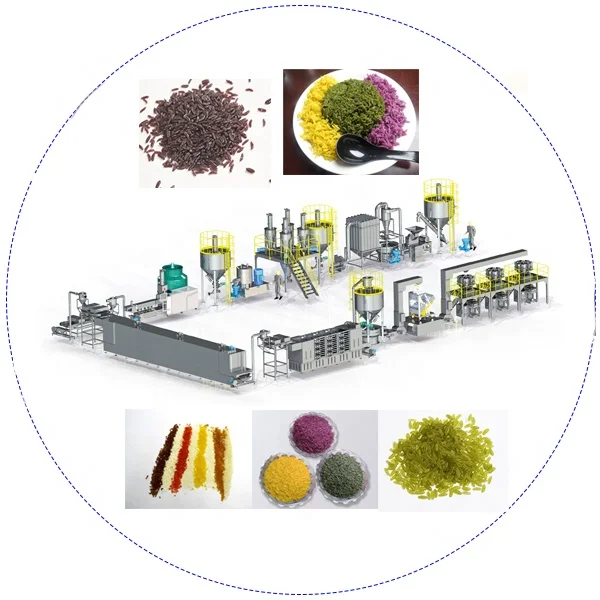
Throughput-Matched Station Design — Every extruder, dryer and cooling unit in the fortified rice extrusion machine full equipment range is specified by individual capacity and footprint so buyers can verify line balance before committing to a layout.
Technical Specifications
| Parameter | Value |
|---|---|
| Model | MT65 / MT70 / MT85 / MT75 / MT95 |
| Product Type | Fortified Rice Extrusion Machine / Artificial Rice Making Machine |
| Screw Type | Twin screw |
| Installed Power | MT65: 85 kW; MT70: 120 kW; MT85: 235 kW; MT75: 180 kW; MT95: 260 kW |
| Power Consumption | MT65: 60 kW; MT70: 85 kW; MT85: 165 kW; MT75: 135 kW; MT95: 195 kW |
| Output Capacity | MT65: 80–100 kg/h; MT70: 100–120 kg/h; MT85: 200–300 kg/h; MT75: 300–500 kg/h; MT95: 800–1000 kg/h (basis not stated in source — confirm raw material formulation and moisture content) |
| Overall Dimensions | MT65: 28×1.2×2.2 m; MT70: 30×1.5×2.2 m; MT85: 34×3.5×4.3 m; MT75: 32×3.5×4.3 m; MT95: 36×3.5×4.3 m |
| Control System | Frequency speed control with high automation |
| Lubrication & Cooling | Automatic lubricating and cooling system |
| Feeding System | Single or double screw feeding system depending on material |
| Drying Oven Heating Source | Electric or gas |
| Drying Oven Feature | Circulation drying with frequency motor controlling mesh belt speed |
| Certification | CE |
Application Suitability
| Application | Material or Output |
|---|---|
| Fortified rice kernel production | Broken rice, rice bran, corn, millet, wheat, oats, buckwheat, beans, starch blended with vitamins and minerals |
| Artificial rice for nutrition programmes | Reconstituted rice grains carrying micro-nutrients solidified through twin-screw extrusion |
| Staple food format expansion | Extruded rice kernels added to existing breakfast cereal or grain processing portfolios |
| Grain by-product valorisation | Conversion of broken rice and rice bran into high-nutrition reconstituted kernels |
What "Nominal Capacity" Means When Your Formula Changes
Capacity figures only hold when the raw material blend and moisture content match the test basis.
I once watched a nutrition programme supplier receive a line rated for rice flour, only to discover their actual formula included a large share of whey protein isolate. The extruder could not maintain the quoted throughput, and expansion collapsed at the die. Two weeks of parameter resets followed before the line stabilized. That scene repeats across the industry whenever a fortified rice extrusion machine full equipment range is sold on a single reference material [NEED_CITE: raw material formulation impact on extruder throughput]. Buyers surveying equipment need every station’s spec visible so they can cross-check the match against their own ingredient list before a purchase order is signed.
How the Five-Model Extruder Range Maps to Production Targets
The MT65 through MT95 series covers installed power from 85 kW to 260 kW, letting buyers align motor load with their daily output goal. Frequency speed control maintains screw RPM consistency across batches, which is critical when vitamin and mineral pre-mixes are sensitive to residence time variation. Each model’s overall dimensions are listed so floor-plan decisions can be made early in the project.
Drying and Cooling Stations That Keep Pace with the Extruder
Circulation drying with a frequency-controlled mesh belt allows operators to adjust drying time without mechanical changes, accommodating different moisture targets for artificial rice kernels. Electric or gas heating options let the line adapt to local utility costs. When the dryer capacity is undersized relative to extruder output, wet kernels accumulate on the vibrating conveyor, causing surface starch to re-absorb moisture and compromise the final texture [NEED_CITE: dryer-extruder throughput matching in grain processing lines].
Reading the Power and Dimension Data for Line Planning
Installed power versus power consumption figures show the difference between peak motor draw and steady-state load. The MT95, for example, lists 260 kW installed but 195 kW consumption, indicating headroom for startup surges and denser formulations. Overall dimensions grow from 28 m line length on the MT65 to 36 m on the MT95, with width expanding from 1.2 m to 3.5 m once downstream stations are included. These numbers drive utility trench placement and ceiling-height requirements. Twin-screw configuration across the range ensures positive conveying of viscous, vitamin-fortified doughs that single-screw designs may struggle to meter evenly.
The Hidden Cost of Skipping a Raw-Material Trial Run
When a line ships without a factory trial on the buyer’s actual formulation, commissioning becomes a trial-and-error exercise on the production floor. Screw and die combinations optimized for plain rice flour may produce kernels that fracture during drying or fail to hold added oils during roasting. Operators then spend weeks adjusting barrel temperatures and moisture addition rates while raw material costs accumulate. In some cases, replacement screw elements must be ordered and air-freighted before the line can deliver saleable product [NEED_CITE: post-installation commissioning delays in food extrusion projects].
Why Buyers Survey the Full Range Before Specifying a Line
Every station in the fortified rice extrusion machine full equipment range is documented with its own capacity and footprint, preventing the common bottleneck where the extruder outpaces the dryer. Screw configuration and die design are recorded against the buyer’s raw material, not copied from a generic build. The in-house testing workshop runs trial batches on customer-supplied ingredients before shipment, generating a report that locks in process parameters. Electrical schematics and voltage confirmations are finalized before production starts, so the control cabinet matches the local grid on arrival. Pre-sales consultation extends through installation, commissioning and operator training, keeping one supplier accountable from first inquiry to steady-state production.
Documentation & Verification
- Line layout and capacity calculation sheet matched to your grain blend and target output
- Screw and die configuration record specified to your vitamin-mineral pre-mix ratio
- Trial run report on your raw material conducted in the testing workshop before dispatch
- Electrical schematic and voltage confirmation document aligned with your local grid standard
- CE declaration of conformity covering the complete extruder and downstream station set
Installation, Commissioning & Support
- Foundation leveling within tolerance for the MT95’s 36 m line length and 4.3 m height clearance
- Dedicated circuit sized for the MT85’s 235 kW installed power peak during motor startup
- Modular station delivery allowing phased assembly when workshop ceiling height is limited
- First-run parameter setting using the trial run report as baseline for barrel temperature and screw speed
- Operator training on frequency speed control interface and automatic lubricating system maintenance
- Wear parts list covering screw elements, die plates and mesh belt sections for the drying oven
Requesting an Accurate Line Proposal
Share your raw material formulation, including the percentage of broken rice, starch carriers and micro-nutrient pre-mix, along with your target daily output in kilograms. Specify your workshop floor area, ceiling height and local voltage and frequency so the electrical cabinet and motor ratings can be confirmed. If you have existing upstream mixing or downstream packing equipment, note the interface points so the line layout accounts for conveyors and buffer hoppers.
Frequently Asked Questions
Q: How is extruder capacity verified against my specific raw material blend?
A: Capacity values in the table are based on reference formulations. We run your actual ingredient blend in the testing workshop, measuring throughput, expansion and kernel integrity. The trial run report then becomes the baseline for line configuration and quotation.
Q: Which screw and die configuration suits a high-protein fortified rice formula?
A: Protein-rich blends require different compression ratios and die orifice sizes compared to plain starch doughs. We select screw element pitch and die geometry after reviewing your formulation sheet, then validate the setup during the pre-shipment trial.
Q: How do I prevent the dryer from becoming a line bottleneck?
A: We match dryer belt width and heating zone length to the extruder’s verified output. The frequency-controlled mesh belt lets operators fine-tune residence time, and electric or gas heating is selected based on your local energy costs.
Q: What supporting stations are included beyond the extruder and dryer?
A: The line typically includes a mixing and batching system, vibrating conveyor, low-temperature drying oven, cooling conveyor, high-temperature roasting unit, secondary cooling stage and packing station. Each is sized to the extruder’s confirmed throughput.
Q: Which documents accompany the shipment?
A: You receive the machine specification sheet, screw and die configuration record, electrical schematic, voltage confirmation, trial run report on your raw material, CE declaration of conformity and an operation and maintenance manual with a wear parts list.