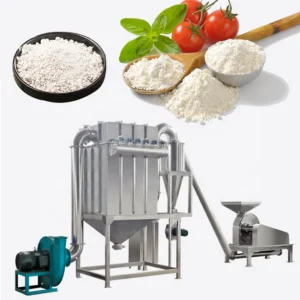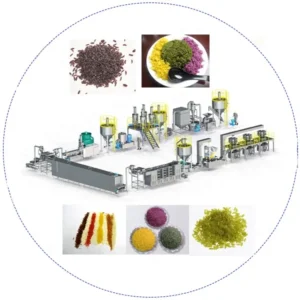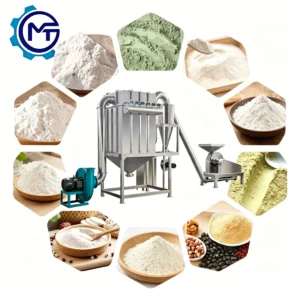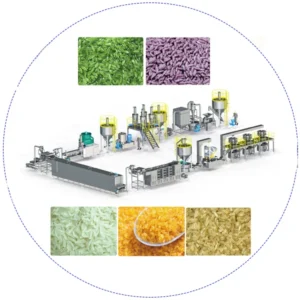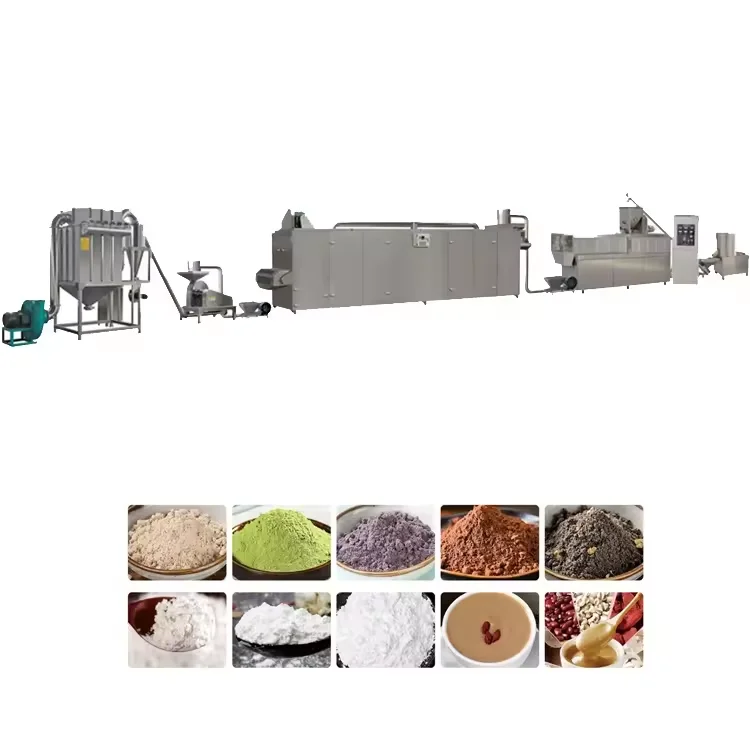
Thermodynamic Balance Across Stations — Throughput is matched at every segment from mixer to packing so the extruder never waits on an undersized dryer or crusher.
Technical Specifications
| Parameter | Value |
|---|---|
| Product Type | Nutritional Powder Processing Line |
| Extruder Models Available | MT65 / MT70 / MT75 / MT85 |
| Screw Type | Twin-screw |
| Installed Power | 84 kW (MT65); 160 kW (MT70); 190 kW (MT75); 210 kW (MT85) |
| Power Consumption | 59 kW (MT65); 120 kW (MT70); 140 kW (MT75); 150 kW (MT85) |
| Output Capacity | 120–150 kg/h to 300–400 kg/h (basis not stated in source — confirm raw material type, moisture, and formulation) |
| Line Stations | Flour mixing → Extruding → Frying/Drying → Pulse crushing → Packing |
| Mixer Capacity Options | 20–30 kg/batch; 70–80 kg/batch; 170–180 kg/batch |
| Mixer Power Options | 4 kW / 7.5 kW / 15 kW |
| Mixer Contact Material | 304 Stainless Steel |
| Pulse Crusher Power | 11 kW |
| Drying Oven | Multi-layer, adjustable temperature and time, double pitch roller chain drive; fuel options: electricity, gas, or other fuel |
| Control System | PLC and MCC control available |
| Voltage & Frequency | 380V 50Hz, Three Phase (customizable for local utility standards) |
| Overall Dimensions | 20,000 × 1,500 × 2,200 mm (MT65) to 25,000 × 1,500 × 3,500 mm (MT85) |
| Standards | CE (declared since 2014), ISO certified |
Application Suitability
| Application | Material or Output |
|---|---|
| Infant nutritional powder | Rice flour, corn flour, wheat flour blended with vitamins and trace elements |
| Fortified baby food supplements | Grain-based formulations with added protein and micronutrients |
| Artificial and fortified rice | Corn grits and rice flour enriched with minerals and vitamins |
| Functional health care powder | Mixed grain powders processed through twin-screw gelatinization |
| Pregelatinized starch products | Corn, wheat, and rice starch for instant food applications |
What Your Formulation Actually Does to the "Rated" Output
A nutritional powder processing line equipment for sale rated at 300 kg/h on standard rice flour may deliver half that once you add whey protein isolate to the recipe.
Most buyers compare extruders on nameplate capacity, but the real throughput depends on your actual raw material. A formulation high in dairy protein changes the melt rheology inside the barrel — shear behavior, melt temperature, and die pressure all shift. If the downstream drying oven and pulse crusher were sized to the nameplate number, you end up with material backing up at the extruder die or arriving at the crusher still too wet to mill. This mismatch is one of the most common reasons commissioning drags on for weeks past the planned schedule [NEED_CITE: extrusion throughput variation with high-protein formulations].
How the Stations Stay in Step
Every segment on this nutritional powder processing line equipment for sale is configured around a single throughput target rather than assembled from standalone units. The mixer batch size is chosen so that discharge intervals match the extruder’s continuous feed rate, avoiding starvation or surge. The multi-layer drying oven length and belt speed are calculated from the moisture content leaving the die — high-moisture formulations need more residence time, which means a longer oven or slower chain speed.
The pulse crusher downstream must handle the dried output without becoming a bottleneck. An undersized crusher forces the oven to hold product longer than necessary, degrading color and nutrient retention. Sizing each station against the actual extruder output — not the nameplate figure — prevents these cascading delays and keeps the line running at a steady state during production.
Screw Configuration and Die Design for Powder and Fortified Rice
Twin-screw extrusion gives you independent control over shear, residence time, and melt temperature across multiple barrel zones [NEED_CITE: twin-screw extrusion process parameters for nutritional powder]. The screw elements can be rearranged to build higher shear for complete starch gelatinization in fortified rice, or gentler conveying for heat-sensitive vitamin blends. Die orifice diameter and land length determine the strand density as the melt exits — a factor that directly controls how much the downstream crusher has to work.
When the target is infant formula powder, the die design favors thin strands that dry quickly and shatter easily in the pulse crusher. For artificial rice grains, the die shapes each pellet before drying, and the oven temperature profile is set to preserve the grain structure rather than puff it. Getting these parameters wrong means the finished powder fails mesh-size specification or the rice grains crack during storage.
Reading the Power and Dimension Data
The installed power jumps from 84 kW on the MT65 to 210 kW on the MT85, but power consumption — what the line actually draws during steady production — ranges from 59 kW to 150 kW across the same models. The gap between installed and consumed power reflects the peak torque needed during start-up and recipe changeover, not continuous operation. When sizing your transformer and dedicated circuit, plan for the installed figure; when calculating energy cost per kilogram, use the consumption figure.
Overall line length stretches from 20 meters to 25 meters depending on model, with a consistent 1.5-meter width up to the MT70, then taller frames on the MT75 and MT85 to accommodate larger drying ovens and crushers. Verify that your facility ceiling height clears the 2,200 to 3,500 mm station heights, especially if overhead conveyors or dust extraction ducts are already in place [NEED_CITE: industrial facility layout clearance requirements for extrusion lines].
The Cost of Ignoring Downstream Sizing
A common scenario: the extruder is specified correctly but the dryer capacity is based on a generic moisture reduction figure rather than your actual formulation. The result is semi-dried powder reaching the pulse crusher, which then clogs its screen and forces repeated shutdowns. Operators open the crusher to clear blockages every shift, and the fine particles that do pass through are off-spec on moisture and particle size [NEED_CITE: impact of incomplete drying on powder milling efficiency]. The line runs, but effective output is a fraction of what was planned and the product fails quality checks.
Why Procurement Through a Single Equipment Range Matters
Sourcing every station from one catalog means the supplier has already matched throughput across the chain before the first machine ships. The mixer batch cycle, extruder screw speed, oven belt speed, and crusher feed rate are all calculated against the same target — your raw material and your product spec. Screw configuration and die design are documented against your specific formulation, not pulled from a generic template.
An in-house testing workshop allows trial runs on your actual raw material before shipment, so the screw profile and drying parameters are validated in advance rather than debugged on your factory floor. Electrical schematics are confirmed against your local voltage and frequency standards before production begins, preventing rewiring delays at commissioning. CE and ISO documentation is issued for the complete line, simplifying customs clearance and regulatory registration in your market.
Documentation & Verification
- Line layout drawing showing station-by-station throughput calculation for your formulation
- Screw and die configuration record matched to your raw material and target powder mesh size
- Trial run report generated from your sample material in the testing workshop before dispatch
- Electrical schematic with confirmed voltage, frequency, and HMI language for your site
- Factory test record capturing motor current, barrel temperatures, and output at each station
- CE declaration of conformity and ISO certificate in electronic format for export documentation
Installation, Commissioning & Support
- Foundation must support the full line length of up to 25,000 mm with level tolerance for the twin-screw extruder barrel alignment
- Dedicated three-phase circuit rated for the installed power of the selected model, up to 210 kW on the MT85
- Stations ship as fully assembled units; final line connection covers material transfer chutes and electrical interlocks
- First production run includes barrel temperature profile setup and screw speed tuning on your actual flour blend
- Operator training covers PLC and MCC interface navigation, screen cleaning, and recipe parameter entry
- Wear parts list covers screw elements, die plates, and crusher screens with reorder lead time confirmed at order
What to Include in Your Inquiry
Provide your complete raw material list with percentages — especially dairy protein, fiber, and fat content — along with target powder particle size or rice grain dimensions. Specify your local voltage, frequency, and required control language. Confirm available floor space and ceiling height so the line layout can be drafted to fit your building, and note any existing upstream or downstream equipment the line must connect to.
Frequently Asked Questions
Q: How is output capacity verified against my actual raw material and formulation?
A: We run a trial in our testing workshop using a sample of your raw material. The report records actual throughput, barrel temperatures, screw speed, and product density. This data — not the generic nameplate figure — becomes the basis for sizing the dryer, crusher, and every other station on your nutritional powder processing line equipment for sale.
Q: What voltage, frequency, and control language will be confirmed before production?
A: Before any machine is built, we confirm your site’s three-phase voltage and frequency, then issue an electrical schematic for your approval. The PLC and MCC interface language is specified at the same stage so operators see instructions in their working language from day one.
Q: Is a trial run performed before shipment, and what does the report include?
A: Yes. Your raw material is processed through the extruder in our testing workshop. The trial run report documents throughput, melt temperature at each barrel zone, die pressure, and the particle size after crushing. Screw configuration changes made during the trial are recorded and applied to the production machine.
Q: Which stations are included, and how is throughput matched between them?
A: The line covers flour mixing, twin-screw extrusion, multi-layer drying, pulse crushing, and packing. Each station is sized against the actual extruder output on your formulation — mixer batch cycle, oven residence time, and crusher feed rate are all calculated from the same throughput target.
Q: What spare wear parts are supplied, and how do I reorder them?
A: A wear parts list is provided with the order, covering screw elements, die plates, crusher screens, and mixer seals. Lead times for reordering are confirmed before shipment so you can plan your first replacement schedule without unexpected downtime.