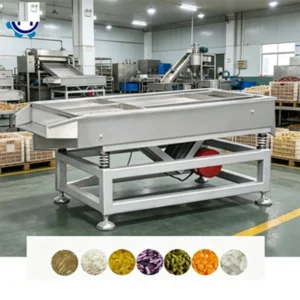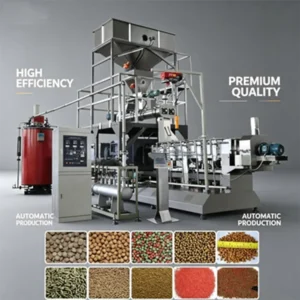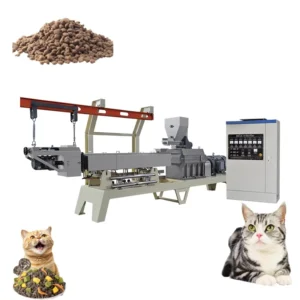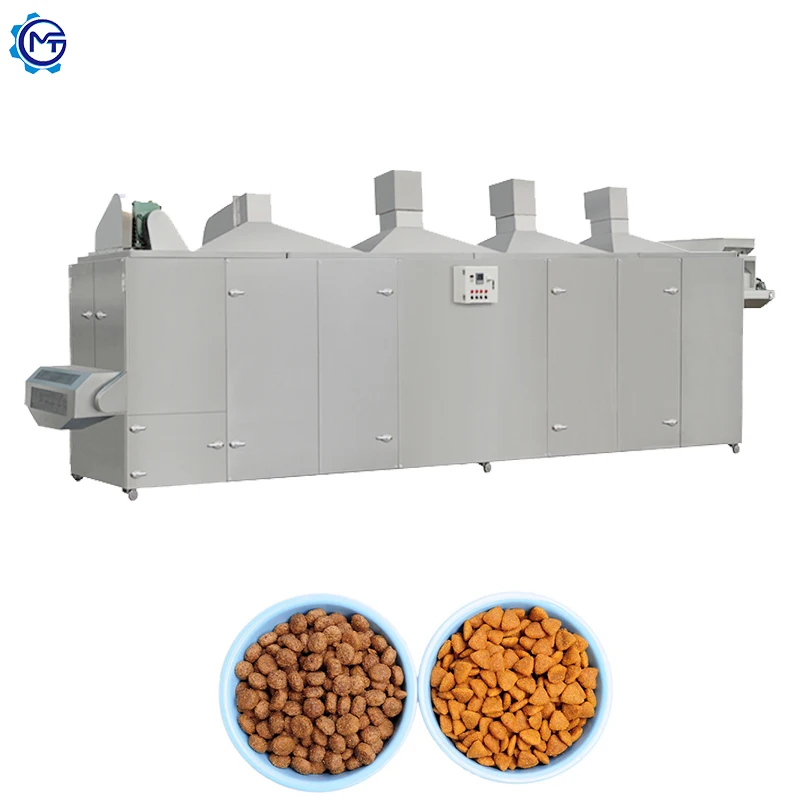
Integrated Equipment Flow — Matching every station from mixer to packer on a pet food making machine full equipment range, based on throughput calculations rather than isolated unit selection.
Technical Specifications
| Parameter | Value |
|---|---|
| Product Type | Pet Food Extrusion Production Line |
| Applications | Dry kibble (dog, cat), aquatic feed (fish) |
| Output Capacity | Up to 3 tons per hour (basis not stated in source — confirm raw material formulation, moisture content, kibble size and density target) |
| Warranty | 1-year |
| Process Documentation | Fish feed process drawing included |
| Control System | PLC or MCC (to be confirmed per buyer specification) |
| Voltage & Frequency | Configurable to destination market (to be confirmed) |
| Certification | CE and ISO documentation available upon confirmation |
| Line Stations | Mixer, extruder, dryer, coating, cooler, packing (scope to be confirmed) |
| Screw Type | Single or twin screw (to be confirmed per application) |
| Rated Power | To be confirmed per line configuration |
Application Suitability
| Application | Material or Output |
|---|---|
| Dry dog kibble production | Poultry meal, bone meal, corn flour, grain blends |
| Dry cat kibble production | Fish meal, meat meal, starch, vitamin premix |
| Floating fish feed pellets | Soybean meal, wheat flour, fish meal, oil coating |
| Sinking aquatic feed | High-density formulations with elevated protein content |
| Premium pet treats | Mixed protein and starch bases with flavouring additions |
What "3 Tons per Hour" Leaves Out When Sizing a Pet Food Making Machine Full Equipment Range
Capacity numbers mean nothing unless every station in the line is matched to the same throughput target.
I remember standing in a feed mill outside Guadalajara watching an extruder push product at full speed while the dryer downstream choked. Pellets piled up on the transfer belt, moisture levels climbed, and within an hour the entire batch went out of spec. The extruder was rated correctly, but nobody had sized the dryer to handle that volume at the required moisture reduction. This mismatch is one of the most common failures buyers encounter when assembling a pet food making machine full equipment range from separate quotations [NEED_CITE: common line bottleneck causes in extruded feed production].
The output figure on a single unit tells you what that unit can do under specific conditions. It does not tell you whether the mixer upstream can deliver enough conditioned material to keep the extruder fed, or whether the coating drum downstream has sufficient residence time to apply fat and palatant evenly. Each station operates within its own physical limits, and the line only runs as fast as its slowest station.
How Each Station in the Line Connects
A pet food making machine full equipment range covers batching, mixing, extrusion, drying, flavour coating, cooling and packing. The extruder is the centre of the process, but its output depends entirely on consistent feed from the mixer. If the mixer delivers material at uneven moisture or particle size, the extruder screw encounters variable resistance and product density fluctuates.
The dryer must reduce pellet moisture from the extrusion point down to a level safe for storage and bagging. Residence time inside the dryer, air temperature and belt speed all factor into this calculation. A dryer sized too small forces the line to slow down; one sized too large wastes energy and floor space.
Coating, Cooling and Packing Throughput Alignment
After drying, kibble enters a coating drum where fat and palatant are applied. The drum must rotate at a speed and angle that distributes coating evenly across every pellet surface. If the drum is undersized relative to the dryer output, material queues at the inlet and coating becomes uneven — a problem that only shows up when the end user opens the bag and finds inconsistent colour and aroma.
Cooling brings the product down to ambient temperature before packing. Skipping adequate cooling leads to condensation inside the bag, mould growth and shelf-life complaints. The packing station must then weigh, fill and seal at a rate that prevents backlog from the cooler [NEED_CITE: shelf-life failure modes in extruded dry pet food].
Reading the Specifications That Actually Matter
The screw type — single or twin — determines how well the extruder handles different raw material blends. Twin-screw configurations offer better self-cleaning and handle higher fat or moisture formulations, while single-screw designs suit simpler grain-based recipes. The L:D ratio influences residence time inside the barrel: longer barrels give more cooking and gelatinisation time, which affects kibble expansion and density at the die.
Die configuration directly controls kibble shape and size. Each die plate is machined with a specific hole pattern, and switching between kibble formats requires a die change. Barrel zone count relates to temperature control precision — more zones allow finer adjustment of the thermal profile along the barrel, which matters when running sensitive formulations like high-protein cat food.
Moisture range and steam or water injection capability determine how much preconditioning the material receives before entering the barrel. Adequate steam injection improves starch gelatinisation, which translates into better pellet durability and float rate in aquatic feed applications.
What Happens When Configuration Goes Wrong
A buyer once specified an extruder with standard screw elements for a dog food recipe that included a high percentage of bone meal. The abrasive content wore through the screw flights within weeks, and particle size at the die became inconsistent. Without a screw configuration matched to that specific formulation, the line produced kibble with density variations — some pellets floated, others sank in the bowl, and the client received complaints about product quality.
Another common failure involves voltage and frequency mismatches. A line built for 380V/50Hz shipped to a market running 440V/60Hz will see motors overheat, heating elements exceed their rated temperature and control boards fail prematurely. This confirmation must happen before production begins, not during commissioning [NEED_CITE: electrical standard mismatches in international machinery exports].
Why Buyers Source the Full Range Here
Every station from batching to packing comes from one supplier, so throughput calculations are performed across the entire line rather than left to individual unit vendors who have no visibility beyond their own equipment.
Screw configurations and die designs are specified after reviewing the buyer’s raw material formulation and target kibble density, not copied from a generic template.
An in-house testing workshop allows trial runs on the buyer’s actual raw material before the line ships, catching formulation issues early.
Experience spans dry kibble, aquatic feed and snack applications, so equipment recommendations account for cross-category processing differences.
Pre-sales engineering covers line layout, utility planning and phased installation scheduling through commissioning and operator training.
Documentation & Verification
- Line layout drawing with capacity matched across every station
- Machine specification sheet per unit in the line
- Screw and die configuration record for your formulation
- Electrical schematic with voltage and frequency confirmation
- Trial run report using your raw material in the testing workshop
- CE and ISO certificate copies for customs clearance
Installation, Commissioning & Support
- Foundation layout provided based on line footprint and extruder weight distribution
- Electrical connection plan specifying dedicated circuits for extruder main drive and dryer heaters
- Equipment arrives in modular sections for assembly inside facilities with limited door clearance
- On-site commissioning includes die trials and dryer temperature profiling for your recipe
- Operator training covers screw combination changes and PLC parameter adjustment for recipe switching
- Wear parts list identifies screws, dies and dryer belt segments stocked for rapid dispatch
What We Need to Configure Your Line
To build an accurate line proposal, share your target kibble format, raw material formulation with approximate ratios, desired output capacity and the market where the product will be sold. Include your facility’s available floor area, ceiling height, local voltage and frequency, and preferred control language. If you already operate upstream milling or downstream bagging equipment, let us know the interface points so the pet food making machine full equipment range integrates without gaps.
Frequently Asked Questions
Q: Which stations are included in the full pet food line and how is throughput matched between them?
A: The line covers mixing, extrusion, drying, coating, cooling and packing. Throughput is calculated across every station using your target capacity, raw material density and moisture reduction requirements so no single unit becomes a bottleneck. Each piece of equipment is sized relative to the others rather than quoted in isolation.
Q: How is output capacity verified against my specific raw material formulation and kibble density target?
A: Before shipment, we run your actual raw material through the extruder in our testing workshop. The trial confirms screw configuration, die selection, moisture levels and throughput achievable with your recipe. A trial run report documents the results, including pellet density and expansion measurements.
Q: What voltage, frequency and control language options are available for my market?
A: Electrical systems are configured to your destination market before production begins. This includes motor ratings, heating element specifications, control panel voltage and PLC interface language. We confirm these details during the quotation stage to prevent mismatches during commissioning.
Q: Can individual stations like the extruder, dryer or coating drum be purchased separately?
A: Individual units are available, though we recommend reviewing the full line configuration to ensure compatibility with existing equipment. Interface specifications — belt widths, transfer heights, control signals — must align with your current stations to maintain continuous material flow.
Q: What spare wear parts are stocked and how are they dispatched after installation?
A: Screws, die plates, dryer belt segments and coating drum liners are documented in a wear parts list provided at delivery. Replacement parts are dispatched from the factory, and the list includes part numbers so you can reorder directly without needing to identify components on-site.