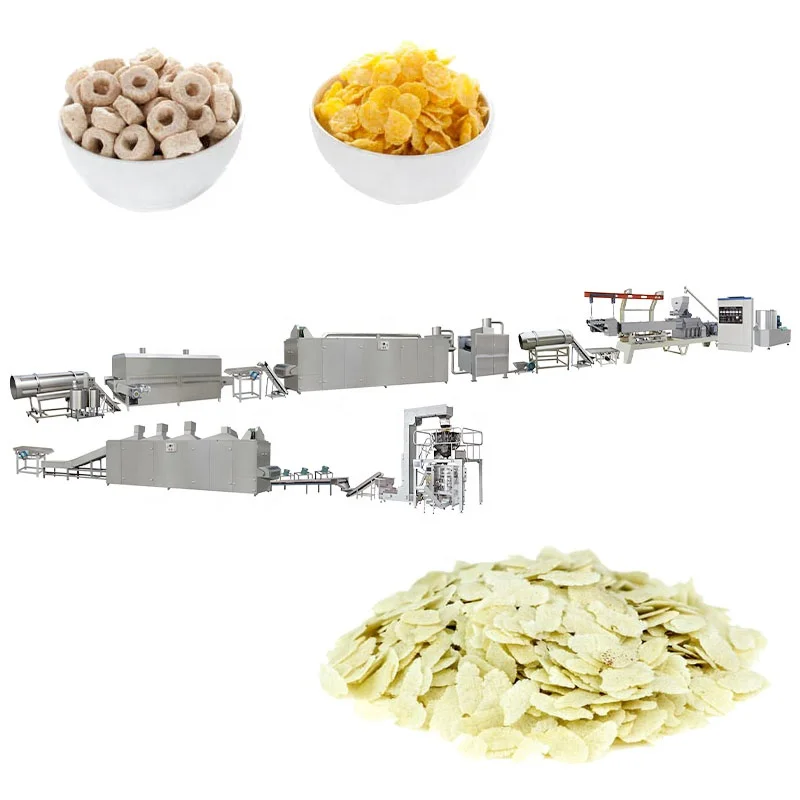
Complete Line Synchronization — Every station from the mixer to the packing conveyor is throughput-matched under a single equipment supplier, preventing the mid-line bottlenecks that stall output when extruders, dryers, and flaking rollers are sourced from separate vendors.
Technical Specifications
| Parameter | Value |
|---|---|
| Product Type | Corn Flakes Production Line |
| Installed Power | 160 kW |
| Power Consumption | 120 kW |
| Output Capacity | 150–200 kg/h (basis not stated in source — confirm raw material, moisture content, and product format) |
| Overall Dimensions (L×W×H) | 41 × 1.5 × 2.2 m |
| Extruder Screw Type | Twin Screw |
| Control System | PLC and MCC |
| Flaking Machinery | Hydraulic double-roller, double motor drive, infrared temperature regulation |
| Roasting Oven | Vibrating pan, conciliation burner, dual circulating fans, cyclone dust removal |
| Coating System | Double tumble sugar melter, elevator, coating drum, spraying nozzle |
| Dryer Heating Source | Gas / Electric |
| Certifications | CE, ISO |
Application Suitability
| Application | Material or Output |
|---|---|
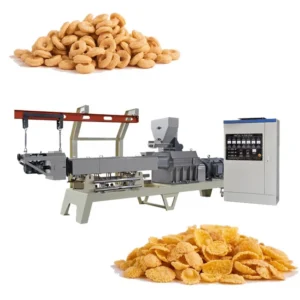
| Natural corn flakes | Corn powder, corn grits, and blended cereal grains (rice, wheat, oat, barley) |
| Sugar-coated breakfast cereals | Corn flakes substrate with syrup or sugar glaze applied in double tumble drum |
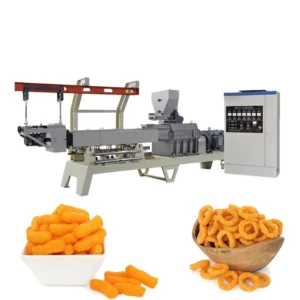
| Multi-shape extruded cereals | Interchangeable die plates producing ball, tube, stick, ring, fruit loop, star, wheel, flower, and heart formats |
| Fortified breakfast cereal bases | Blends incorporating vitamin and mineral premixes into corn or multi-grain dough |
What Capacity Ratings Overlook in a Breakfast Cereal Corn Flakes Machine Full Equipment Range
The stated kg/h figure only holds when every downstream station can absorb the extruder’s continuous discharge without buffering or starvation.
A buyer sourcing an extruder from one vendor, a flaking unit from another, and a roasting oven from a third often discovers that the dryer becomes the choke point. The extruder pushes material forward faster than the oven can reduce moisture to target crispness, and half-finished flakes pile up on transfer conveyors. I have seen lines nominally rated for continuous operation where operators had to throttle the extruder motor down to match the roaster’s actual throughput [NEED_CITE: throughput balancing methodology for multi-vendor food processing lines]. The breakfast cereal corn flakes machine full equipment range eliminates this mismatch because every station is sized and specified together before fabrication begins.
Throughput Matching Across Every Processing Station
When evaluating a breakfast cereal corn flakes machine full equipment range, the critical engineering question is whether the mixer’s batch cycle, the extruder’s continuous output, and the flaking roller’s nip rate are all calculated against the same material density and moisture profile. If the extruder discharges dough at a rate the flaking machinery cannot compress into uniform sheets, the backlog degrades texture consistency. The hydraulic double-roller flaking station on this line features independent motor drives for each roller and infrared temperature sensing, which maintains sheet thickness even when upstream discharge rates fluctuate slightly during product changeovers.
The Full Sequence From Batching To Packing
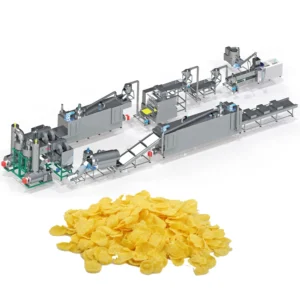
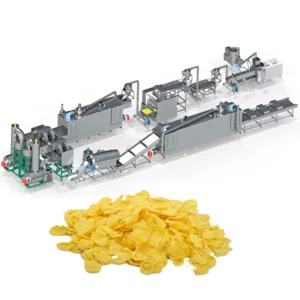
The natural corn flake variant moves through mixing, extruding, flaking, drying, hot air roasting, cooling, and packing in a continuous sequence. The sugar-coated variant inserts a sugar spraying and tumble coating stage between drying and final packing. Each transfer point — elevator, vibrating conveyor, cyclone separator — is specified to handle the volumetric flow without material bridging or dead zones where product can accumulate and scorch. This matters because a single undersized conveyor can degrade output across the entire breakfast cereal corn flakes machine full equipment range, even when the extruder and oven are correctly sized [NEED_CITE: material handling transfer point design in cereal processing].
Interpreting Screw Configuration and Flaking Parameters
The twin-screw extruder section relies on screw element arrangement and barrel temperature zoning to control dough gelatinization and residence time. Corn-based formulations require specific shear profiles to achieve the starch conversion needed for proper flake expansion during roasting; a generic screw build copied from a snack application will produce dough that either fragments at the flaking nip or emerges too dense to blister correctly in the oven. The hydraulic flaking machinery uses infrared-regulated temperature pipes to keep roller surfaces within the band where dough adheres and compresses without sticking or tearing. The roasting oven’s dual circulating fans and cyclone dust removal maintain uniform air velocity across the vibrating pan, which is what produces the characteristic surface blistering on natural corn flakes. Control language, voltage, and frequency for the PLC and MCC systems are configurable to the destination market’s electrical standard.
The Cost of Ignoring Raw Material Variables
A line that runs smoothly during factory acceptance on standardized test flour may behave entirely differently once installed at the buyer’s facility. Local corn grits vary in moisture content, particle size distribution, and starch-to-protein ratio depending on growing region and milling method. I have watched a flaking unit produce perfect sheets on one corn source, then tear and stick on the next batch because the moisture differential shifted the dough’s rheology past the roller’s compression window [NEED_CITE: raw material variability effects on extrusion and flaking consistency]. When screw configuration and flaking pressure are set to a single reference material without margin for incoming variation, the line demands constant manual adjustment and generates off-spec product during every transition.
Why Sourcing The Complete Range Matters Here
Every station in this line is specified and fabricated by a single supplier, so the mixer’s batch timing, extruder discharge rate, flaking roller nip, and oven residence time are calculated as one system rather than negotiated between separate vendors. Screw elements and die plates are configured to the buyer’s declared raw material and target flake format, not pulled from a generic build library. The in-house testing workshop runs trial batches on the buyer’s actual corn grits or cereal blend before the line ships, generating a trial run report that documents screw speed, barrel temperatures, and flaking pressures for that specific material. Electrical schematics, voltage confirmation, and PLC language are finalized to the destination facility’s supply before production starts. Wear parts lists covering screws, dies, and flaking roller segments ship with the line so the first replacement cycle does not trigger an emergency order.
Documentation & Verification
- Line layout drawing showing throughput calculations for every station from mixer to packer
- Screw and die configuration record matched to declared corn grit or cereal blend formulation
- Factory trial run report conducted on buyer’s actual raw material with logged parameters
- Electrical schematic with voltage, frequency, and PLC language confirmed to destination market
- CE declaration of conformity and ISO certificate for the complete line assembly
Installation, Commissioning & Support
- Foundation plan accounts for the 41-meter line footprint and vibrating pan dynamic loads
- Electrical room must supply the 160 kW installed load with dedicated breaker and the confirmed local voltage
- Stations arrive as modular sections requiring mechanical coupling and belt alignment on site
- Commissioning includes screw speed, barrel zone, and flaking pressure calibration on buyer’s material
- Operator training covers PLC navigation, hydraulic roller adjustment, and cyclone filter maintenance
- Wear parts inventory includes replacement screw elements, die plates, and flaking roller segments
What To Prepare Before Requesting A Quotation
Provide the specific corn variety or cereal blend you intend to run, including typical moisture content and particle size from your local supplier. Confirm the target output format — natural flake, sugar-coated, or a multi-shape extruded variant — along with daily production volume and shift structure. Share your facility’s available floor space, ceiling height, and existing utility specifications including voltage, phase, and frequency so the line configuration matches your electrical standard from day one.
Frequently Asked Questions
Q: How is output capacity verified across every station in the line?
A: Each station is sized so its maximum continuous throughput matches or exceeds the extruder’s discharge rate for the declared raw material. The capacity figure of 150–200 kg/h assumes specific moisture and formulation parameters that must be confirmed with your actual corn grit or cereal blend during the pre-shipment trial run in the testing workshop.
Q: Can the line process grains other than corn?
A: The twin-screw extruder accommodates rice, wheat, oat, and barley blends by adjusting screw element arrangement, barrel temperature profile, and moisture addition rate. The flaking machinery and roasting oven parameters are also recalibrated for each grain type to maintain target sheet thickness and surface blistering characteristics.
Q: What electrical and control options are available?
A: The PLC and MCC systems are configurable to the destination market’s voltage, frequency, and phase requirements. Control panel language is set to the operator’s preference before shipment. Electrical schematics and wiring diagrams are provided in the documentation package with all terminal markings matching the installed hardware.
Q: What wear parts should be stocked on site?
A: The initial spare parts list covers twin-screw elements, extruder die plates, and flaking roller segments that experience normal abrasion during continuous operation. The wear parts list shipped with the line identifies reorder codes so replacements can be sourced directly without reverse-engineering dimensions from worn components.