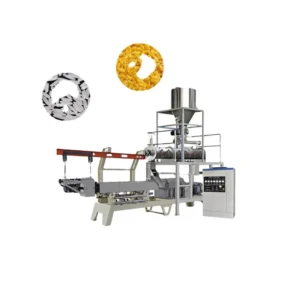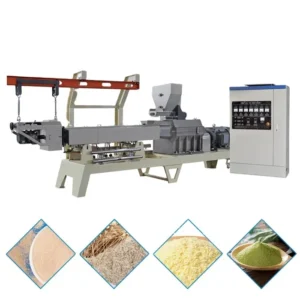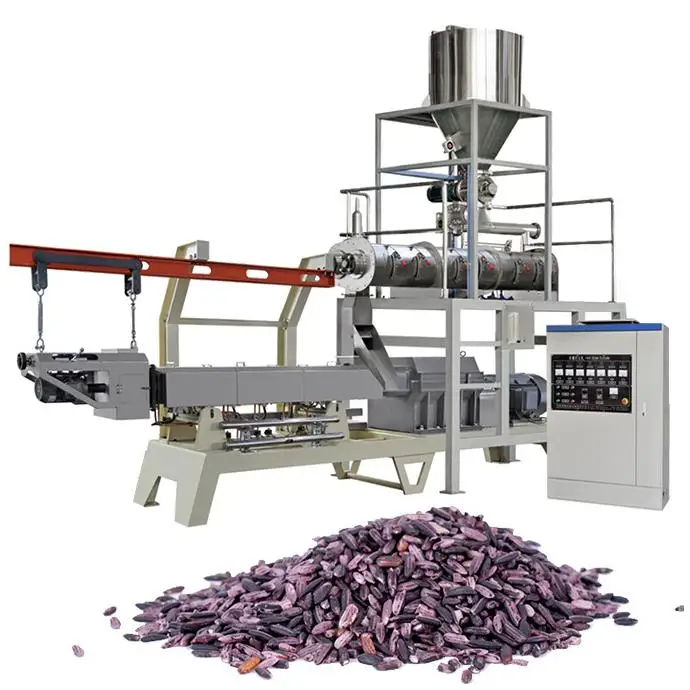
Screw and Die Matching — every MT65 through MT95 extruder is configured to the buyer’s grain formulation and target kernel density before dispatch.
Technical Specifications
| Parameter | Value |
|---|---|
| Model | MT65 / MT70 / MT85 / MT75 / MT95 |
| Product Type | Nutritional Fortified Rice Production Line |
| Screw Type | Twin-screw |
| Installed Power | MT65 — 85 kW; MT70 — 120 kW; MT85 — 235 kW; MT75 — 180 kW; MT95 — 260 kW |
| Power Consumption | MT65 — 60 kW; MT70 — 85 kW; MT85 — 165 kW; MT75 — 135 kW; MT95 — 195 kW |
| Output Capacity | MT65 — 80–100 kg/h; MT70 — 100–120 kg/h; MT85 — 200–300 kg/h; MT75 — 300–500 kg/h; MT95 — 800–1000 kg/h (basis not stated in source) |
| Overall Dimensions | MT65 — 28 × 1.2 × 2.2 m; MT70 — 30 × 1.5 × 2.2 m; MT85 — 34 × 3.5 × 4.3 m; MT75 — 32 × 3.5 × 4.3 m; MT95 — 36 × 3.5 × 4.3 m |
| Feeding System | Single or double screw feeding, selectable by material |
| Screw Material | Special wear-resistant alloy |
| Control System | Frequency speed control with high automation |
| Lubrication | Automatic lubricating and cooling system |
| Drying Oven Heating Source | Electric or gas |
| Drying Oven Control | Frequency motor controls mesh belt speed |
| Assembly State | Complete line (turnkey) |
Application Suitability
| Application | Material or Output |
|---|---|
| Fortified food programmes | Rice flour, broken rice, and corn blended with vitamin and mineral premixes into nutritionally dense kernels |
| Grain reprocessing | Broken rice and rice bran converted into uniform artificial rice with consistent cooking behaviour |
| Functional rice products | Millet, wheat, oats, buckwheat, and bean formulations shaped into quick-cooking or slow-release rice formats |
| Nutrition programme supply | High-volume artificial rice kernels meeting institutional fortification standards |
Why the Dryer Sizing Question Matters More Than Extruder Output
A twin-screw extruder rated at a given throughput is only as fast as the dryer that follows it.
I have seen buyers sign off on a fortified rice extruder machine based on the nameplate kg/h figure, only to find the downstream drying oven cannot keep up once production starts. Moisture must drop from the extrudate to a level where kernels hold shape during cooling and packing. When the dryer is undersized, kernels exit too wet, stick together on the belt, and deform before reaching the cooler. The line then idles while the oven catches up. [NEED_CITE: typical moisture reduction requirements for extruded rice kernels before packing]
This happens because the extruder nameplate capacity is often quoted without specifying the raw material moisture content, recipe density, or target kernel dimensions — the very variables that determine how much water must be driven off downstream. The fortified rice production line equipment catalogue here lists five twin-screw models with their power consumption and footprint so you can match the dryer oven and cooler to the actual wet-kernel output, not just the dry-weight number.
Feeding System Options for Variable Grain Blends
The choice between single-screw and double-screw feeding is not cosmetic. When a rice or corn blend contains sticky starch fractions or vitamin-mineral premixes that tend to bridge in the hopper, a double-screw feeder prevents rat-holing and maintains consistent mass flow into the barrel. This matters for a fortified rice production line equipment setup because any interruption at the feed zone propagates downstream as density variation in the finished kernel. Dry starches and free-flowing grits, by contrast, feed reliably through a single-screw arrangement, reducing mechanical complexity where bridging is not a concern.
Barrel Zones and Gelatinisation Control in Fortified Rice Extrusion
Twin-screw extrusion for artificial rice relies on controlled starch gelatinisation inside the barrel. The screw elements generate shear and residence time that convert raw starch granules into a continuous dough matrix. When that matrix exits the die at the correct temperature and moisture level, the kernel holds its shape during drying rather than cracking or collapsing. Each model in this artificial rice extruder machine range operates with automatic lubrication and cooling, which stabilises barrel temperature across long production runs and prevents the localised overheating that degrades heat-sensitive vitamin additives. [NEED_CITE: effect of barrel temperature profile on vitamin retention in extruded rice]
Reading the Spec Sheet: What the Power and Dimension Figures Mean
Installed power versus power consumption tells you where energy goes. On the MT85, for example, 235 kW is installed but 165 kW is drawn during steady-state operation — the difference covers motor starting surge and peak-torque events when thick dough passes through the die plate. Overall dimensions matter for workshop planning: the MT75 and MT95 share the 3.5 m width and 4.3 m height envelope, which dictates ceiling clearance and the aisle space needed for maintenance access. The frequency-controlled dryer belt speed allows operators to adjust residence time without changing oven temperature, giving a second adjustment point when a new formulation dries faster or slower than expected. Wear-resistant alloy screw elements extend the interval between barrel inspections, though the exact service life depends on the abrasiveness of the grain and mineral content in the recipe.
The Cost of Misaligned Line Stations
When extruder throughput exceeds dryer capacity, the line produces wet kernels that cannot be cooled or packed at specification. This forces operators to reduce feed rate, which then means the extruder runs below its designed fill level, altering shear and gelatinisation. The result is a product that does not match the trial-run sample the buyer approved. [NEED_CITE: common production losses from mismatched extruder and dryer capacity in grain processing lines]
Why Source the Full Line From One Catalogue
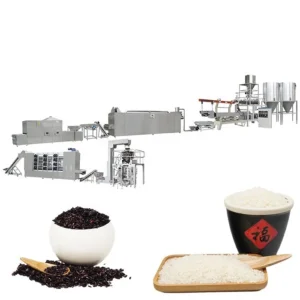
Every station from the batching mixer through the twin-screw extruder, vibrating screen, low-temperature dryer, cooler, high-temperature roasting unit, and final packing station is specified here with matching throughput, so the line is engineered as a system rather than assembled from disconnected vendors. Screw and die configurations are documented against the buyer’s raw material and target kernel specification before production begins. Trial runs on customer-supplied raw material take place in the testing workshop, generating a report that confirms kernel density, cooking behaviour, and moisture content before the line ships. Pre-sales engineering covers line layout and utility planning, and on-site commissioning includes operator training on the frequency-controlled dryer and feeding system adjustments.
Documentation & Verification
- Line layout and capacity calculation showing throughput match across every station
- Screw and die configuration record tied to the buyer’s grain and vitamin formulation
- Electrical schematic confirming voltage and frequency for the destination facility
- Trial run report produced on customer raw material before shipment
- CE declaration of conformity and ISO certificate included with dispatch documents
Installation, Commissioning & Support
- MT95 line requires a 36 × 3.5 m footprint with 4.3 m ceiling clearance for the dryer stack
- Dedicated power circuit sized to the model’s installed power, up to 260 kW for the MT95
- Frequency-controlled dryer belt calibrated on site to match the actual kernel moisture at exit
- Automatic lubrication system checked and primed before first production run during commissioning
- Screw and die configuration verified against trial-run sample before full-speed operation begins
- Wear parts list with recommended spare screw elements and die plates provided at handover
What to Include With Your Inquiry
Provide the grain or starch base you plan to extrude, the vitamin and mineral premix percentage, and the target kernel dimensions. Specify your facility voltage and frequency, the control language your operators require, and the available workshop dimensions including ceiling height. If you can ship a sample of your raw material for a trial run, note that in your message so testing workshop scheduling can be arranged alongside the technical proposal.
Frequently Asked Questions
Q: How is output capacity verified for each model?
A: The capacity figures listed for the MT65 through MT95 are based on standard test conditions that have not been specified in the source material. For your actual formulation — including grain type, moisture content, and premix ratio — a trial run in the testing workshop produces real throughput data and kernel quality measurements before the line is finalised.
Q: How do I confirm electrical specifications match my facility?
A: Voltage, frequency, and control language are confirmed during the specification review stage before production starts. The electrical schematic is included in the documentation package, and the frequency-controlled drives on both the extruder and the dryer oven are set to match your local power supply.
Q: What screw and die setup is used for my grain formulation?
A: Screw element arrangement and die plate design are configured after reviewing your raw material composition and target kernel density. The configuration is recorded in the documentation package and validated during the in-house trial run, so the production line arrives with the correct setup already installed.
Q: Can I send raw material for a pre-shipment trial?
A: Yes. The testing workshop accepts customer-supplied raw material for trial runs. The resulting report documents extrusion parameters, kernel density, moisture levels, and cooking behaviour, providing a benchmark that the commissioned line must match on your production floor.
Q: How are dryer and cooler capacities matched to the extruder?
A: Each dryer oven and cooler in the line is sized to handle the wet-kernel output of the corresponding extruder model. The frequency-controlled mesh belt on the dryer allows on-site adjustment of drying time, and the layout document confirms that every downstream station is matched to the extruder’s actual throughput.