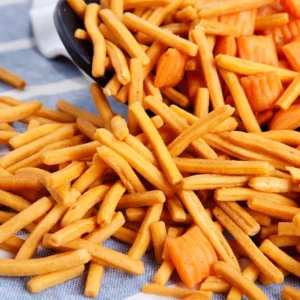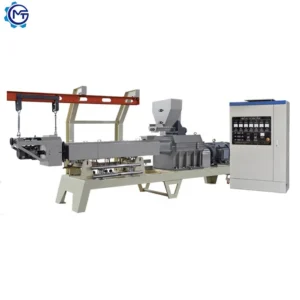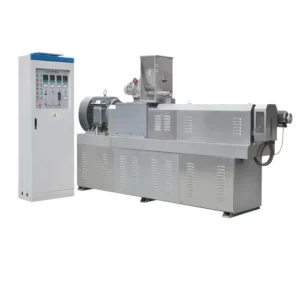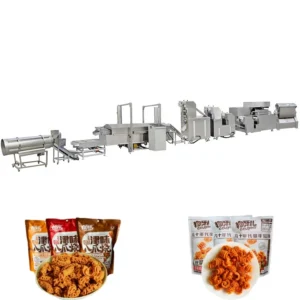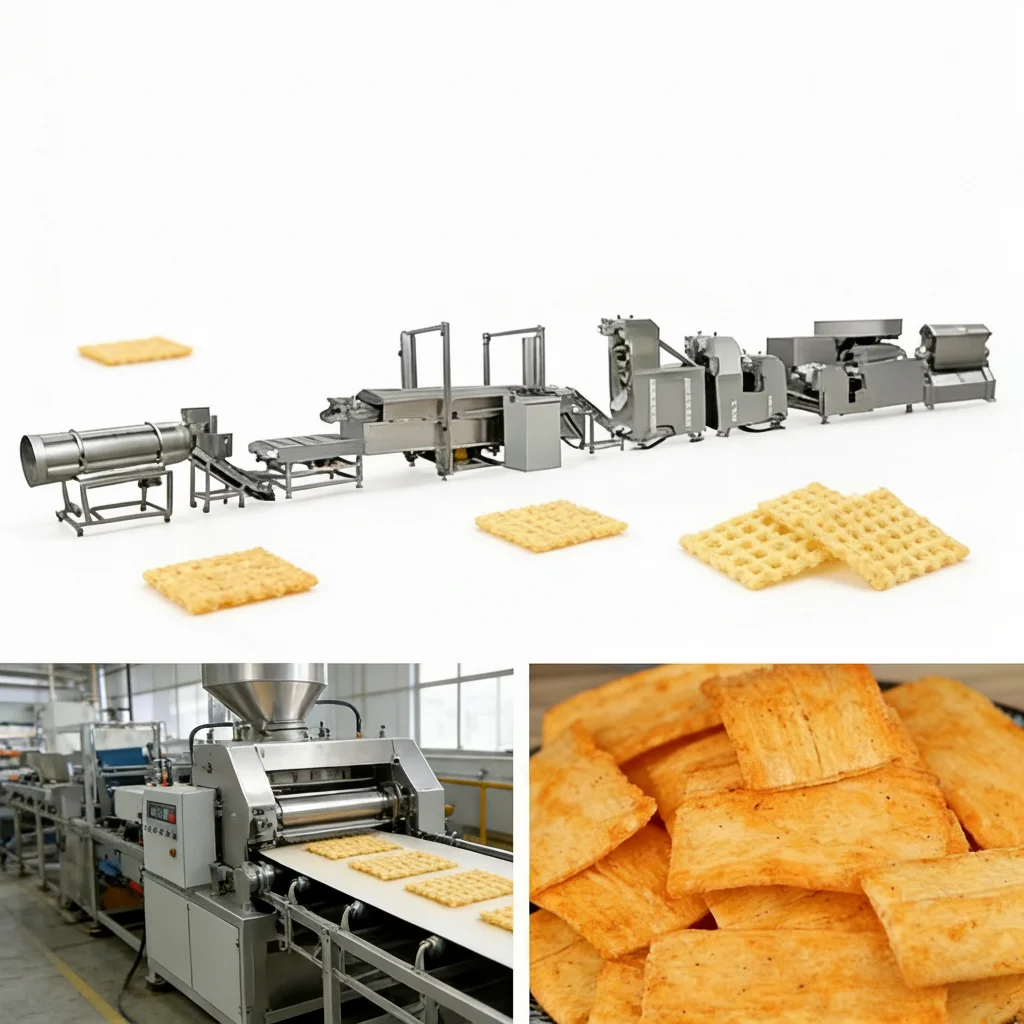
Integrated Station Sizing — Every station from mixer to packer is matched for throughput, so the extruder never waits on a dryer or fryer that cannot keep up.
Technical Specifications
| Parameter | Value |
|---|---|
| Product Type | Single Screw Extruder Snack Production Line |
| Extruder Model Options | MT100 / MT120 |
| Extruder Configuration | Single screw (high and low pressure screw options) |
| Rated Power | 50–70 kW (basis not stated in source — confirm electricity / gas / diesel / steam configuration) |
| Output Capacity | 120 kg/h (basis not stated in source — confirm raw material, moisture, product shape) |
| Voltage & Frequency | Three phase 380V/50Hz; Single phase 220V/50Hz (customizable) |
| Overall Dimensions (L×W×H) | 12,000–26,000 × 1,200 × 2,200 mm |
| Raw Materials | Wheat flour, corn starch, potato starch |
| Product Shapes | Screw shell, round tube, square tube, ring, cartoon shapes (via die adjustment) |
| Energy Options | Electricity, gas, diesel, or steam |
| Contact Material | Food grade stainless steel 201/304 |
| Motor | Siemens (China-made) or China top brand |
| Inverter | Delixi or Delta |
| Control System | Available with PLC or MCC control (to confirm) |
| Line Stations | Mixer → Screw Conveyor → Single Screw Extruder → Pulling and Cutting Machine → Automatic Fryer → Automatic Flavoring Line → Cooling → Packing |
| Assembly State | Complete production line |
| Warranty | One year warranty and lifetime technical guidance |
| Standards | CE, ISO 9001 |
Application Suitability
| Application | Material or Output |
|---|---|
| Golgappa / pani puri production | Wheat flour or corn starch sheets for secondary puffing |
| Fried screw shell snacks | Wheat flour and potato starch blends extruded into shell dies |
| Puffed ring and tube snacks | Corn starch and wheat flour mixes through ring or tube dies |
| Cartoon-shaped fried snacks | Potato starch and wheat flour blends with custom die plates |
| Leisure snack food lines | Mixed grain starches for secondary puffing and frying |
Why Voltage Confirmation Beats Capacity on Paper
A single screw extruder snack production line for sale only delivers its rated output when every electrical parameter matches the factory grid it lands on.
I spent years in the Pearl River Delta fitting out snack lines and learned early that a nameplate reading 380V/50Hz means little if the buyer’s workshop runs on a 440V three-phase supply or a 60Hz local grid. The extruder motor pulls amperage at the wrong frequency, the inverter trips during ramp-up, and the fryer temperature controllers drift outside their set bands. Entire commissioning schedules collapse before the first batch of golgappa leaves the die. [NEED_CITE: voltage and frequency standards by export market]
Buyers frequently submit an inquiry with target snack shape and daily tonnage but skip the utility survey. Without confirmed voltage, frequency, and control language, the single screw extruder snack production line for sale cannot be wired at the factory, and on-site electricians are left improvising cable schedules under time pressure. The result is intermittent faults that only appear after the installation crew has flown home.
Matching Extruder Throughput to Fryer and Flavoring Capacity
A common failure on snack lines is an extruder sized for a given hourly output while the fryer basket and flavoring drum cannot absorb that same throughput. Dough pieces stack in the fryer, oil temperature drops, and the golgappa shells emerge undercooked on the inside and over-browned on the outside. This single screw extruder snack production line addresses that mismatch by sizing the pulling and cutting machine, automatic fryer, and flavoring drum as one chain, so cut pieces enter the oil at the rate the fryer can maintain temperature.
The line runs either high-pressure or low-pressure single screw configurations depending on the raw material. Wheat flour with moderate gluten content requires different screw geometry than a pure corn starch blend, and swapping the screw changes residence time and shear inside the barrel. Getting this right at the quoting stage prevents the situation where a producer has to reformulate their recipe just to keep the line running.
How Die Interchangeability Expands Product Range on One Barrel
A single extruder barrel with a set of interchangeable dies lets a snack manufacturer move from screw shells to round tubes, square tubes, rings, and even cartoon shapes without purchasing a second machine. The die plate bolts onto the barrel flange, and the pulling and cutting machine speed is adjusted to match the new cross-section. This flexibility matters when a brand wants to test a new format for a seasonal promotion or when a distributor needs to fulfill mixed-shape container orders. [NEED_CITE: food extrusion die design standards for snack shapes]
Food-grade stainless steel 201 or 304 contact surfaces keep the die, barrel, and conveyor in compliance with hygiene regulations across most export markets. The material choice also affects heat transfer at the die face, which influences how cleanly the cut piece releases and whether the edge seals properly before the piece enters the fryer.
Reading the Specs: What the Numbers Mean for Your Workshop
The rated power band of 50–70 kW covers the full line from mixer through fryer and flavoring, but the split between electricity, gas, diesel, or steam determines the actual utility draw at each station. A factory with abundant steam from an existing boiler will route heat to the dryer and fryer differently from a plant relying solely on electric heating elements. Confirming the energy source before production ensures the control panel is wired for the correct contactor ratings.
The overall length range of 12,000–26,000 mm reflects line configurations with or without intermediate cooling and packing conveyors. A compact layout fits inside a workshop with a single bay door, while the extended arrangement allows space for a cooling carousel before packing. Floor plans should account for fryer oil drainage and flour dust extraction ducting, neither of which shows up in a simple length measurement.
Motor specification lists Siemens China-made or equivalent top Chinese brand, paired with Delixi or Delta inverters. The inverter controls screw speed and cutting frequency, so its brand and rating affect how smoothly the line responds to throughput adjustments. Specifying the inverter model before dispatch avoids last-minute substitutions that can change the acceleration profile of the screw.
The Cost of Skipping a Factory Trial Run
I once watched a snack line get assembled on site only to discover that the local wheat flour had a lower starch content than the test sample. The extruder barrel temperature profile was set for a higher-gelatinisation flour, and the golgappa shells came out dense and brittle, cracking during frying and producing a high reject rate. A trial run on the buyer’s actual raw material in the supplier’s testing workshop would have flagged the issue and allowed screw configuration adjustment before the machines left the factory. [NEED_CITE: importance of raw material trial runs in extrusion]
When no trial run takes place, product development happens during commissioning, with the supplier’s engineers on site and the clock running on their service contract. Raw material waste, oil waste, and idle operator time all add up while die shapes and barrel temperatures are adjusted by trial and error.
Why Buyers Source This Line Here
Complete line coverage from mixing through packing means one supplier holds responsibility for throughput matching at every station, removing the blame-shifting that happens when separate vendors supply the extruder and the fryer.
Screw configuration and die design are specified against the buyer’s raw material and target snack shape rather than copied from a generic build, reducing the risk of wrong texture or density in the finished product.
An in-house testing workshop allows trial runs on customer-supplied flour and starch blends before shipment, so the first production day on site starts with proven parameters rather than guesswork.
Multiple energy options — electricity, gas, diesel, steam — let the line adapt to whatever utility infrastructure exists at the buyer’s factory, rather than forcing a workshop to install new gas lines or upgrade transformer capacity.
Pre-sales engineering covers line layout, capacity calculation, and utility planning, with on-site installation, commissioning, and operator training included in the project scope.
Documentation & Verification
- Line layout drawing showing throughput balance between extruder, fryer, and flavoring drum
- Machine specification sheet listing screw configuration and die record for your chosen snack shape
- Electrical schematic with confirmed voltage, frequency, and control panel language for your market
- Factory test record on your wheat flour or corn starch blend before dispatch
- CE declaration of conformity and ISO 9001 certificate for customs clearance
- Packing photographs showing crate bracing and moisture protection for ocean freight
Installation, Commissioning & Support
- Floor space of 12,000–26,000 mm length requires level concrete slab with anchor points for extruder and fryer
- Three-phase 380V/50Hz dedicated circuit with breaker sized to the 50–70 kW total line load
- Line ships in modular sections; on-site assembly includes barrel alignment and conveyor belt tensioning
- First-run commissioning covers screw speed, barrel temperature zones, fryer oil temperature, and cutting frequency
- Operator training on die changeover, inverter parameter adjustment, and fryer oil filtration cycle
- Wear parts list covers screw segments, die plates, cutting blades, and fryer basket mesh
Before You Send an Inquiry
To size the line correctly, share the raw material type and its starch or gluten content, the target snack shape and die preference, and the daily output you need to meet market orders. Include your workshop’s available voltage, frequency, and whether you have steam or gas on site. If you have existing upstream batching or downstream packing equipment, note the interface dimensions so the new line ties in without a gap.
Frequently Asked Questions
Q: How is output capacity verified against my specific raw material and snack shape?
A: The supplier runs a trial on your actual wheat flour, corn starch, or potato starch in an in-house testing workshop. Screw speed, barrel temperature, and die selection are adjusted until the extruded piece meets your density and shape requirements. A written trial report accompanies the shipment.
Q: Which energy source fits my factory utility setup?
A: The line supports electricity, gas, diesel, or steam. You provide your available utility type and capacity during the quoting stage, and the heating elements, burner assemblies, or steam heat exchangers are configured at the factory so no retrofit is needed on arrival.
Q: What die shapes are available, and can custom shapes be tooled?
A: Standard dies include screw shell, round tube, square tube, ring, and cartoon shapes. Custom die plates can be manufactured to your drawing, provided the cross-section is compatible with single-screw extrusion pressure and the pulling and cutting machine geometry.
Q: How do fryer and flavoring capacities match the extruder throughput?
A: Each station is sized as part of one system during line layout. The fryer basket volume and oil heating rate are calculated to handle the cut-piece output of the extruder, and the flavoring drum rotation speed is set to coat the full throughput without accumulation.
Q: What voltage, frequency, and control language will be configured before dispatch?
A: You confirm your local three-phase voltage, frequency, and preferred control panel language during the specification review. The electrical schematic is updated, the inverter parameters are pre-set, and the HMI labels are printed in your chosen language before the machines leave the factory.