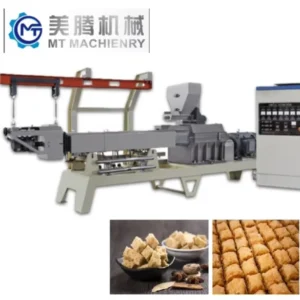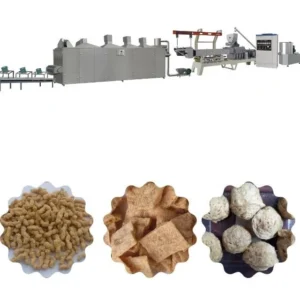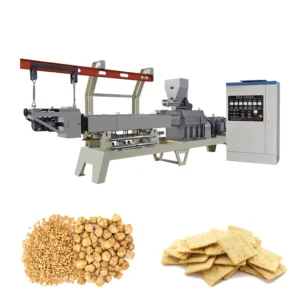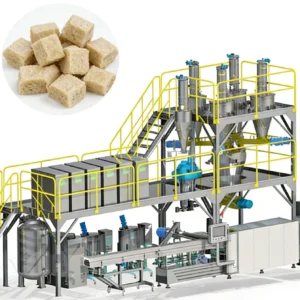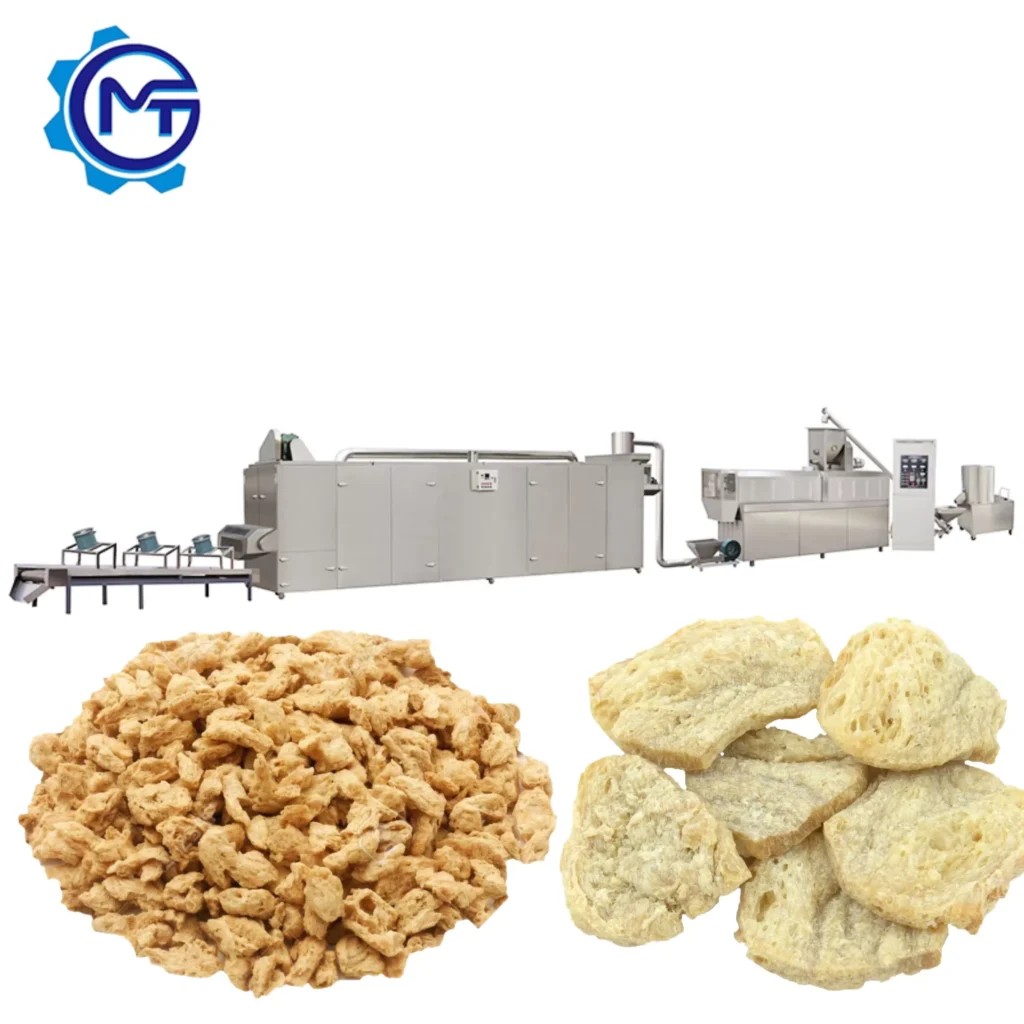
Capacity-Matched Line Integration — every station from the vertical mixer to the multi-layer dryer is sized against the extruder’s real throughput on your raw material, not its nameplate rating.
Technical Specifications
| Parameter | Value |
|---|---|
| Product Type | Twin Screw Extruder Line for Textured Soybean Protein |
| Models Available | MT65 / MT70 / MT75 / MT85 |
| Screw Type | Twin screw |
| Screw Length Options | 1050 mm, 1520 mm |
| Main Motor Power (MT65) | 22 kW |
| Main Motor Power (MT70) | 30 kW |
| Main Motor Power (MT75) | 45 kW |
| Installed Power (MT85) | 210 kW |
| Output Capacity (MT65) | 100–150 kg/h (basis not stated in source — confirm raw material type and moisture) |
| Output Capacity (MT70) | 150–200 kg/h (basis not stated in source — confirm raw material type and moisture) |
| Output Capacity (MT75) | 150–200 kg/h (basis not stated in source — confirm raw material type and moisture) |
| Output Capacity (MT85) | 250–300 kg/h (basis not stated in source — confirm raw material type and moisture) |
| Mixer Type | Vertical mixing machine |
| Mixer Capacity Options | 20–30 kg, 70–80 kg, 170–180 kg |
| Mixer Power Options | 4 kW, 7.5 kW, 15 kW |
| Dryer Drive | Double pitch roller chain drive, round-trip drying |
| Dryer Fuel Options | Electricity, gas, fuel |
| Dryer Control | Adjustable temperature and time |
| Line Sequence | Mixer → Screw Conveyor → Twin Screw Extruder → Air Conveyor → Multi-layer Dryer → Cooling Machine |
| Certification | CE |
Application Suitability
| Application | Material or Output |
|---|---|
| Textured soy protein (TVP / TSP) production | Defatted soya flour, low-temperature soya flakes |
| Soya chunks and soy nuggets | Defatted soya flour blended with starch and water |
| Plant-based meat analogue for food service | Soy protein concentrate with fibre alignment |
| Ingredient supply for meat extenders | Soya flour and soybean dregs |
| Cereal snack formats (by screw adjustment) | Corn grits, rice flour, blended cereal bases |
Why "Rated Capacity" Fails on Real Soya Flour
When a plant based meat processing equipment manufacturer quotes a line at a nominal output figure, that number rarely survives contact with the buyer’s actual defatted soya flour or low-temperature flakes. Capacity must be verified against your specific raw material formulation and moisture level before the contract is signed.
In my years walking trade floors and commissioning lines across Europe, the most common post-installation argument starts with throughput. A line spec sheet says one thing; the actual kilos landing on the cooling conveyor tell another. Wet soy mass that does not meet its drying target accumulates, sours, and gets scrapped. That is not a minor variance — it is an entire shift lost [NEED_CITE: moisture and fibre alignment tolerance in high-moisture extrusion]. Selecting the right plant based meat processing equipment manufacturer means insisting on a trial report that names your flour, your water ratio, and your target fibre structure.
Screw Configuration Is Where Fibre Structure Lives or Dies
Textured soybean protein depends entirely on the shear profile and residence time inside the barrel. The twin screw extruder in this line offers screw lengths of 1050 mm and 1520 mm, which changes how long the protein matrix stays under thermal and mechanical stress. A plant based meat processing equipment manufacturer that ships a generic screw build without adjusting to your soya flake particle size will deliver nuggets that crumble or fibres that refuse to align. The screw elements must be matched to whether you are running pure defatted flour or a blend carrying peanut dregs and starch.
Dryer Capacity Must Track the Extruder, Not the Other Way Around
The multi-layer dryer on this line runs a double pitch roller chain with round-trip passes and adjustable temperature zones. Its job is to pull moisture from hot, expanded soy mass fast enough to prevent collapse and slow enough to avoid case-hardening the outer shell. If the dryer is undersized relative to the extruder output, you get a queue of cooling-bound product sitting in the air conveyor, losing structure. Fuel flexibility — electricity, gas, or liquid fuel — lets the plant based meat processing equipment manufacturer adapt the dryer to your local utility costs without resizing the heat transfer area [NEED_CITE: dryer residence time and moisture gradient in TVP production].
Reading the Specs Against Your Production Reality
The installed power range across the four models — from 84 kW on the MT65 to 210 kW on the MT85 — tells you where the line sits in energy intensity. Main motor options of 22 kW, 30 kW, and 45 kW govern barrel torque, which directly affects how aggressively the screws shear the soy protein. Higher torque means tighter fibre alignment but also more heat that the barrel cooling zones must absorb. The vertical mixer capacities of 20–30 kg up to 170–180 kg batch sizes need to cycle in time with the extruder feed rate; a mixer that empties too slowly starves the screws and creates density variation in the final chunk. Line dimensions reach up to 45,000 mm in length on the MT85, so floor planning and utility routing must account for that footprint from day one.
The Downstream Bottleneck Nobody Quoted For
A recurring failure pattern in textured protein lines is the mismatch between extrusion output and cooling capacity. The extruder delivers hot, moist product at a steady rate. If the air conveyor or cooling machine cannot accept that volume, semi-finished nuggets pile up, stick together, and lose their individual piece integrity. In one commissioning case I walked into, the extruder was running fine but the cooling belt was specified for a lighter snack product — the result was a continuous jam that forced the entire line to run at half speed [NEED_CITE: downstream capacity matching in continuous extrusion lines]. That kind of error does not show up on the quotation; it shows up on the factory floor three weeks after startup.
Procurement Logic for This Line
Every station from the vertical mixer through the screw conveyor, twin screw extruder, air conveyor, multi-layer dryer, and cooling machine is specified as a matched set rather than assembled from separate vendors. This means throughput is calculated across the entire sequence before the layout drawing is released. The screw and die configuration is documented against the buyer’s raw material sample, not pulled from a generic library. An in-house testing workshop runs your defatted soya flour or soya flakes before the machine ships, producing a trial report that records fibre structure, expansion ratio, and moisture at the dryer exit. Pre-sales consultation covers line layout and utility planning; on-site installation includes parameter tuning for your local voltage and frequency. Spare wear parts — screws, dies, barrel segments — are listed and available so the first replacement does not halt production.
Documentation & Verification
- Line layout and capacity calculation showing matched throughput at every station
- Screw and die configuration record tied to your raw material sample
- Trial run report on your defatted soya flour or flakes before dispatch
- Electrical schematic with confirmed voltage and control language
- CE declaration of conformity with full machinery directive compliance
- Operation and maintenance manual with wear parts replacement intervals
Installation, Commissioning & Support
- Floor space planning for line lengths up to 45,000 mm including utility clearances
- Dedicated power circuit sized to installed load, up to 210 kW on the MT85
- Vertical mixer positioned for ergonomic loading at the specified batch capacity
- Dryer fuel connection configured for local electricity, gas, or liquid fuel supply
- First-run parameter tuning on site with screw speed and barrel temperature mapping
- Operator training covering screw changeover, die cleaning, and dryer adjustment
- Wear parts list with lead times for screws, dies, and barrel liner segments
Before You Send the Inquiry
To size this line correctly, the conversation needs to start with your raw material specification — whether you are running defatted soya flour, low-temperature flakes, or a blend that includes soybean dregs or starch carriers. Your target daily output and the number of shifts you plan to run will determine which model in the MT65 through MT85 range fits. Share your workshop dimensions and ceiling height so the line layout accounts for the dryer’s vertical clearance and the cooling machine’s discharge height.
Frequently Asked Questions
Q: How is output capacity verified on my specific raw material and what is the test basis?
A: We run your actual defatted soya flour or soya flakes through the twin screw extruder in our testing workshop before shipment. The trial report records the exact formulation, moisture content, screw configuration, and the measured output in kilograms per hour under those conditions. That figure becomes the contractual capacity reference, not a generic catalog number.
Q: How do I select the right extruder model and screw configuration for my target texture?
A: Selection depends on your desired fibre alignment, chunk size, and raw material blend. The screw length options of 1050 mm and 1520 mm change residence time and shear intensity. We test multiple screw element arrangements on your material during the trial run and document the configuration that produces the fibre structure your end customer expects.
Q: What voltage and frequency options are available for my market?
A: The electrical system is configurable to match local grid standards before production begins. We confirm voltage, frequency, and control panel language during the specification review. This avoids commissioning delays caused by incompatible motor ratings or unreadable HMI text when the line arrives at your facility.
Q: How are dryer capacity and extruder throughput matched to avoid bottlenecks?
A: The multi-layer dryer is sized based on the extruder’s verified output and the moisture reduction required for your specific product format. We calculate residence time across the round-trip drying passes and confirm that the dryer can handle peak extruder volume without product queuing on the air conveyor upstream.
Q: Can I run a trial on my raw material before the line ships?
A: Yes. The in-house testing workshop is part of the standard process. You send your raw material, we run it through the configured extruder and dryer, and you receive a trial report documenting output, texture, moisture, and fibre structure. Product development starts in our facility, not on your factory floor after installation.