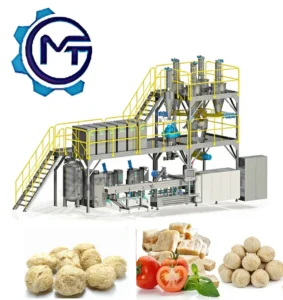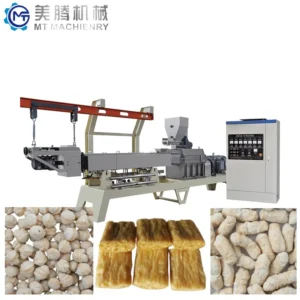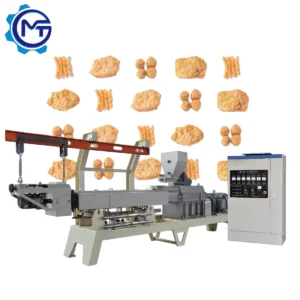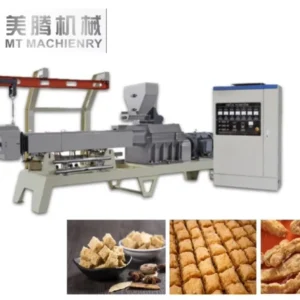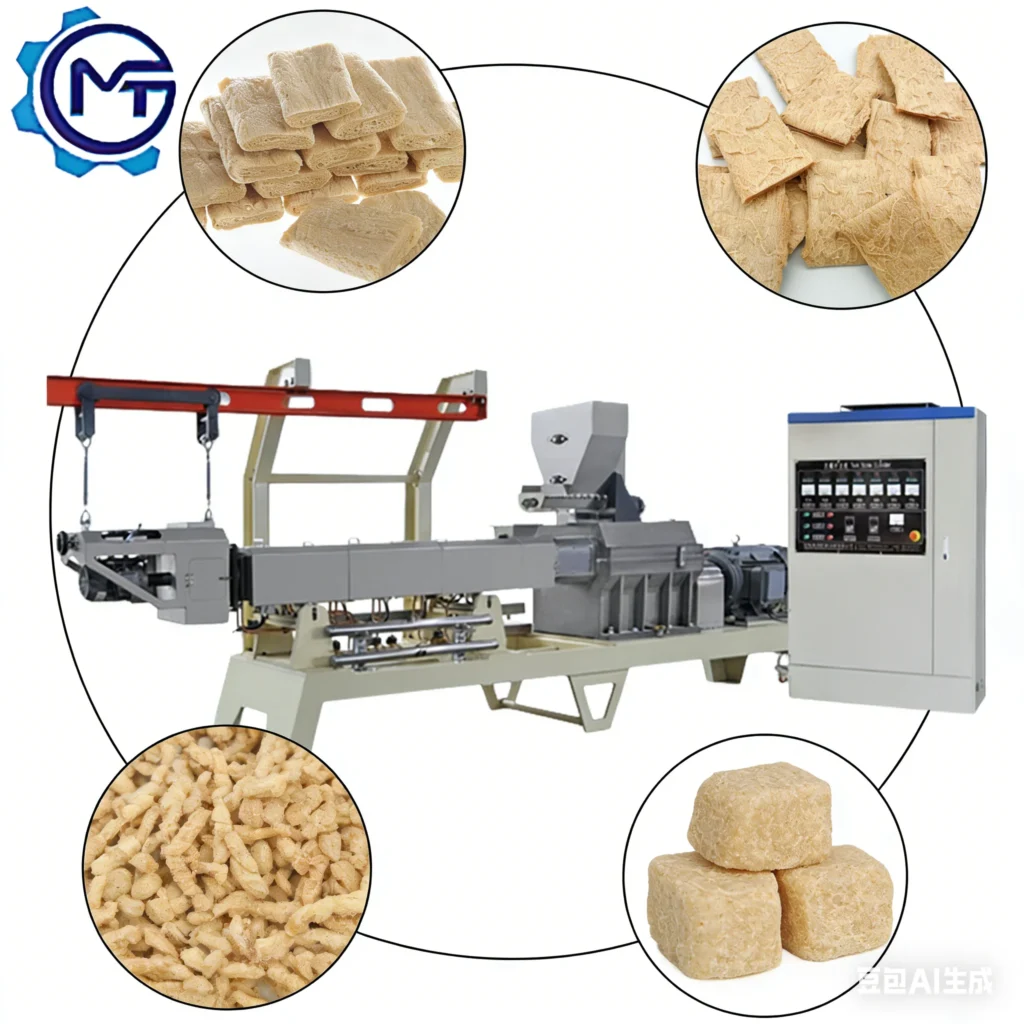
Screw configuration matched to material — Die geometry and screw profile are specified to the buyer’s actual defatted soya flour or flakes, validated through in-house trial runs before the textured vegetable protein extruder for sale leaves the factory.
Technical Specifications
| Parameter | Value |
|---|---|
| Product Type | Twin Screw Extruder for Textured Vegetable Protein (TVP) |
| Model Options | MT65 / MT70 / MT75 / MT85 |
| Screw Type | Twin screw |
| Installed Power | MT65 — 84 kW; MT70 — 160 kW; MT75 — 190 kW; MT85 — 210 kW |
| Power Consumption | MT65 — 59 kW; MT70 — 120 kW; MT75 — 140 kW; MT85 — 140 kW |
| Output Capacity | MT65: 100–150 kg/h; MT70: 150–200 kg/h; MT75: 150–200 kg/h; MT85: 250–300 kg/h (basis not stated in source — confirm raw material, moisture content and target TVP format) |
| Main Motor Power | 22 kW / 30 kW / 45 kW (model mapping to be confirmed) |
| Screw Length | 1050 mm / 1520 mm (model mapping to be confirmed) |
| Heating Power | 10 kW / 14 kW / 14 kW (model mapping to be confirmed) |
| Feeding Motor Power | 0.75 kW |
| Rotary Cutting Motor Power | 0.75 kW |
| Pump Motor Power | 0.37 kW |
| Die Configuration | Interchangeable moulds for soya nuggets, TVP/TSP, soya chunks |
| Control System | PLC / MCC availability to be confirmed |
| Mixer Type | Vertical mixing machine with stainless steel 304 mixing ruler |
| Mixer Capacity Options | 20–30 kg / 70–80 kg / 170–180 kg |
| Mixer Power Options | 4 kW / 7.5 kW / 15 kW |
| Dryer Drive | Double pitch roller chain drive, round-trip drying |
| Dryer Energy Options | Fuel / gas / electricity (buyer selectable) |
| Line Stations | Mixer → Screw Conveyor → Twin Screw Extruder → Air Conveyor → Multi-layer Dryer → Cooling Machine |
| Certification | CE (declared since 2014); ISO certified |
Application Suitability
| Application | Material or Output |
|---|---|
| Textured vegetable protein production | Defatted soya flour, low-temperature soya flakes |
| Soya nuggets and soya chunks | Soybean dregs, peanut dregs |
| Plant-based meat analogue processing | High-protein soya formulations for meat substitution |
| Meat products industry input | TVP as partial meat replacement in sausages and patties |
| Fast food and deep-freeze food input | Rehydratable TVP for frozen ready meals |
| Cereal and snack formats | Starch-based formulations via screw configuration adjustment |
Why Nominal Throughput Figures Mislead TVP Buyers
A capacity rating means nothing until it is proven on your specific soya flour at your target moisture level.
When a textured vegetable protein extruder for sale is quoted at a certain kilogram-per-hour figure, that number almost always comes from a test run on a standard reference material. I once set up a line for a plant-based meat producer using standard defatted soya meal for the trial. The customer’s actual raw material arrived with protein content noticeably lower than the test batch. The extruded TVP came out soft, lacking the fibrous chew their market expected. We had to rework the screw combination and die geometry from scratch. This kind of mismatch is common, and it is why every Meiteng line is validated on the buyer’s actual material in the testing workshop before dispatch [NEED_CITE: protein content variation in commercial soya flour batches].
How Screw Profile Shapes TVP Fibre Structure
The twin screw extruder for TVP production relies on shear, heat, and pressure to align protein molecules into a fibrous matrix that mimics animal muscle tissue. The screw configuration — the arrangement of conveying elements, kneading blocks, and reverse-flight sections — determines how much mechanical energy is transferred into the soya dough. A configuration with aggressive kneading blocks generates higher shear, producing denser, more tightly layered protein fibres suitable for soya chunks. A gentler profile yields the open, sponge-like structure typical of fine TVP granules. Each model in this range can be fitted with a screw profile selected specifically for the buyer’s target product format and raw material characteristics.
Matching Dryer Capacity to Extruder Output
A frequent problem on protein extrusion lines is an undersized dryer sitting downstream of a high-output extruder. The extruder pushes out moist, expanded TVP at a steady rate, but the dryer cannot remove enough moisture in the available residence time. The result is product that feels tacky, stores poorly, and fails rehydration tests. The multi-layer dryer in this line uses a double pitch roller chain drive for smooth round-trip conveying, with adjustable temperature and drying time. Energy source — fuel, gas, or electricity — is selectable to match the buyer’s facility. Dryer dimensions and belt length are matched to the extruder model so throughput stays balanced across every station [NEED_CITE: moisture content targets for shelf-stable TVP storage].
What the Power and Motor Specs Mean for Your Facility
The installed power across the four models ranges from 84 kW to 210 kW, but actual power consumption during production runs lower — 59 kW on the MT65 up to 140 kW on the MT75 and MT85. This gap between installed and consumed power reflects the thermal headroom needed for start-up heating and load spikes when cold material first enters the barrel. The main motor options — 22 kW, 30 kW, and 45 kW — drive the screw shafts and must be matched to the torque demand of the specific soya formulation. Higher protein content and lower moisture levels increase dough viscosity, requiring more torque. Heating power at 10 kW or 14 kW maintains barrel temperature zones that control starch gelatinisation and protein denaturation. These parameters should be reviewed against the buyer’s electrical supply capacity before the order is finalised.
The Cost of Skipping a Pre-Shipment Trial
Buyers who accept an extruder without a material-specific trial run often discover texture problems only after installation, when the machine is bolted to the floor and utility connections are live. Correcting screw configuration at that stage means ordering new elements, waiting for international freight, and losing weeks of production time. In some cases the die geometry also needs adjustment — the wrong orifice size produces nuggets that are either too dense to rehydrate properly or too fragile to survive packaging and transport. These delays compound when the buyer’s downstream customers are waiting on sample batches for approval [NEED_CITE: lead times for replacement extruder screw elements shipped internationally].
Why Procurement Teams Specify This Line
The complete station sequence — mixer through screw conveyor, extruder, air conveyor, dryer, and cooling machine — comes from one supplier, which means throughput is calculated across every link rather than left to chance. Screw configuration and die design are specified to the buyer’s raw material and target TVP format, not copied from a generic build. The in-house testing workshop runs the buyer’s actual soya flour or flakes before shipment, producing a trial run report that confirms texture, density, and output. The vertical mixer uses stainless steel 304 contact surfaces for food safety compliance, with carbon steel framing for structural rigidity. Documentation covers electrical schematics, screw configuration records, and CE conformity — everything needed for customs clearance and local regulatory approval.
Documentation & Verification
- Line layout showing matched throughput from mixer through cooling station for your TVP format
- Screw and die configuration record matched to your soya flour protein content and target density
- Trial run report on your actual raw material produced in the testing workshop before dispatch
- Electrical schematic with voltage and frequency confirmed to your facility standard
- CE declaration of conformity and ISO certificate included in the shipping documentation package
Installation, Commissioning & Support
- Foundation plan based on full-line footprint and weight distribution across all stations
- Power supply assessment for installed load up to 210 kW with dedicated circuit recommendations
- Modular station delivery allowing phased positioning in facilities with limited access height
- First-run parameter setting covering barrel temperature zones, screw speed, and feeder rate
- Operator training on die changeover procedures between soya nugget and TVP granule formats
- Wear parts list covering screw elements, die plates, and cutting blades with reorder codes
Before You Request a Quote
To configure a twin screw extruder for TVP production that fits your operation, we need to understand your raw material specifications — particularly the protein content and particle size of your soya flour or flakes — along with your target TVP format, whether that is fine granules, soya nuggets, or large soya chunks. Please also share your local voltage and frequency standards, available workshop floor space, and whether you need the dryer configured for gas, fuel, or electric heating. If you are replacing or expanding an existing line, details on your current upstream and downstream equipment help us match throughput precisely.
Frequently Asked Questions
Q: How is the output capacity of each model verified before purchase?
A: Each model’s capacity rating is based on specific raw material and moisture conditions that must be confirmed for your application. We run your actual defatted soya flour or flakes in our testing workshop and document the achieved throughput, product density, and fibre structure in a trial run report before the machine ships.
Q: How do you match screw and die configuration to my TVP product?
A: We review your raw material data sheet — protein content, fat level, particle size — and your target product format. Screw elements are arranged to deliver the correct shear and residence time, while die orifice geometry is selected to produce the fibre alignment and expansion ratio your market expects.
Q: What electrical details must be confirmed before production begins?
A: We need your facility voltage, frequency, and phase specification, along with your preferred control interface language. These are locked in during the specification confirmation stage so the electrical schematic, motor ratings, and PLC programming match your local standards and avoid commissioning delays.
Q: How is dryer and cooling capacity sized relative to the extruder?
A: The multi-layer dryer and cooling machine are sized so their throughput matches the extruder output for your selected model. Belt width, drying length, and air flow are calculated to achieve target moisture content without creating a bottleneck, keeping the line balanced from mixer through cooling.
Q: Are replacement screw elements and dies available after initial installation?
A: A wear parts list is provided with every line, identifying screw elements, die plates, and cutting blades by reorder code. Replacement parts are manufactured to the same specification as the originals, ensuring the texture and density achieved during your trial run remain consistent through subsequent production cycles.