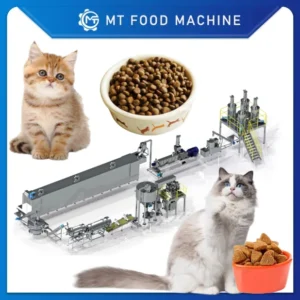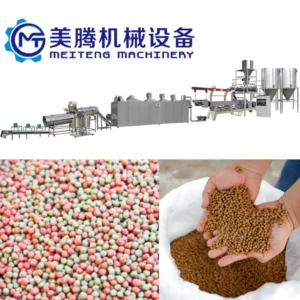
Station Matched Output — Every supporting machine from mixing to packing is sized against the extruder discharge rate, preventing capacity gaps that stall continuous aquatic feed production.
Technical Specifications
| Parameter | Value |
|---|---|
| Product Type | Twin Screw Aquatic Feed Extrusion Line |
| Screw Type | Twin screw |
| Control System | PLC automatic control system |
| Material Contact Parts | Food-grade 304 stainless steel |
| Pellet Buoyancy | Floating and sinking (adjustable) |
| Pellet Properties | Uniform density, smooth surface, adjustable size and hardness |
| Output Capacity | Basis to be confirmed on raw material formulation and moisture content |
| Line Stations | Raw material mixer, extruder, dryer, seasoning coating machine, vibrating sieve, conveyor equipment |
| Energy Design | Optimized energy-saving transmission structure and heating system |
| Operating Mode | Full continuous automatic production |
| Assembly State | Complete matched production configuration |
Application Suitability
| Application | Material or Output |
|---|---|
| Commercial koi and goldfish feed production | Fish meal, soybean meal, corn powder, compound additives |
| Tropical fish pellet mass production | Blended protein and starch bases with vitamin premix |
| Freshwater aquaculture feed manufacturing | Grain and animal protein mixes for catfish and tilapia |
| Sinking pellet runs for bottom-feeding species | High-density formulations requiring controlled extrusion shear |
Why Matching Dryer and Coater Capacity Decides Your Line’s Real Output
A floating or sinking pellet line is only as fast as its slowest station downstream of the extruder.
Buyers often focus negotiation on the extruder barrel diameter and motor power, then discover after installation that the dryer cannot handle the wet discharge volume or the coating drum cannot season pellets at the same rate. The extruder runs at full screw speed for an hour, product piles up on the transfer conveyor, and operators start shutting down upstream to let the back end catch up. What was quoted as continuous production becomes a series of stops [NEED_CITE: throughput balancing across extrusion line stations]. An aquatic feed extrusion machine full equipment range that is specified as a single matched system avoids this mismatch because every station is calculated against the same discharge baseline from the outset.
Each Station Sized Against the Extruder Discharge Rate
The raw material mixer is selected so batch cycle time aligns with the extruder’s continuous feed demand, preventing starvation or overflow at the feed hopper. The twin screw extruder itself sets the throughput ceiling, and every downstream unit is specified to match that ceiling. This approach to specifying an aquatic feed extrusion machine full equipment range removes the guesswork that happens when machines are sourced from separate vendors who each quote their own nominal capacity.
Dryer and Coating Drums Configured for Pellet Moisture Load
Wet extruded pellets carry substantial surface and internal moisture that must be reduced before coating and packing. The dryer length, airflow volume, and heat zone count are matched to the extruder output so pellets reach the coating drum at the target moisture without queuing. The seasoning coating machine then applies fat or flavour slurry at a rate the pellets can absorb before screening and cooling [NEED_CITE: moisture reduction requirements for extruded aquatic feed pellets].
How Screw Geometry and Die Selection Shape Pellet Density
The twin screw configuration allows operators to adjust shear, residence time, and pressure profile by changing screw element arrangement and die plate geometry. Floating pellets require high expansion at the die face, achieved through specific moisture and temperature conditions combined with a die orifice that permits rapid pressure release. Sinking pellets demand the opposite — lower expansion and higher density — which means a different screw profile and die selection. Food-grade 304 stainless steel on all contact parts resists the corrosive salts and oils common in fish meal and marine protein blends.
What Happens When Line Stations Are Not Balanced
An extruder running at full output into an undersized dryer creates a backlog of wet pellets that begin to clump and deform under their own weight. By the time they reach the coating drum, surface moisture is uneven, and fat absorption is inconsistent across the batch. The vibrating sieve then rejects a higher proportion of misshapen pellets, pushing actual saleable yield well below the quoted line capacity. These losses accumulate every shift and are rarely traced back to the original station sizing decision [NEED_CITE: yield loss from mismatched extrusion line equipment].
Why Procure the Full Range From One Equipment Supplier
Every station in this aquatic feed extrusion machine full equipment range is selected under one line layout calculation, so throughput figures across the mixer, extruder, dryer, coater, and sieve share the same baseline. Screw and die configuration is specified against the buyer’s raw material formulation and target buoyancy, not copied from a generic build. The in-house testing workshop runs the buyer’s actual ingredient blend before shipment, generating a trial report that confirms pellet density, expansion, and surface quality. Electrical schematics and voltage specifications are locked before production begins, avoiding commissioning delays caused by mismatched frequency or control language. PLC automatic control coordinates start-up and shut-down sequences across all stations from a single interface.
Documentation & Verification
- Line layout drawing showing throughput calculation for every station in the aquatic feed line
- Screw and die configuration record matched to your raw material and target pellet buoyancy
- Trial run report on your ingredient blend conducted in the testing workshop before dispatch
- Electrical schematic with confirmed voltage, frequency, and PLC language for your facility
- Factory test record documenting continuous run parameters and pellet sample measurements
Installation, Commissioning & Support
- Foundation plan and floor space layout covering the full line from mixer to vibrating sieve
- Dedicated power circuit specification matched to the PLC-controlled extruder and dryer heaters
- Assembly sequence for twin screw barrel sections, dryer modules, and coating drum installation
- First-run parameter logging and screw speed calibration on your raw material formulation
- Operator training covering PLC screen navigation, screw element changes, and die plate swaps
- Wear parts list identifying screws, dies, and dryer belt sections with re-supply lead times
What to Include With Your Inquiry
Send your raw material formulation — including protein source, starch percentage, and additive blend — along with the target pellet diameter and whether you need floating, sinking, or both formats. Specify your workshop ceiling height and available floor length so the line layout can be drafted to fit. Confirm local voltage and frequency, and the language your operators need on the PLC interface.
Frequently Asked Questions
Q: How are mixing, extrusion, drying and coating capacities matched to avoid line bottlenecks?
A: Each station is selected based on the extruder’s calculated discharge rate at your specific raw material moisture and formulation. The mixer batch cycle, dryer residence time, and coating drum speed are all derived from that single throughput figure, so no station runs faster or slower than the one before it.
Q: Which raw materials and pellet formats can each station configuration support?
A: The line processes fish meal, soybean meal, corn powder, and compound additive blends. Twin screw geometry and die selection are adjusted to produce floating pellets with high expansion or sinking pellets with controlled density, and the dryer and coater are re-sized accordingly for each format.
Q: What utility requirements does the full line need at the planned capacity?
A: Power supply for the extruder drive, dryer heating zones, and PLC panel must be confirmed at your local voltage and frequency. Compressed air is needed for pneumatic gates and seasoning spray nozzles. Steam supply may be required for preconditioning depending on the raw material moisture target.
Q: How is the trial run on buyer’s raw material conducted before shipment?
A: Your ingredient blend is shipped to the testing workshop where the matched screw and die configuration runs a continuous batch. The trial report documents pellet density, expansion ratio, surface texture, and moisture content at each station discharge point before the line is approved for packing.
Q: What spare wear parts are included and how is re-supply handled?
A: The wear parts list covers twin screw elements, die plates, and dryer belt sections most likely to require replacement during initial production cycles. Dimensions and material grades are recorded so re-supply orders can be manufactured and dispatched without needing new measurements from the installed line.