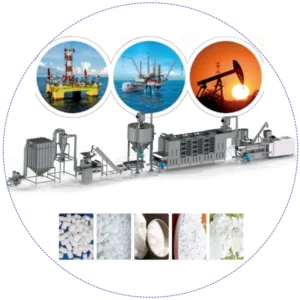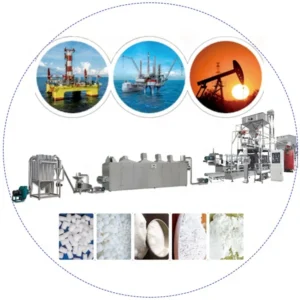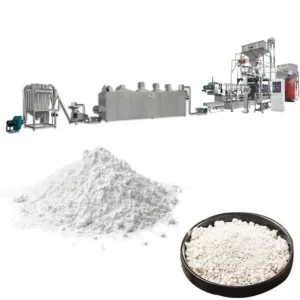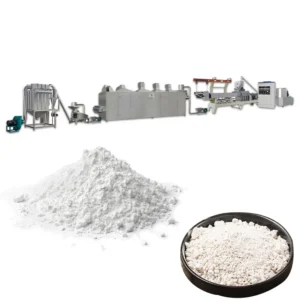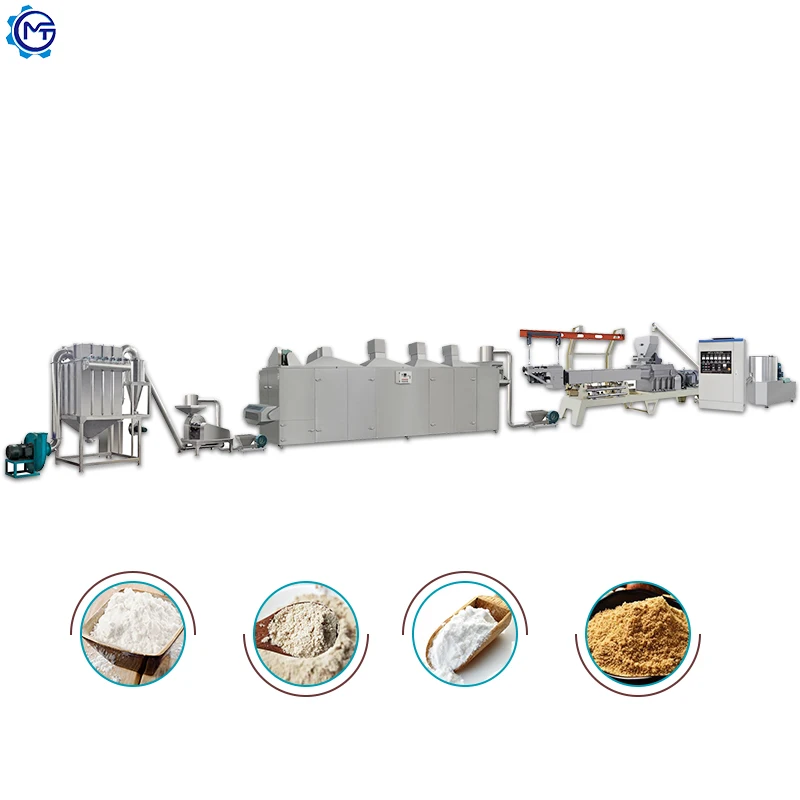
Integrated Station Sizing — Every mixer, extruder, dryer and grinder in this modified starch line is capacity-matched to prevent upstream or downstream bottlenecks before commissioning begins.
Technical Specifications
| Parameter | Value |
|---|---|
| Product Type | Twin-Screw Extrusion Line for Modified Starch |
| Screw Type | Twin-screw |
| Capacity Range | 80–500 kg/h (basis not stated in source — confirm raw material type, moisture content, and target starch specification) |
| Rated Power | approx. 100 kW (electricity); 50–60 kW (gas or diesel heating) |
| Voltage & Frequency | Three-phase 380 V / 50 Hz; Single-phase 220 V / 50 Hz (customizable to local supply) |
| Frame Material | Stainless steel 201 |
| Contact Material | Food-grade stainless steel 304 |
| Energy Options | Electricity / gas / diesel / steam |
| Control System | PLC or MCC (confirm before order) |
| Mixer Motor | 4.0 kW |
| Mixer Dimensions | 1.2 × 0.9 × 1.4 m |
| Mixer Batch Output | 3.0–4.0 kg/batch (basis not stated in source — confirm raw material density and moisture) |
| Screw Conveyor Motor | 1.1 kW |
| Screw Conveyor Dimensions | 2.5 × 0.6 × 2.3 m |
| Screw Conveyor Throughput | 0–150 kg/h (basis not stated in source — confirm material and angle) |
| Barrel Material | 45 steel (screw element) |
| Die Configuration | Interchangeable dies (geometry specified to target starch modification) |
| Warranty | One year; lifetime technical guidance |
| Certification | CE, ISO |
Application Suitability
| Application | Material or Output |
|---|---|
| Food-grade modified starch powder | Corn starch, wheat flour, potato starch |
| Pregelatinized adhesive powder | Corn starch, potato starch for paper and industrial bonding |
| Pre-gelatinized starch for instant foods | Wheat flour and corn starch blends |
| Modified starch for textile sizing | Corn starch and potato starch derivatives |
What "80 to 500 kg/h" Leaves Out About a Modified Starch Processing Line Equipment Manufacturer
Capacity is only meaningful when measured against your actual raw material and target gelatinisation degree.
When a modified starch processing line equipment manufacturer quotes a single number without stating the feedstock, moisture content, or target modification, that figure becomes unreliable fast. I once configured a twin-screw extrusion line for a Middle Eastern customer using our in-house corn starch for the trial run — everything passed. When the line arrived on site and they fed cassava starch, the viscosity profile was completely different, and it took four days of adjustment before the product met specification. That experience is why I now insist every buyer sends their actual raw material for a pre-shipment trial. Different starches gelatinise at different temperatures and shear thresholds, and no capacity plate holds true across all of them [NEED_CITE: starch gelatinisation temperature ranges by source material].
How Twin-Screw Configuration Shapes Starch Modification
The twin-screw extruder sits at the heart of this modified starch processing line equipment manufacturer catalogue. Its co-rotating screw pair generates the shear and residence time needed to break down native starch granules and achieve consistent gelatinisation. Interchangeable dies allow operators to adjust back-pressure and expansion ratio, which directly influence whether the output is a fully pregelatinized powder or a partially modified granular product. Food-grade stainless steel 304 contact surfaces ensure that no corrosion residues contaminate sensitive food or pharmaceutical starch batches.
Matching Dryer and Grinder Throughput to Extruder Output
A twin-screw extruder that produces wet, expanded starch ribbons faster than the downstream dryer can handle leads to product accumulation, moisture inconsistency, and eventual spoilage. This line stations a dryer between two air conveyors, followed by a conditioning unit and a grinder, so each transfer point is specified as part of one integrated flow. When the dryer capacity falls short, moisture in the final powder drifts above the target window, and grinder screen loading becomes uneven. Specifying every station together — rather than sourcing the extruder separately — removes this mismatch before metal is cut [NEED_CITE: moisture content specifications for commercial pregelatinized starch powders].
Reading the Specs That Matter for Starch Extrusion
The 100 kW electrical rating and the 50–60 kW thermal rating represent peak line draw, not steady-state consumption; actual energy use depends on the heating medium you select — electricity, gas, diesel, or steam — and the barrel temperature profile your modification requires. The 45 steel screw elements withstand the abrasive wear that starch granules impose over extended production runs, while stainless steel 304 barrels prevent iron contamination in food-grade output. The mixer’s 3.0–4.0 kg batch size must be reconciled with the extruder’s continuous feed rate; if batch cycle time exceeds the extruder’s minimum feed requirement, you will see surge and starvation in the barrel. Voltage confirmation — three-phase 380 V or single-phase 220 V — must happen before the electrical panel is wired, because rewiring a PLC cabinet on site is costly and delays commissioning.
The Hidden Cost of a Mismatched Line Configuration
When a buyer sources the extruder from one vendor and the dryer from another, throughput imbalances often surface only during on-site commissioning. The extruder may run at nameplate output, but the dryer cannot remove moisture fast enough, forcing the operator to slow the entire line. Die geometry copied from a generic build — rather than specified to the buyer’s target starch modification — produces powder with the wrong particle density, leading to rejection by downstream food or paper mills [NEED_CITE: particle density tolerances for industrial pregelatinized starch]. These mismatches add days or weeks to start-up and erode buyer confidence before the first commercial shipment leaves the factory.
Why Source This Line From One Equipment Range
Every station in this modified starch processing line equipment manufacturer catalogue — from the 4.0 kW mixer through the twin-screw extruder, dryer, conditioner, and grinder — is sized against the others so that no single machine throttles the flow. Screw configuration and die geometry are specified to your raw material and target starch type, not copied from a generic template. An in-house testing workshop runs your actual feedstock before shipment, producing a trial report that confirms capacity and product quality on your material. Multiple energy options — electricity, gas, diesel, steam — let the line fit your plant’s existing utility infrastructure rather than forcing a costly upgrade. CE and ISO documentation is prepared per shipment, and electrical schematics confirm voltage, frequency, and control language before the panel is built.
Documentation & Verification
- Line layout showing throughput balance across mixer, extruder, dryer, and grinder stations
- Screw and die configuration record matched to your corn, wheat, or potato starch
- Trial run report on your raw material produced in the testing workshop before dispatch
- Electrical schematic confirming voltage, frequency, and PLC language for your plant
- CE declaration of conformity and ISO certificate included with shipping documents
Installation, Commissioning & Support
- Foundation must support the extruder’s approx. 100 kW electrical load on a dedicated three-phase circuit
- Dryer station requires exhaust ducting sized for steam or gas heating exhaust volumes
- Line arrives in station modules; assembly sequence follows the provided layout drawing
- First-run parameter setting covers barrel temperature zones, screw speed, and die back-pressure
- Operator training covers die changeover, screen replacement on the grinder, and daily sanitation
- Wear parts list identifies screw elements, die inserts, and grinder screens for initial spares stock
Before You Send an Inquiry
Share the specific starch type you will process — corn, wheat, potato, or cassava — along with the target modification and end-use specification. Confirm your plant’s voltage, frequency, and available heating medium so the electrical and thermal systems are built correctly from the start. If you are replacing a single station in an existing line, provide the throughput and interface dimensions of your upstream and downstream equipment to ensure compatibility.
Frequently Asked Questions
Q: How is the 80–500 kg/h capacity verified against my raw material?
A: The quoted range depends on feedstock type, moisture content, and the target degree of gelatinisation. We run your actual raw material in our testing workshop and document the achievable throughput in a trial report before the line ships, so the capacity figure reflects your process conditions rather than a generic benchmark.
Q: Which supporting stations are included, and how is throughput balanced?
A: The line comprises a mixer, screw conveyor, twin-screw extruder, air conveyors, dryer, conditioning unit, and grinder. Each station is sized during the layout stage so that the extruder’s wet output matches the dryer’s evaporation rate and the grinder’s screen capacity, preventing accumulation or starvation at any transfer point.
Q: Which energy source should I select for my plant?
A: The line accepts electricity, gas, diesel, or steam for heating. Selection depends on your existing utility infrastructure and local energy cost. We confirm the heating medium during the specification stage and build the thermal system — burners, heat exchangers, or electric elements — to match your available supply.
Q: How are voltage and control language confirmed before shipment?
A: During the specification phase we collect your plant’s voltage, frequency, and preferred PLC language. An electrical schematic is issued for approval before the control panel is wired, preventing costly rewiring or transformer additions after the line arrives on site.
Q: Can I send raw material for a trial run before the line ships?
A: Yes. Our in-house testing workshop runs your actual starch — whether corn, wheat, potato, or cassava — through the extruder and dryer. The resulting trial report records throughput, product moisture, and gelatinisation quality, giving you verified data before the line leaves the factory.