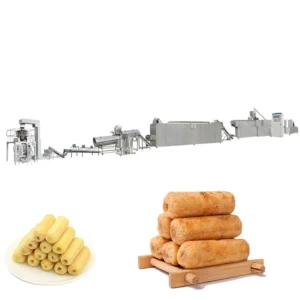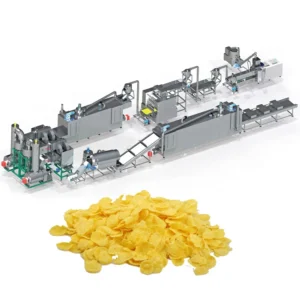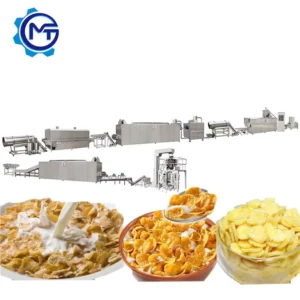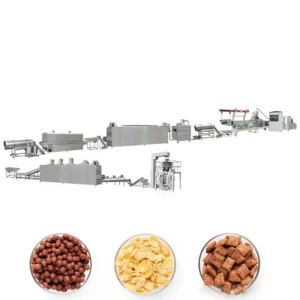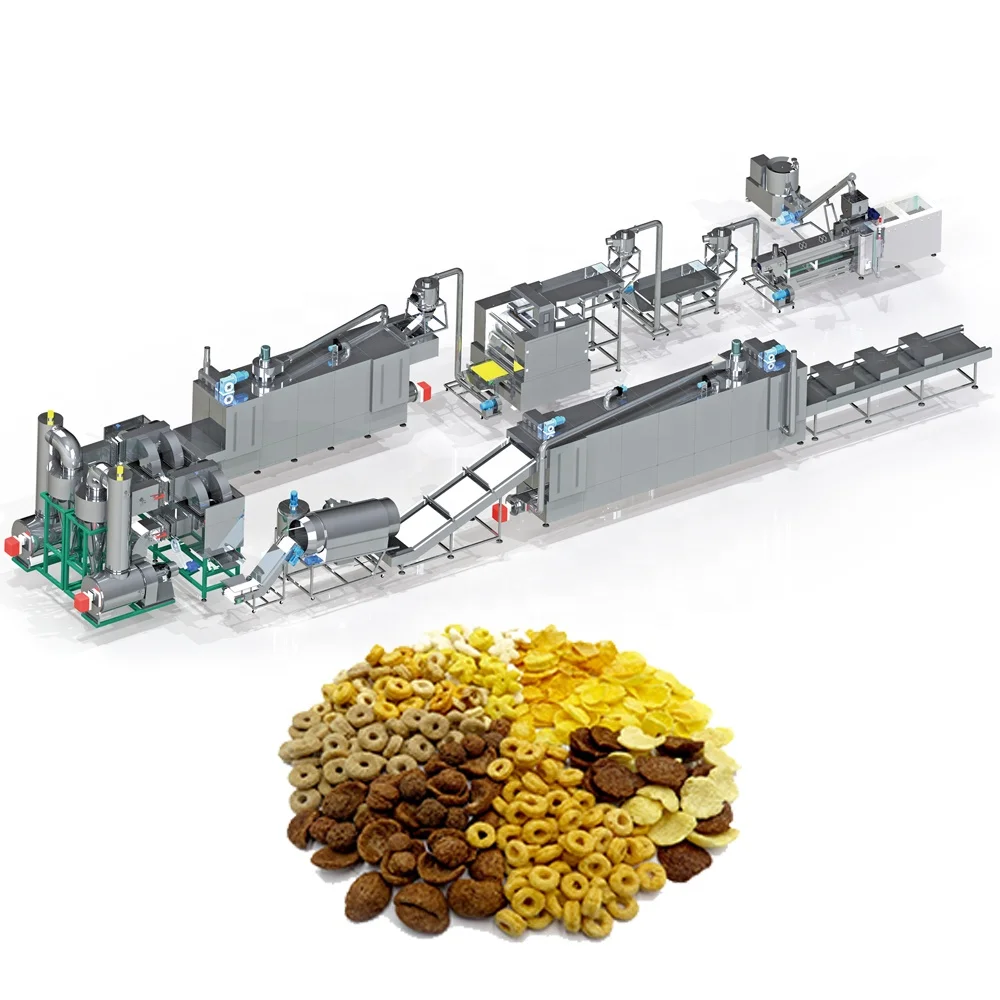
Capacity-Matched Station Integration — Every mixer, extruder, flaker, dryer and roaster in this line is sized to the same throughput target, preventing the bottleneck that forms when stations are sourced from separate vendors.
Technical Specifications
| Parameter | Value |
|---|---|
| Product Type | Corn Flakes Production Line |
| Model | MT75 (line variants MT70 / MT85 available) |
| Extruder Type | Twin-screw |
| Installed Power | MT75 210 kW / MT70 160 kW / MT85 190 kW |
| Power Consumption | MT75 150 kW / MT70 120 kW / MT85 140 kW |
| Output Capacity | MT70 150–200 kg/h; MT85 300–400 kg/h; MT75 300–500 kg/h (basis not stated in source — confirm raw material formulation and moisture content) |
| Overall Dimensions (L×W×H) | MT75 45 × 1.5 × 3.5 m / MT70 41 × 1.5 × 2.2 m / MT85 43 × 1.5 × 3.2 m |
| Extruder Standalone Capacity | 200–300 kg/h (basis not stated in source) |
| Flaking Machine Capacity | 200–300 kg/h (basis not stated in source) |
| Flaking Control | PLC with hydraulic double-roller system, dual-motor separate drive |
| Dryer Heating Source | Gas or Electric |
| Roasting Oven | Hot air with vibrating pan, conciliation burner, dual circulating fans, cyclone dust removal |
| Coating System | Double tumble sugar melter, elevator, coating drum, spray nozzle |
| Control System | PLC (flaking station); MCC and PLC (line-wide) |
| Voltage & Frequency | To be confirmed before quotation |
| Production Procedure | Mixing → Extruding → Flaking → Drying → Hot Air Roasting → Sugar Coating (optional) → Cooling → Packing |
| Standards | CE; ISO certified |
Application Suitability
| Application | Material or Output |
|---|---|
| Natural corn flakes | Corn grits, corn flour |
| Sugar-coated corn flakes | Corn base with sugar/syrup coating |
| Multi-shape breakfast cereals | Rings, balls, tubes, sticks, stars, wheels, flowers, hearts (die change on extruder) |
| Alternative grain cereals | Rice, wheat, oat, barley powder formulations |
Why "Rated Output" Means Nothing Without Your Raw Material
A corn flakes machine complete equipment range only delivers its nameplate capacity when every station is balanced to the buyer’s actual feedstock, not a generic test flour.
Buyers regularly receive extrusion lines quoted on standard corn flour trial data, then discover their local corn grits — often higher in moisture and different in particle size — produce dense, under-expanded flakes. The extruder may physically run, but the flakes emerge too thick, the dryer cannot remove enough moisture in the available residence time, and the line settles at a fraction of its rated throughput. I have seen this mismatch force entire batch rejections at commissioning because the flaking rolls could not flatten the oversized pellets uniformly [NEED_CITE: raw material moisture impact on extrusion expansion]. The corn flakes machine complete equipment range must therefore be configured against a trial run on your specific grain source before the dryer length and flaking roll gap are finalized.
Every Station Sized to the Same Throughput Target
The MT75 line integrates mixing, extruding, flaking, drying, roasting, coating and cooling under a single equipment supplier. This means the flaking machine capacity is matched to the extruder output, and the dryer belt length is calculated against the moisture load arriving from the flaker. When stations are sourced independently, the extruder often outpaces the dryer, forcing operators to slow the entire line. A matched corn flakes machine complete equipment range eliminates that hidden ceiling.
Flaking Precision That Holds Across a Full Shift
The flaking station uses a hydraulic double-roller system with dual-motor separate drive, giving independent speed and pressure control on each roll. An infrared sensor monitors roll surface temperature continuously, and the PLC adjusts hydraulic pressure to maintain consistent flake thickness as the rolls warm up during production. Consistent flake geometry matters because uneven thickness causes some flakes to over-roast while others remain damp inside, leading to texture complaints downstream [NEED_CITE: flake thickness uniformity and roasting consistency].
Reading the Specs That Actually Matter
The twin-screw extruder configuration determines how thoroughly the starch gelatinises before the material exits the die. Longer barrel sections give more residence time for high-moisture corn grits, while shorter barrels suit dry corn flour. The die and mould set is interchangeable: a standard corn flakes die produces flat pellets for flaking, while ring, ball or star dies let the same extruder platform produce shaped cereals without a second machine. Hot air roasting relies on a conciliation burner and two separate circulating fans to distribute heat evenly across the vibrating pan; the cyclone dust removal captures fine particles before they scorch inside the oven chamber. Gas or electric dryer heating is selectable to match the buyer’s available utility infrastructure, a decision that must be locked in before fabrication begins because the dryer frame and insulation profile differ between the two options.
The Cost of Undersizing the Dryer and Roaster
When the dryer is specified to a generic belt length rather than calculated against the actual moisture content of the buyer’s corn variety, flakes exit the dryer still holding internal moisture. They then blister unevenly in the roaster, producing a mix of burnt edges and soft centres that fails packaging quality checks. Replacing a dryer section after installation means cutting out welded frame segments, re-routing ductwork and recalculating airflow — work that halts the line for days and costs far more than sizing correctly at the quotation stage [NEED_CITE: post-installation dryer modification costs in extrusion lines].
What the Full Equipment Range Actually Covers
One supplier provides the batching and mixing system, the twin-screw extruder, the hydraulic flaker, the dryer, the hot air roaster, the sugar coating drum and the cooling conveyor — all capacity-matched on a single line layout drawing. The screw configuration and die design are specified to the buyer’s grain type and target flake density, not copied from a generic build. Before shipment, the line runs a trial on the customer’s actual raw material in an in-house testing workshop, generating a test report that confirms expansion ratio and flake geometry. PLC and MCC control panels are built with the buyer’s confirmed voltage, frequency and operator language, so commissioning starts with parameters that match the local electrical grid rather than requiring on-site rewiring. The documentation package includes the screw and die configuration record, electrical schematic and factory test report specific to each order.
Documentation & Verification
- Line layout and capacity calculation showing matched throughput at every station
- Screw and die configuration record matched to buyer’s grain type
- Electrical schematic with voltage and frequency confirmed before production
- Trial run report on customer’s actual raw material from in-house testing workshop
- CE declaration of conformity and ISO certificate
- Operation and maintenance manual with wear parts list
Installation, Commissioning & Support
- Foundation plan accounts for the MT75 line’s 45 m length and vibrating roaster pan load
- Dedicated power circuit sized to 210 kW installed capacity with confirmed voltage and frequency
- Equipment ships in modular sections for container loading, reassembled on site to layout drawing
- First-run commissioning includes PLC parameter tuning against local grain moisture content
- Operator training covers die change procedure for switching between flake and shaped cereal formats
- Wear parts list identifies screw elements, die plates and flaking roll surfaces with replacement intervals
What to Include in Your Inquiry
To receive an accurate line configuration, specify your grain type and its typical moisture content, your target hourly output, and the floor area and ceiling height available in your production hall. Confirm the local voltage and frequency standard, the preferred control panel language, and whether your product will be natural or sugar-coated. If you can ship a sample of your actual raw material, a trial run in the testing workshop will confirm expansion behaviour and flake geometry before the quotation is finalised.
Frequently Asked Questions
Q: How is each station’s capacity matched to prevent bottlenecks across the line?
A: The extruder output, flaker throughput, dryer belt speed and roaster pan capacity are all calculated against the same target using the buyer’s raw material moisture data. The line layout document shows the rated flow at every station, so no single machine limits overall output below the agreed production rate.
Q: What supporting equipment differs between natural and sugar-coated corn flakes?
A: Natural corn flakes require the extruder, flaker, dryer and roaster. Sugar-coated production adds a double tumble sugar melter, coating drum and spray nozzle station between the roaster and cooler. The coating drum speed and syrup temperature are matched to the extruder output to maintain even coverage.
Q: Which extruder model fits a given production target and factory footprint?
A: The MT70 suits smaller output targets with a shorter line footprint, the MT85 covers mid-range volumes, and the MT75 handles higher throughput with a longer overall layout. Selection depends on confirmed capacity against your specific raw material, which is established during the pre-shipment trial run.
Q: Can the same line produce multiple breakfast cereal shapes?
A: Yes. The twin-screw extruder accepts interchangeable die and mould sets for rings, balls, tubes, sticks, stars and other shapes. Switching formats requires a die change and corresponding screw configuration adjustment, documented in the configuration record supplied with the line.
Q: What electrical and control details must be confirmed before production begins?
A: Voltage, frequency, plug type and control panel language are confirmed during the specification stage and written into the electrical schematic. This prevents commissioning delays caused by mismatched motor ratings or unreadable HMI text at the buyer’s facility.