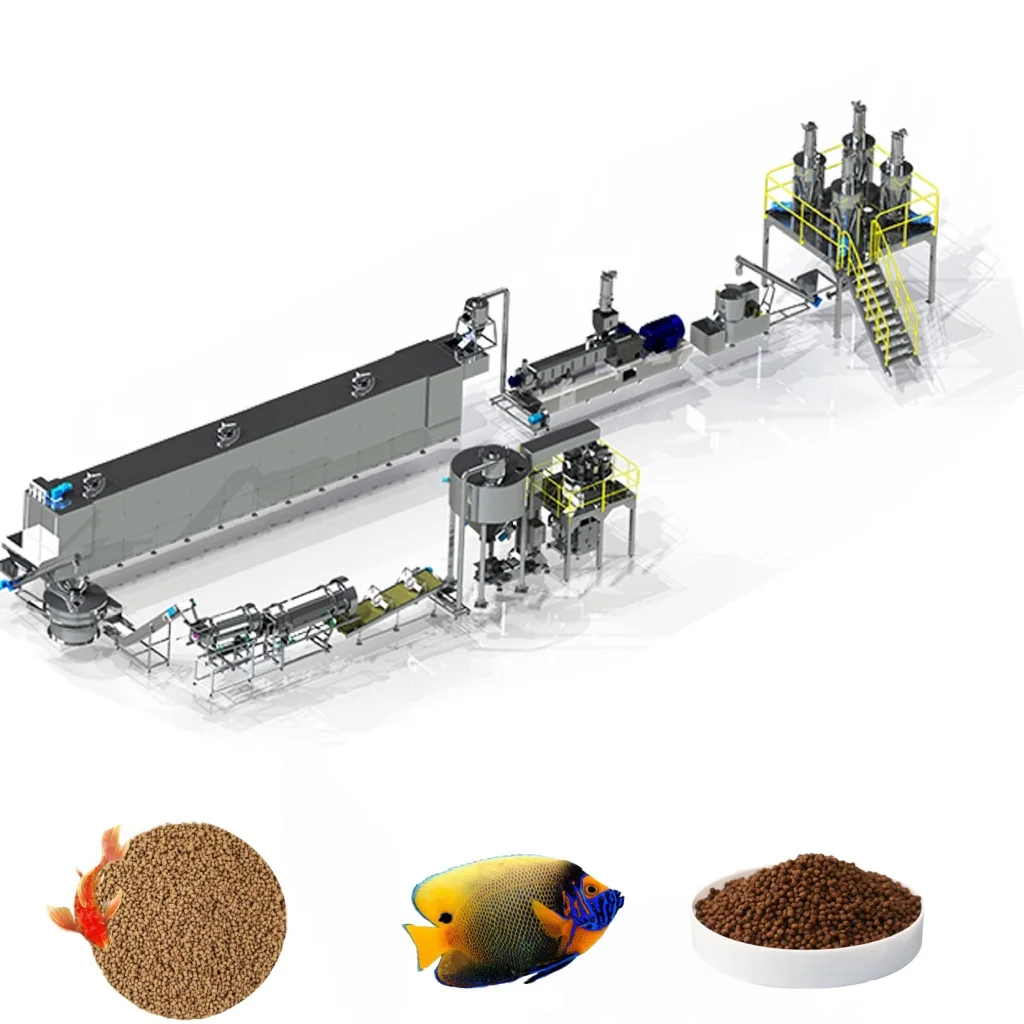
Throughput-Matched Stations — Every mixer, extruder, dryer and packer in this fish feed line is sized against the same formulation baseline, so no single unit chokes the output once real ingredients hit the hopper.
Technical Specifications
| Parameter | Value |
|---|---|
| Product Type | Fish Feed Extrusion Production Line |
| Automation Level | Full-Automatic Operation |
| Construction Material | Stainless Steel (food-grade contact points) |
| Control System | PLC and MCC control |
| Pellet Type Supported | Floating and Sinking Pellets |
| Voltage | 380V (frequency and phase to be confirmed for target market) |
| Line Configuration | Complete production line from batching to packing |
| Customization | Screw, die, and barrel profile adjustable per formulation |
| Energy Efficiency | Energy-saving drive design (basis to be confirmed) |
| Output Capacity | High capacity (basis not stated in source — confirm target pellet size, formulation and moisture) |
| Standards | CE, ISO |
Application Suitability
| Application | Material or Output |
|---|---|
| Floating aquaculture pellets | Catfish and tilapia feed from fish meal, soy, and starch binders |
| Sinking aquaculture pellets | Shrimp and bottom-feeder feed with higher protein and fat content |
| Cross-over evaluation | Pet food manufacturers assessing extruder compatibility for aquatic formats |
| Turnkey plant specification | Contractors comparing station throughput before locking in full line layout |
What "High Capacity" Leaves Out on a Fish Feed Production Line Full Equipment Range
Nominal throughput means nothing unless the dryer, cooler, and coater are sized to the same actual formulation.
I once watched a line quoted at impressive numbers stall at the dryer because the moisture load from a high-fresh-meat formulation was far beyond what standard corn-flour trials predicted. The extruder pushed product through fine, but wet pellets piled up ahead of the dryer, and the whole fish feed production line full equipment range backed up within an hour [NEED_CITE: moisture differential between trial and actual aquatic feed formulations]. Buyers who only compare extruder output without verifying downstream station capacity end up paying for a bottleneck they did not see coming.
Matching Every Station to the Real Formulation
A fish feed production line full equipment range only delivers rated throughput when each station — batching, extrusion, drying, coating, cooling, packing — is calculated against the same raw material profile. If the formulation uses high-moisture fresh fish or fat-rich binders, the dryer must handle a heavier evaporative load than a standard starch-based trial would indicate. We specify dryer bed length, airflow volume, and coating drum residence time based on the buyer’s actual ingredient list, not a generic reference recipe.
Screw and Die Configuration for Pellet Density Control
Floating and sinking pellets demand opposite expansion behaviors from the same extruder platform. Floating pellets require higher barrel temperature and specific screw shear to trap gas cells inside the kibble, while sinking pellets need denser compression and controlled moisture to collapse those same cells [NEED_CITE: twin-screw extrusion parameters for floating versus sinking aquatic feed]. Our screw element sequence and die orifice diameter are selected after reviewing the buyer’s target species and water-column behavior requirement, then recorded in the configuration document that ships with the line.
Reading the Spec Sheet Beyond the Headline Numbers
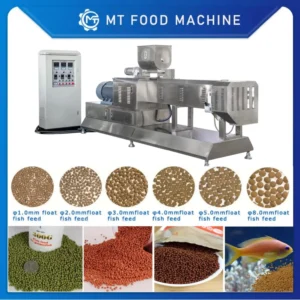
Stainless steel construction across food-grade contact points matters not just for hygiene audits but for corrosion resistance when fish meal and marine oils run through the barrel and die plate daily. The PLC and MCC control system allows operators to store and recall separate recipes for floating and sinking pellet runs, keeping barrel temperature zones and screw speed consistent across shifts. Voltage at 380V is common in many export markets, but frequency and phase must be confirmed before electrical panels are wired — a mismatch discovered after shipment delays commissioning by weeks. Customizable screw and die settings mean the same extruder platform can shift between a 2 mm shrimp pellet and an 8 mm catfish pellet by swapping die plates and adjusting the screw profile, rather than requiring a separate machine.
The Hidden Cost of Skipping Station-by-Station Verification
When a line is assembled from separate vendors without a single throughput calculation tying every station together, the extruder may outpace the cooler, leading to warm pellets entering the packing scale and causing weight drift. Undersized coating drums leave fat unevenly distributed, and some pellets fail palatability tests in the field [NEED_CITE: post-extrusion fat coating uniformity in aquaculture feed]. These problems rarely surface during factory acceptance trials running on clean, dry reference material — they appear weeks after commissioning, once real production ramps up.
Why Source the Full Equipment Range Here
Every station from batching to packing comes from one supplier, so throughput calculations are built on a single set of assumptions rather than patched together across vendors. Screw configuration and die design are matched to your specific raw material and target pellet, documented before production begins. Our in-house testing workshop runs trial batches on your actual ingredients before the line ships, so formulation issues surface in Jinan rather than on your factory floor. PLC and MCC panels are wired and labeled to your voltage, frequency, and control language before crating. Pre-sales consultation covers layout and utility planning, and on-site commissioning includes operator training on recipe changeover between floating and sinking pellet modes.
Documentation & Verification
- Line layout and capacity calculation showing throughput at every station from batching to packing
- Screw and die configuration record matched to your floating or sinking pellet target
- Electrical schematic confirming voltage, frequency, phase, and panel language
- Trial run report on your raw material performed in the testing workshop before dispatch
- CE declaration of conformity and ISO certificate for the complete line
- Operation and maintenance manual with wear parts list for extruder screws and dies
Installation, Commissioning & Support
- Foundation plan referencing the PLC cabinet footprint and extruder motor anchor points
- Dedicated power circuit sized for 380V supply with confirmed frequency and phase
- Modular station delivery allowing phased installation from batching through packing
- First-run parameter setting for barrel temperature zones and screw speed on your formulation
- Operator training on PLC recipe recall for switching between floating and sinking pellet modes
- Wear parts list covering screw elements, die plates, and dryer belt sections for initial stock
Before You Send the Inquiry
To size this fish feed production line full equipment range accurately, share your target pellet diameter, floating or sinking requirement, and the primary protein source in your formulation. Let us know your local voltage, frequency, and preferred control language so the electrical panels are built to match from the start. If you have existing upstream milling or downstream packing equipment, tell us the interface specifications so the new line integrates without flow gaps.
Frequently Asked Questions
Q: How is the output capacity verified, and what formulation is it based on?
A: Capacity is verified through a trial run in our testing workshop using the buyer’s actual raw material or a close proxy. The trial run report documents throughput at each station — extruder, dryer, cooler, and packer — against the specific moisture, protein, and fat content of the tested formulation, so the quoted number reflects real conditions rather than a generic starch benchmark.
Q: Which supporting stations are included, and how is throughput matched across them?
A: The line covers batching, mixing, extrusion, drying, coating, cooling, and packing. Each station is sized using a single capacity calculation tied to your formulation’s moisture load and pellet density target, so the dryer bed length, coating drum volume, and cooler conveyor speed all align with the extruder output rather than operating as independent selections.
Q: What voltage, frequency, and control language options are available?
A: Electrical panels are configured to the buyer’s local supply standard before shipment. We confirm voltage, frequency, and phase during the specification stage, and the PLC interface language is set to the operator’s preference. This prevents rewiring or reprogramming delays during on-site commissioning.
Q: How do screw and die configurations differ between floating and sinking pellets?
A: Floating pellets require a screw profile that generates higher shear and gas retention, paired with a die orifice that allows controlled expansion. Sinking pellets use a compression-heavy screw sequence and smaller die openings to produce denser, non-buoyant output. Both configurations are documented and can be swapped on the same extruder platform.
Q: Is a trial run on the buyer’s own raw material available before shipment?
A: Yes. Buyers can ship a representative sample of their raw material to our testing workshop. We run the sample through the configured extruder and record pellet density, expansion ratio, and moisture at the die face. The trial report ships with the line, giving your team a verified starting point for commissioning rather than an untested baseline.