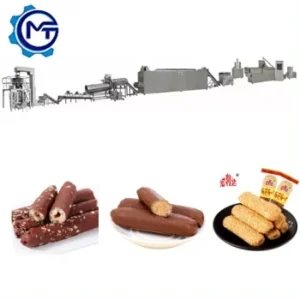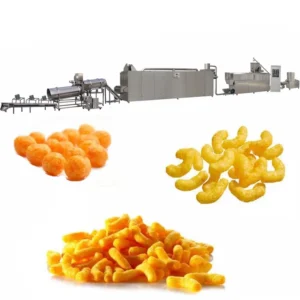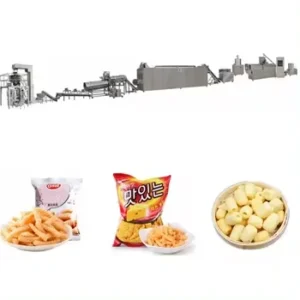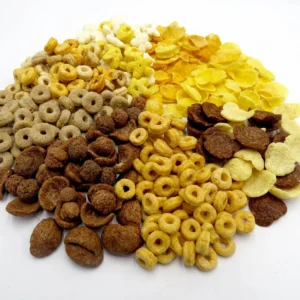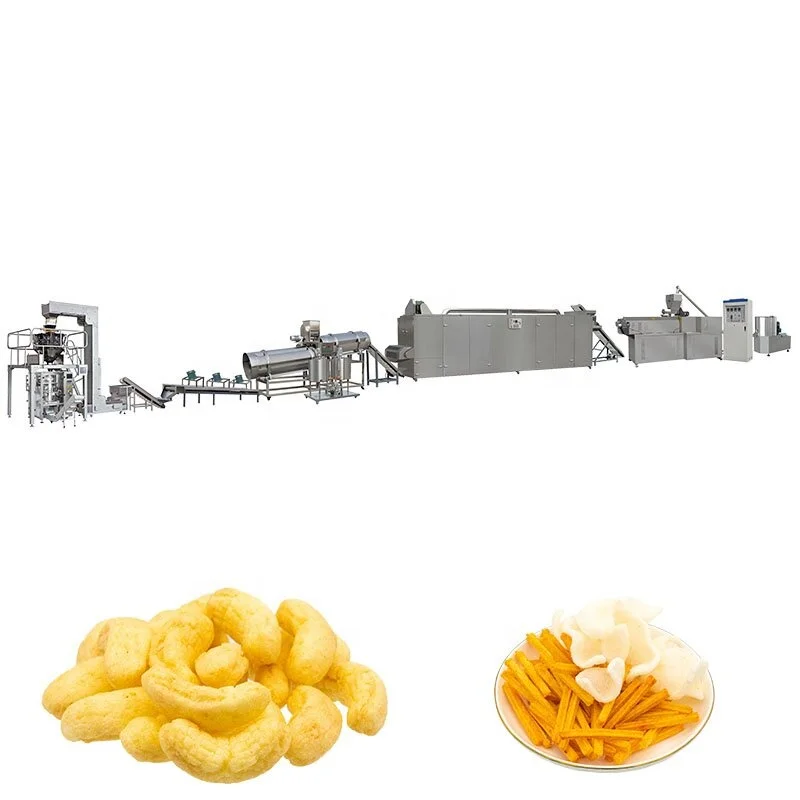
Throughput-Balanced Stations — A puffed snack extrusion line is only as productive as its slowest downstream station; we match the dryer length, flavoring drum cycle, and conveyor speed to the twin-screw extruder’s verified output on your specific grain blend.
Technical Specifications
| Parameter | Value |
|---|---|
| Product Type | Twin Screw Puffed Snack Food Extrusion Line |
| Extruder Type | Twin screw (double screw) |
| Line Automation | Fully automatic, one-pass operation from mixing to flavoring |
| Control System | PLC and MCC |
| Line Stations | Mixing & batching → Extruding → Shaping → Cutting → Drying → Flavoring |
| Dryer Type | Multi-layer mesh belt dryer (length and layer configured per product) |
| Flavoring System | Semi-automatic or automatic; handles sugar, oil, and powder seasoning |
| Screw Configuration | Matched to raw material and target product |
| Die Configuration | Customized to product shape and size |
| Output Capacity | Basis to be confirmed per raw material and product specification |
| Voltage & Frequency | Confirmed per buyer’s market before production |
| Certification | CE, ISO 9001 |
| Warranty | 24 months with lifetime service support |
| Assembly State | Complete integrated line |
| Documentation Language | Operation and maintenance manual in English |
Application Suitability
| Application | Material or Output |
|---|---|
| Puffed corn snack production | Corn grits, corn flour, maize-based blends |
| Puffed rice snack production | Rice flour, rice grits, mixed grain formulations |
| Core-filled and co-extruded snacks | Starch-based shell with cream, chocolate, or fruit filling |
| Artificial and fortified rice extrusion | Rice flour blends with added micronutrients |
| Fried snack pellet precursors | Potato starch, tapioca, wheat-based dough sheets |
| 2D and 3D pellet snack bases | Multi-grain starch blends for secondary frying or hot-air expansion |
Why Nominal Line Capacity Rarely Survives Contact With Your Raw Material
A rated throughput means nothing if the dryer cannot remove moisture fast enough to keep pace.
I have watched producers in Central America invest in a puffed snack food extrusion line manufacturer’s headline capacity number, only to find corn-based dough behaves differently at altitude, pulling extruder output down while the dryer runs at its original spec. The result is half-finished product accumulating between stations, operators manually clearing conveyors, and the whole line running at a fraction of what the brochure promised. The gap between a catalog number and real throughput on your flour blend is where most snack line projects quietly lose money [NEED_CITE: moisture migration rates in starch-based extrudates at varying altitudes].
How Screw Geometry Dictates Snack Texture Before the Die
The twin-screw extruder in this puffed snack food extrusion line is configured with screw elements selected for your raw material’s starch content, moisture level, and target expansion ratio. Forward-conveying elements dominate when you need gentle shear for a light, airy corn puff, while kneading blocks are introduced when processing higher-protein blends that require more mechanical energy input to achieve gelatinisation. The barrel temperature profile works in tandem with this screw arrangement — each heating zone is set to manage the dough’s viscosity as it moves toward the die plate.
Die Plate Design and the Shape Consistency Problem
Every die opening in this system is machined to produce a specific cross-section, whether you are running ring shapes, tubes, stars, or core-filled shells. The land length inside each die channel controls back-pressure, which directly governs how uniformly the product expands as it exits into atmospheric pressure. Inconsistent land lengths across a multi-hole die plate cause some holes to produce dense, under-expanded pieces while neighboring holes produce fragile, over-expanded ones. We specify die geometry after reviewing your target snack’s dimensional tolerance and crunch profile, not from a generic catalog [NEED_CITE: die land length effects on extrudate expansion uniformity].
Reading the Specs That Actually Matter for Snack Extrusion
The PLC and MCC control architecture governs every station from the batching mixer through the flavoring drum, which means a single operator interface manages screw speed, barrel zone temperatures, dryer belt speed, and seasoning drum rotation rate. This matters because puffed snack density is set by the interplay of extruder shear, die pressure, and dryer retention time — if these are adjusted independently across separate control panels, batch-to-batch drift becomes inevitable. The multi-layer mesh belt dryer is specified in length and layer count based on the moisture gradient your product requires; a corn puff exiting at higher moisture needs more belt travel than a thin rice crisp. Voltage and frequency are confirmed against your facility’s supply before the electrical panels are wired, avoiding the commissioning delays that arise when a 60 Hz motor is shipped to a 50 Hz market. The flavoring station is configurable between semi-automatic and fully automatic operation, with provisions for oil spraying, sugar coating, and dry powder dusting — the seasoning method is selected based on your product’s surface adhesion requirements and target shelf life.
The Downstream Bottleneck Nobody Quotes For
When a producer sources an extruder from one vendor and a dryer from another, the dryer vendor has no incentive to oversize their equipment for the extruder’s peak throughput. I have seen flavoring drums that cannot complete a coating cycle before the next batch arrives from the dryer, forcing operators to reduce extruder speed and accept the resulting output loss. The mismatch is invisible at the quotation stage because each machine, tested alone, meets its own nameplate rating [NEED_CITE: throughput balancing methodology in multi-station food processing lines].
Why Buyers Consolidate This Line Under One Equipment Supplier
Screw configuration and die design are specified against your raw material and target product format before production begins, rather than pulled from a generic build template. The in-house testing workshop runs your actual flour or grain blend through the extruder and downstream stations, generating a trial run report that documents real throughput and product quality before the line ships. Every station — mixer, extruder, dryer, flavoring drum — is throughput-matched by a single engineering team, eliminating the finger-pointing that occurs when mismatched standalone machines underperform. Electrical schematics, voltage, frequency, and control language are confirmed during the specification stage so that commissioning proceeds without on-site rewiring. Operator training covers the full line sequence from batching parameters through seasoning drum calibration, not just isolated machine functions.
Documentation & Verification
- Line layout showing throughput calculation matched across every station from mixer to packer
- Screw and die configuration record tied to your raw material and snack format
- Trial run report from testing workshop using your flour or grain blend
- Electrical schematic with voltage, frequency, and control language confirmed for your market
- CE declaration of conformity and ISO 9001 certificate
- Operation and maintenance manual with wear parts list
Installation, Commissioning & Support
- Foundation and floor space layout provided per the configured line footprint and station spacing
- Dedicated electrical circuits sized to the PLC and MCC panel load for each extruder and dryer motor
- Line arrives in modular assemblies requiring on-site mechanical joining and belt alignment
- First-run parameter setting covers screw speed, barrel zones, dryer temperature, and belt speed
- Operator training addresses batching ratios, die changeover, and flavoring drum adjustment
- Wear parts list covers screws, dies, and mesh belt sections with reorder intervals
What to Prepare Before Requesting a Quotation
Send your raw material specification — the grain type, particle size, moisture content, and any pre-blended additives — along with your target snack format, whether that is a solid corn puff, a core-filled shell, or a pellet for secondary frying. Confirm your facility’s voltage, frequency, and available floor space with ceiling height clearance for the dryer exhaust. If you are replacing or expanding an existing line, share the throughput of your current upstream and downstream equipment so the new puffed snack food extrusion line manufacturer can match station capacities accordingly.
Frequently Asked Questions
Q: How is line capacity verified against my actual raw material?
A: We run your specific flour or grain blend through the twin-screw extruder and downstream stations in our in-house testing workshop before shipment. The trial run generates a documented report covering achieved throughput, product density, moisture content after drying, and expansion ratio — so the capacity figure you receive is based on your material, not a generic benchmark.
Q: What screw and die configuration fits my target snack texture?
A: Screw element arrangement and die land geometry are selected after reviewing your raw material’s starch-to-protein ratio, desired expansion level, and final crunch profile. High-expansion corn puffs require different kneading block placement and die channel dimensions than dense, core-filled shells, and we document the chosen configuration for your records.
Q: Can the dryer and flavoring stations scale if I increase extruder throughput later?
A: The multi-layer mesh belt dryer is specified with additional length and layer capacity margins when your growth plan calls for a future extruder upgrade. The flavoring drum is likewise sized with headroom for higher product flow, avoiding the bottleneck that occurs when downstream stations are specified only for initial capacity.
Q: Do you conduct trial runs before shipment, and can I attend?
A: Yes, the in-house testing workshop runs your raw material through the complete line before dispatch. Buyers are welcome to witness the trial in person or review the recorded results, which include throughput data, product samples, and moisture readings at each station.
Q: What is the typical timeline from order to factory test and shipment?
A: Lead time depends on line configuration complexity and the level of customization in screw, die, and dryer specification. After order confirmation and voltage verification, production and factory testing follow, with typical multi-week lead times before the line is packed and released for shipment.