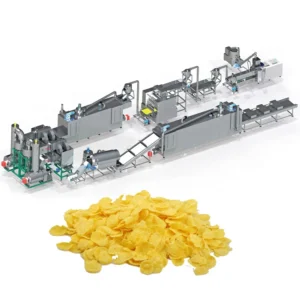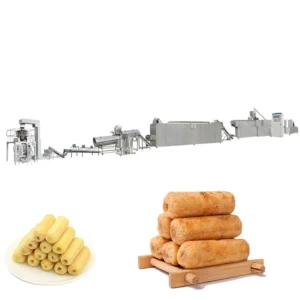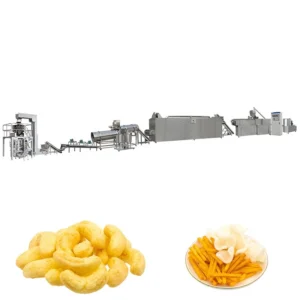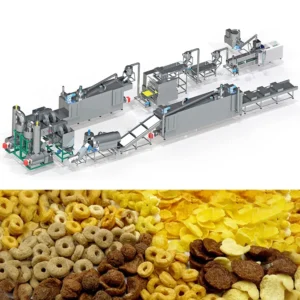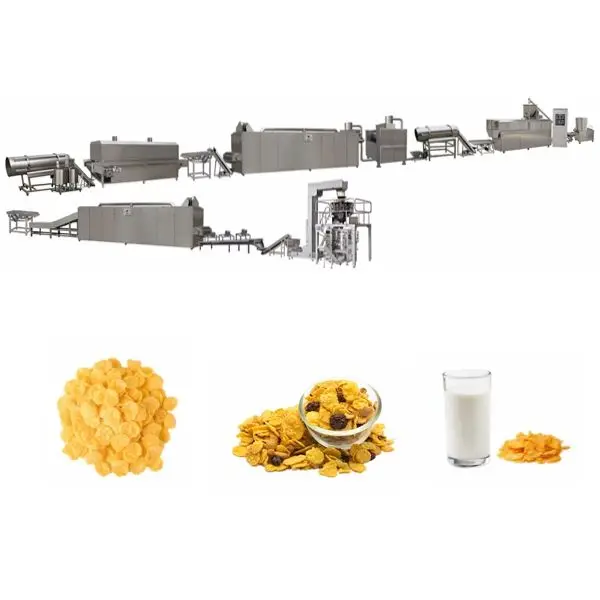
Complete Line Matching — Every station from the twin-screw extruder through the roaster and coater is sized against the actual output so no single unit becomes the bottleneck on your breakfast cereal corn flakes machine full equipment range.
Technical Specifications
| Parameter | Value |
|---|---|
| Product Type | Breakfast Cereal Corn Flake Production Line |
| Model Options | MT70 / MT85 / MT75 |
| Extruder Type | Twin Screw |
| Installed Power | 160 kW (MT70) / 190 kW (MT85) / 210 kW (MT75) |
| Power Consumption | 120 kW (MT70) / 140 kW (MT85) / 150 kW (MT75) |
| Capacity | 150–200 kg/h (MT70) / 300–400 kg/h (MT85) / 300–500 kg/h (MT75) (basis not stated in source) |
| Overall Dimensions | 41 × 1.5 × 2.2 m (MT70) / 43 × 1.5 × 3.2 m (MT85) / 45 × 1.5 × 3.5 m (MT75) |
| Screw Feature | Automatic lubricating, cooling function, wear-resistant material |
| Flaking Machine Control | PLC control, hydraulic double-roller system, dual independent motors, infrared sensor temperature control |
| Dryer Heating Source | Gas / Electric |
| Roasting Oven | Hot air roasting, vibrating pan, dual circulating fans, cyclone dust removal, conciliation burner |
| Coating System | Double tumble sugar melter, elevator, coating drum, spraying nozzle |
| Basic Raw Materials | Corn, rice, wheat, oat, barley powder |
| Certifications | CE, ISO |
Application Suitability
| Application | Material or Output |
|---|---|
| Natural corn flake production | Corn grits and corn flour blends |
| Sugar-coated breakfast cereal | Corn base with syrup or sugar glaze |
| Multi-grain cereal flakes | Rice, wheat, oat, and barley powder blends |
| Shaped snack cereal formats | Ball, tube, ring, fruit loop, star, wheel, flower, heart via die changes |
| Fortified breakfast cereal | Grain base with added nutritional premix |
Why Capacity Numbers Alone Will Mislead Your Line Design
The extruder output is only the starting point; every downstream station must be matched to the same throughput under your actual raw material conditions.
I have watched buyers compare breakfast cereal lines on extruder capacity alone, only to find the dryer or roaster cannot keep pace once production starts. A flaker that runs fine on standard corn grits may stall when the formula includes soy protein or extra fiber, and the roaster may need a longer dwell time that the original layout did not account for [NEED_CITE: raw material moisture and formula impact on extrusion throughput]. When you survey a breakfast cereal corn flakes machine full equipment range, the real question is whether each station — flaker, dryer, roaster, coater — was selected against the same basis.
Station-by-Station Flow for Corn Flake Production
The line follows a defined sequence: mixing, twin-screw extrusion, flaking, drying, hot air roasting, optional sugar coating, cooling, and packing. Each station in the breakfast cereal corn flakes machine full equipment range is specified so that material flows continuously without accumulation or starvation between units. The flaker uses a hydraulic double-roller system with independent motors, keeping roller gap and pressure consistent as extrudate arrives from the upstream twin-screw extruder.
Matching Dryer and Roaster Capacity to the Extruder
Drying removes surface moisture before the flakes enter the roasting oven, where hot air circulation and a vibrating pan create the characteristic surface blistering and crispness. If the dryer is undersized relative to the extruder, flakes arrive at the roaster with uneven moisture, leading to inconsistent color and texture. The roasting oven on this line includes dual circulating fans and a cyclone dust removal device, maintaining even heat distribution across the full pan width [NEED_CITE: hot air circulation uniformity in cereal roasting ovens].
Reading the Specification Sheet for Line Balance
The three extruder models — MT70, MT85, and MT75 — span different installed power and power consumption tiers, each paired with downstream equipment rated for the corresponding throughput band. Screw configuration uses wear-resistant material with automatic lubricating and cooling, which matters for maintaining barrel temperature profiles during extended runs on abrasive grain blends. The flaking machine’s infrared sensor temperature control monitors roller surface conditions, preventing sticking or tearing when processing higher-moisture doughs. Choosing between gas and electric dryer heating depends on local utility costs and available infrastructure, a decision that affects both operating expense and the physical layout of the drying section.
The Hidden Cost of an Undersized Coating Station
When the sugar coating drum cannot handle the volume coming off the roaster, flakes pile up in cooling conveyors, losing the temperature window where syrup adhesion is most effective. I have seen lines where the coating drum was specified for a lighter capacity, forcing operators to slow the entire line to match [NEED_CITE: sugar coating temperature window and adhesion quality]. The double tumble sugar melter and dedicated spraying nozzle on this line are sized to the selected extruder model, so the coating stage does not become the constraint during peak production.
Why Procurement from One Equipment Range Matters
Sourcing every station from a single equipment catalogue means throughput calculations are done against one set of assumptions rather than stitched together from separate vendor quotations. The screw and die configuration is specified to your raw material formula before the extruder ships, not guessed from a generic build. An in-house testing workshop runs your actual corn, rice, or multi-grain blend through the extruder and flaker before dispatch, catching density or texture issues early. Layout engineering accounts for your factory footprint, placing the roaster and coating drum where utility connections and material flow align. The PLC control on the flaking machinery integrates with the broader line control architecture, reducing commissioning time on site.
Documentation & Verification
- Line layout and capacity calculation showing throughput matching across extruder, flaker, dryer, and roaster
- Machine specification sheet for each station with electrical schematic and voltage confirmation
- Screw and die configuration record matched to your corn or multi-grain raw material formula
- Factory test record and trial run report on your actual raw material before shipment
- CE declaration of conformity and ISO certificate for the complete line
- Operation and maintenance manual covering every station from mixer to packing conveyor
Installation, Commissioning & Support
- Engineer-designed layout accounts for the 41–45 m line length and local utility routing
- Power supply planning covers 160–210 kW installed capacity with dedicated circuits per station
- Flaking machine PLC configured to local voltage and control language before dispatch
- On-site commissioning includes parameter calibration for your specific corn or grain blend
- Operator training covers screw wear inspection and hydraulic roller gap adjustment
- Wear parts list identifies screws, dies, and roller surfaces with recommended replacement intervals
What to Prepare Before Requesting a Quotation
Share your target raw material formula, including any soy protein, fiber, or fortification additions, along with the moisture content you plan to run. Confirm your local voltage and frequency, the control language your operators need, and the factory floor dimensions available for the line. If you are adding this breakfast cereal corn flakes machine full equipment range to an existing facility, note any upstream mixers or downstream packing machines that must integrate with the new stations.
Frequently Asked Questions
Q: How is each station’s capacity matched to the extruder output?
A: Each downstream unit — flaker, dryer, roaster, coater — is selected based on the throughput band of the chosen MT70, MT85, or MT75 extruder. Capacity calculations account for material dwell time at each stage so that no station accumulates backlog or forces the line to slow down during steady-state production.
Q: What supporting equipment is included in the full line?
A: The lineup covers mixing and batching, twin-screw extrusion, flaking, drying, hot air roasting, optional sugar coating with double tumble melter, cooling, and packing conveyors. Each station is specified and sourced as part of the same equipment range, with throughput matched across every section.
Q: Can the line layout fit my existing factory floor?
A: The layout is engineered to your factory dimensions, accounting for the 41–45 m overall line length and the ceiling height required by the roaster and dryer sections. Utility connection points for gas, electric, and compressed air are placed according to your existing infrastructure.
Q: What changes between the natural and sugar-coated corn flake flow?
A: The natural flow ends after roasting and cooling. The sugar-coated flow adds a coating stage with a double tumble sugar melter, elevator, coating drum, and spraying nozzle before the final cooling and packing stations, requiring additional floor space and thermal energy.
Q: Which extruder model fits a mid-range production target?
A: The MT85 sits in the middle of the range with 190 kW installed power and is paired with a flaker, dryer, and roaster sized for its throughput band. The final model selection depends on your raw material formula and the specific flake density your market requires.