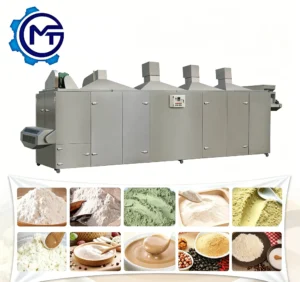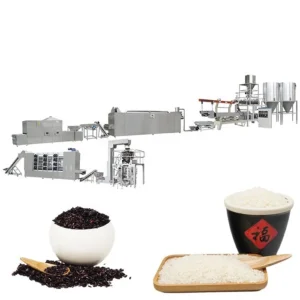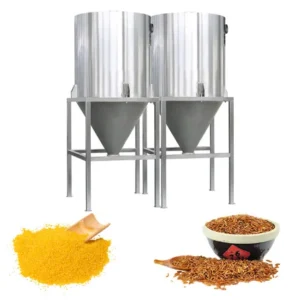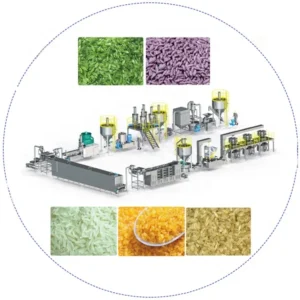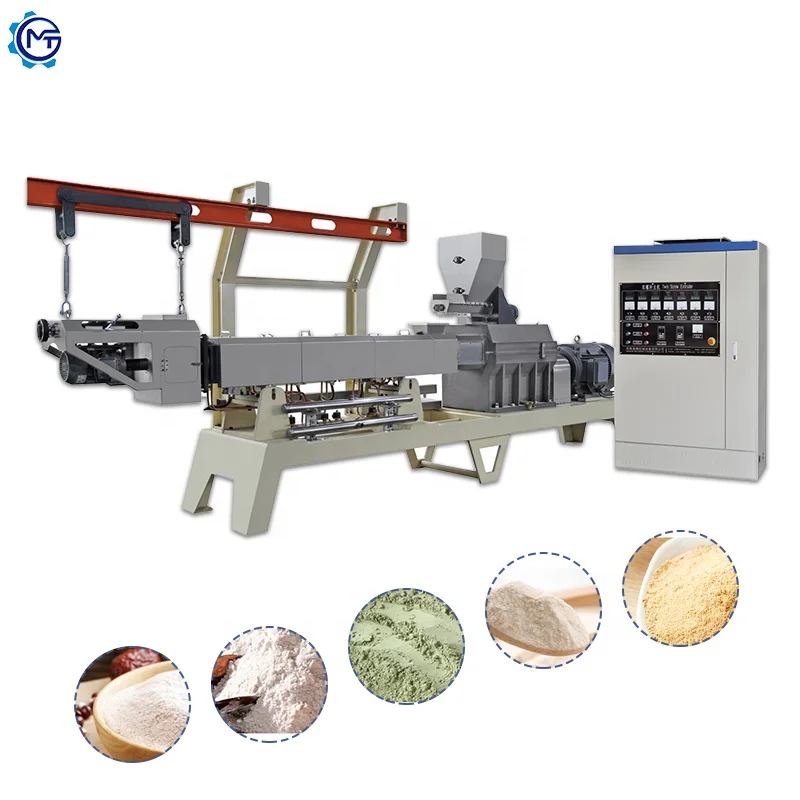
Screw & Die Configuration — matched to your specific raw material blend and target powder density to ensure correct expansion across the full Instant Baby Food Porridge Production Line full equipment range.
Technical Specifications
| Parameter | Value |
|---|---|
| Product Type | Instant Baby Food Porridge Production Line |
| Model Options | MT-65 / MT-70 / MT-85 |
| Screw Type | Twin-screw |
| Installed Power | MT-65: 81.5 kW / MT-70: 115 kW / MT-85: 181 kW |
| Actual Consumed Power | MT-65: 53 kW / MT-70: 76 kW / MT-85: 117 kW |
| Output Capacity | MT-65: 100–150 kg/h (basis not stated in source) / MT-70: 200–240 kg/h (basis not stated in source) / MT-85: 400–500 kg/h (basis not stated in source) |
| Overall Dimensions (L×W×H) | MT-65: 21000 × 1200 × 2200 mm / MT-70: 23000 × 1500 × 2200 mm / MT-85: 28000 × 3500 × 4300 mm |
| Control System | Automated PLC / MCC |
| Line Stations | Mixing → Crushing → Extrusion → Drying → Cooling → Secondary Crushing → Secondary Mixing → Packaging → Warehousing |
| Standards | CE |
Application Suitability
| Application | Material or Output |
|---|---|
| Infant Nutrition Powder | Corn, rice, millet, oats, milk powder, vitamin C blends for cerelac-type porridge |
| Health Care Nutrition Powder | Highland barley, Coix seed, yam, konjac supplemented with peanut and black sesame |
| Grain Expanded Powder | Corn, wheat, and rice processed as auxiliary thickener for food and beverage industries |
| Edible Fungus Solid Beverage | Hericium erinaceus and similar functional mushroom powders |
Why an Extruder’s Nameplate Capacity Is Only Half the Story
The actual throughput of an Instant Baby Food Porridge Production Line full equipment range depends entirely on what happens after the die plate.
Buyers frequently quote a standalone extrusion machine based on its motor power or screw diameter, only to find the downstream dryer cannot keep pace. In one Middle East installation I oversaw, a client purchased a high-fat infant formula extruder without sizing the drying beds to the specific moisture load; the resulting bottleneck forced them to discard tons of out-of-spec powder before we recalculated the thermal balance. Matching throughput across every connected station is the only way to guarantee the nameplate figure [NEED_CITE: material throughput calculation in food extrusion lines].
Mapping the Seven-Station Process Flow
This Instant Baby Food Porridge Production Line full equipment range moves material through seven distinct stations, from the initial batching mixer to the final secondary mixing drum before packaging. Each station must be sized so that the residence time in the dryer, the cooling conveyor length, and the secondary crusher capacity all align with the extruder’s output, preventing buffer silos from overflowing or starving the next stage.
Thermal Balance and Moisture Removal
The drying stage is where most nutritional powder lines fail. High-fat blends like those containing milk powder or black sesame require longer dwell times and precise temperature zoning to drive off moisture without scorching the delicate vitamins. I have seen lines where the dryer was specified generically for starch, resulting in a final powder moisture content that caused caking in the packaging stage, a failure that only became apparent weeks after commissioning [NEED_CITE: drying requirements for high-fat nutritional powders].
Reading the Power and Capacity Data
The actual consumed power versus installed power figures reveal the true mechanical load during extrusion. The MT-85, for example, has an installed power of 181 kW but draws 117 kW in typical operation, indicating the motor sizing accounts for the high torque needed to shear dense grain blends. Capacity figures are listed for each model but require confirmation based on your specific raw material formulation and target moisture content, as a high-fiber mix will behave very differently from pure rice flour inside the barrel.
The Cost of Mismatched Downstream Equipment
If the cooling conveyor is too short for the ambient humidity of your facility, the powder will reabsorb moisture before it reaches the secondary crusher, leading to inconsistent particle size. I recall a project where the client ignored the site-specific humidity data, and the resulting condensation in the cooling stage ruined the flowability of the cerelac powder, requiring a complete retrofit of the climate control system. These hidden costs far outweigh the initial savings of buying undersized auxiliary stations [NEED_CITE: impact of ambient humidity on extruded powder quality].
Why Sourcing the Full Line Matters Here
Every station in this Instant Baby Food Porridge Production Line full equipment range is specified as a single package, meaning the mixer batch size, extruder screw speed, and dryer belt width are calculated together. We provide a screw and die configuration record matched to your raw material, rather than a generic build. Our in-house testing workshop runs trial batches on your actual formulation before shipment, validating the expansion and density. The line layout and capacity calculation document ensures utility planning and phased installation proceed without spatial or electrical conflicts.
Documentation & Verification
- Line layout and capacity calculation showing matched throughput across all seven stations
- Machine specification sheet detailing screw configuration and die design for your raw material
- Trial run report on your specific nutritional powder blend conducted before dispatch
- Electrical schematic with voltage and frequency confirmation for your target market
- Factory test record documenting dimensional checks and control system validation
Installation, Commissioning & Support
- Foundation planning based on the MT-85 footprint of 28000 × 3500 × 4300 mm
- Dedicated circuit sizing for the MT-70 actual consumed load of 76 kW
- Assembly and alignment of the twin-screw extruder barrel and die plate on-site
- First-run parameter setting for barrel temperature profile and screw speed
- Operator training covering PLC interface navigation and emergency stop protocols
- Wear parts list specifying replacement intervals for screws, dies, and mixer blades
What We Need to Specify Your Line
To configure this Instant Baby Food Porridge Production Line full equipment range accurately, please provide the exact formulation of your nutritional powder, including fat and fiber percentages. We also need your target daily output, the available floor space and ceiling height in your facility, and your local voltage and frequency standards to finalize the electrical schematics.
Frequently Asked Questions
Q: How do I select the right extruder model based on my capacity target?
A: Selection depends on your raw material characteristics as much as the target kg/h. The MT-65, MT-70, and MT-85 cover different volume ranges, but a high-fat infant formula blend may require a larger model than a pure corn starch product to achieve the same throughput without overloading the screw. We calculate the exact match after reviewing your formulation.
Q: What supporting stations are included and how is throughput matched?
A: The line includes mixing, crushing, extrusion, drying, cooling, secondary crushing, secondary mixing, and packaging. We match throughput by calculating the material residence time and volume at each station, ensuring the dryer belt speed and cooling conveyor length are precisely sized to the extruder’s output so no single station becomes a bottleneck.
Q: Can you confirm voltage, frequency, and control language before shipment?
A: Yes, the electrical schematic and voltage confirmation are finalized during the engineering phase. We configure the PLC and MCC control system to your local power grid standards and set the operator interface language to your preference, preventing delays during on-site commissioning and ensuring your team can operate the line immediately.
Q: Is a trial run performed on my specific raw material before dispatch?
A: We conduct trial runs in our in-house testing workshop using your actual raw material blend. This allows us to validate the screw configuration, die design, and drying parameters against your target powder density and moisture content, generating a trial run report that confirms the line will perform as expected before it leaves our factory.
Q: How are spare wear parts managed for this line?
A: We provide a detailed wear parts list with the initial documentation, specifying items like screws, dies, and mixer blades. Because the screw and die configuration is custom-recorded for your product, we maintain those specifications on file to ensure exact replacements are available when your first scheduled changeover is due, minimizing unplanned downtime.