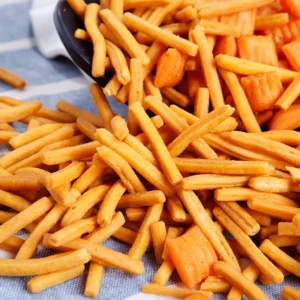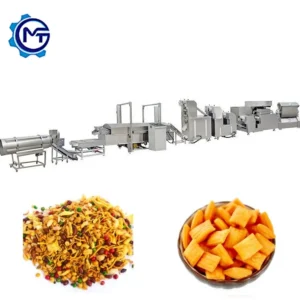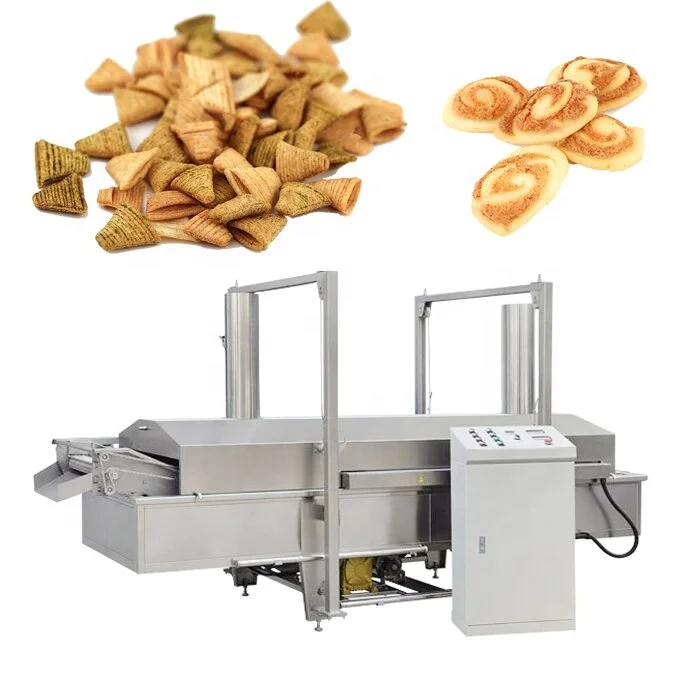
Throughput-Matched Station Sizing — every mixer, extruder, fryer and flavoring drum in this line is specified to the same output range so no single station chokes production.
Technical Specifications
| Parameter | Value |
|---|---|
| Product Type | Continuous Fryer |
| Available Models | MT65, MT70, MT85, MT75, MT95 |
| Installed Power | 142 kW (MT65); 185 kW (MT70); 240 kW (MT85); 245 kW (MT75); 370 kW (MT95) |
| Actual Power Consumption | 100 kW (MT65); 130 kW (MT70); 180 kW (MT85); 185 kW (MT75); 280 kW (MT95) |
| Output Capacity | 120–150 kg/h (MT65); 200–250 kg/h (MT70); 300–500 kg/h (MT85); 400–500 kg/h (MT75); 800–1000 kg/h (MT95) (basis not stated in source — confirm product type, moisture, raw material) |
| Overall Line Dimensions (L×W×H) | 22,000×1,200×2,200 mm (MT65) to 30,000×1,500×2,800 mm (MT95) |
| Frying Temperature Range | 0–260 °C |
| Fryer Unit Dimensions | 4,500×1,350×2,350 mm |
| Fryer Capacity | 200–300 kg/h (basis not stated in source — confirm product type, moisture) |
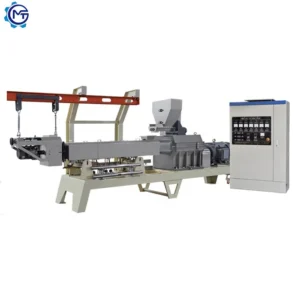
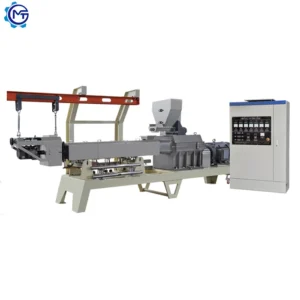
| Twin-Screw Extruder Output | 200–250 kg/h (basis not stated in source — confirm raw material, moisture) |
| Extruder Main Motor Power | 30 kW |
| Extruder Installed / Actual Power | 45.87 kW installed; 30–35 kW actual |
| Extruder Dimensions | 2,800×830×1,875 mm |
| Screw Type | Twin-screw |
| Flavor Line Output | 400 kg/h (basis not stated in source — confirm product type, seasoning load) |
| Flavor Line Power / Dimensions | 1.5 kW; 3,000×1,650×1,800 mm |
| Powder Mixer Output | 300–600 kg/h (basis not stated in source — confirm raw material, moisture) |
| Powder Mixer Tank Volume / Speed | 150 kg; 385 rpm; 10 min per batch |
| Powder Mixer Power / Dimensions | 4 kW; 1,000×630×1,100 mm |
| Construction Material | Stainless steel food-grade contact parts |
| Standards | CE, ISO |
| Warranty | 1 year with lifetime maintenance service |
Application Suitability
| Application | Material or Output |
|---|---|
| Triangle crisps and tortilla chip lines | Corn masa, wheat flour, rice flour blends extruded then fried |
| Bugles and horn-shaped fried snacks | Corn grits or corn-soy blends requiring twin-screw gelatinisation before frying |
| Rice crust and puffed rice crackers | Rice flour and starch blends needing controlled expansion through the fryer |
| Novelty-shaped snacks (small fish, gourd, golden corners) | Composite cereal doughs shaped at the die and set by continuous frying at 0–260 °C |
| Small-to-medium fried snack manufacturers | Production targets from 120 kg/h entry lines up to 1,000 kg/h scaled operations |
Why Quoted Line Capacity Rarely Survives First Contact With Your Raw Material
A frying chips making machine line only holds its nameplate throughput when every station is matched to the actual product, not the catalogue product.
I have seen buyers sign off on an extruder rated for a comfortable daily output, then watch the continuous fryer fall behind because the product entering the oil carries a different moisture level than the one used for the original quote. The chips emerge under-coloured or over-darkened, the seasoning drum piles up, and the whole afternoon is spent chasing a bottleneck that was baked into the line specification. When a frying chips making machine full equipment range is assembled from separate vendors, each supplier guarantees their own station — nobody guarantees the gap between them [NEED_CITE: throughput matching methodology across multi-vendor snack lines].
Every Station on the Floor — No Hidden Gaps
This catalogue lays out the complete frying chips making machine sequence from powder mixer through twin-screw extruder, continuous fryer, and flavoring drum so you can cross-check capacity before a single purchase order is issued. Each station carries its own installed power, actual consumption, and physical footprint, letting you verify that floor space, electrical panels, and extraction ducts will accommodate the full layout without field improvisation.
Matching Oil Residence Time to Snack Geometry
The continuous fryer spans a 0–260 °C range, which covers the thermal window for corn-based tortilla chips, wheat-based triangle crisps, and rice-based crust snacks. Residence time inside the fryer is governed by belt speed and oil volume; a thicker corn chip demands a longer fry at moderate temperature, while a thin rice crust requires a shorter pass at higher heat. Selecting the correct fryer capacity tier relative to the extruder die output ensures the product exits with the colour and moisture the market expects [NEED_CITE: frying temperature profiles for extruded cereal snacks].
Reading the Power and Dimension Data Before You Commit
Installed power figures across the line — from the 4 kW powder mixer to the 370 kW MT95 full line — tell you the transformer and bus-bar sizing you need before the machines arrive. Actual power consumption runs lower because heaters cycle and motors rarely draw peak current continuously, but electrical planning must account for the installed figure. Line length stretches from 22 metres for the MT65 layout to 30 metres for the MT95, which affects building column spacing, utility trench routing, and the position of the packing station downstream. The twin-screw extruder alone occupies 2,800×830×1,875 mm and draws 30 kW on its main motor, meaning screw changes and barrel maintenance need clear access on three sides.
When Stations Are Sized Independently
An extruder pushing product faster than the fryer belt can carry it forces operators to throttle the screw speed, which changes shear, gelatinisation, and ultimately snack texture — the very parameters you chose the twin-screw configuration to control. Downstream, an undersized flavoring drum creates a pile-up of hot, oily product that cools unevenly and absorbs seasoning inconsistently. These mismatches surface only after installation, when re-engineering the line means new conveyors, re-wired panels, and lost production weeks [NEED_CITE: snack line bottleneck case studies from extrusion to packing].
What You Receive Beyond the Hardware
Every line ships with a capacity calculation showing throughput matching across the mixer, extruder, fryer, and flavoring stations so you can see the numbers before the machines are built. Screw configuration and die design are recorded against your raw material and target shape, not pulled from a generic build library. An in-house testing workshop runs your actual flour or grits through the extruder and fryer before dispatch, producing a trial report that confirms colour, expansion, and oil uptake. Electrical schematics arrive with voltage and frequency locked to your facility standard, and the control language is confirmed before the panels are wired — not after they land on your floor.
Documentation & Verification
- Line layout and capacity calculation matched to your extruder-fryer throughput targets
- Machine specification sheet listing installed and actual power for every station
- Screw and die configuration record tied to your raw material and snack geometry
- Electrical schematic with voltage, frequency, and control language confirmed pre-production
- Trial run report from the testing workshop on your flour, grits, or masa blend
- Factory test record and packing photographs before crate closure
Installation, Commissioning & Support
- Foundation and floor-loading plan based on the 22–30 m line length and individual station weights
- Dedicated electrical circuit sizing using the installed power figure up to 370 kW for the MT95
- Modular station delivery allowing phased uncrating where access door width is limited
- First-run parameter logging for fryer belt speed, oil temperature, and extruder screw RPM
- Operator training covering twin-screw changeover, fryer oil filtration, and flavoring drum adjustment
- Wear parts list specifying screws, dies, and fryer belt sections included with initial shipment
What to Prepare Before Requesting a Quote
Share the raw material composition you plan to run — corn masa, rice flour blend, or composite cereal dough — along with the target snack shape and finished moisture level. Provide your facility voltage, phase, and frequency, plus the available floor length and ceiling height so the line layout can be drafted without assumptions. If you already operate upstream batching or downstream packing equipment, send the interface dimensions and throughput so the new frying chips making machine stations can be matched to them.
Frequently Asked Questions
Q: How do I match fryer capacity to extruder output so the line does not bottleneck at the frying station?
A: We start with your target product weight and moisture loss during frying, then calculate the oil residence time needed. The fryer belt speed and extruder screw RPM are set so product enters the oil at the same rate it exits. A capacity calculation document shows both values side by side before you approve the layout.
Q: What voltage, frequency, and control language options are confirmed before the machines enter production?
A: During the specification stage we record your site voltage, phase, and frequency, then confirm the control panel language. These details are locked on the electrical schematic before any panel is wired, preventing commissioning delays caused by mismatched transformers or untranslated HMI screens.
Q: Which screw configuration and die design are recommended for my specific raw material and target snack shape?
A: The twin-screw elements and die geometry are selected after reviewing your raw material data sheet and the cross-section of the target snack. A configuration record is issued with the quotation so you can see the element arrangement and die orifice pattern before production begins.
Q: Can a trial run be performed on my raw material in the testing workshop before shipment?
A: Yes. You can send a sample batch of your flour, grits, or masa blend to the in-house testing workshop. The extruder and fryer are set to the proposed production parameters, and a trial report documenting expansion, colour, oil uptake, and texture is provided before the line is crated.
Q: What spare wear parts are included with the first shipment, and how are replacements sourced later?
A: The initial shipment includes a documented wear parts list covering screws, die plates, and fryer belt sections. Replacement part numbers are cross-referenced on the list so you can reorder directly or source locally using the same specifications when the first change-out is due.