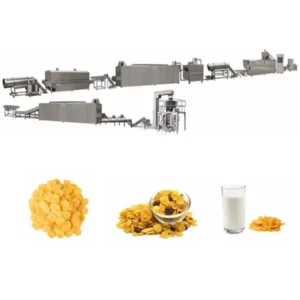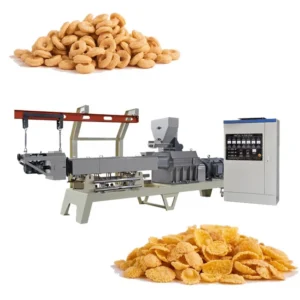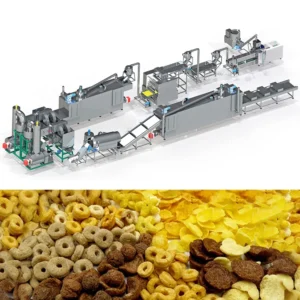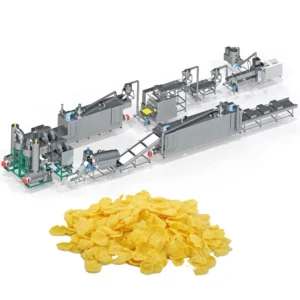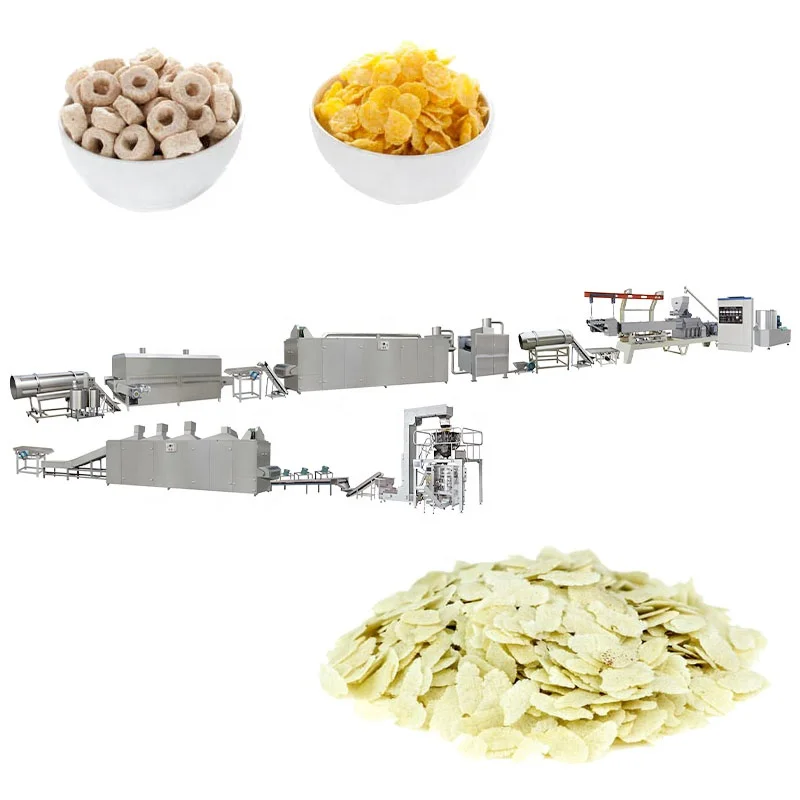
Line-Wide Throughput Matching — Every station from the twin-screw extruder to the sugar coating drum is sized to the same output band, so no single unit caps the line below its nameplate rating.
Technical Specifications
| Parameter | Value |
|---|---|
| Model | MT70 / MT85 / MT75 |
| Product Type | Corn Flakes Breakfast Cereal Production Line |
| Extruder Type | Twin Screw |
| Installed Power | MT70 — 160 kW; MT85 — 190 kW; MT75 — 210 kW |
| Power Consumption | MT70 — 120 kW; MT85 — 140 kW; MT75 — 150 kW |
| Output Capacity | MT70 — 150–200 kg/h (basis to be confirmed); MT85 — 300–400 kg/h (basis to be confirmed); MT75 — 300–500 kg/h (basis to be confirmed) |
| Overall Dimensions (L×W×H) | MT70 — 41 × 1.5 × 2.2 m; MT85 — 43 × 1.5 × 3.2 m; MT75 — 45 × 1.5 × 3.5 m |
| Screw Feature | Automatic lubricating and cooling; wear-resistant screw material |
| Flaking Machine Control | PLC with hydraulic double-roller system, separate dual-motor drive, infrared sensor temperature control |
| Dryer Heating Source | Gas or Electric (configurable) |
| Roasting Oven | Hot air roasting, vibrating pan, dual circulating fans, cyclone dust removal, precise temperature control |
| Coating System | Double tumble sugar melting, elevator, coating drum, spraying nozzle |
| Raw Materials | Corn, rice, wheat, oat, barley powder |
| Final Products | Natural corn flakes, sugar-coated corn flakes, shaped cereals (ball, tube, stick, ring, fruit loop, star, wheel, flower, heart) |
| Production Flow (Natural) | Mixing → Extruding → Flaking → Drying → Hot Air Roasting → Cooling → Packing |
| Production Flow (Sugar-Coated) | Mixing → Extruding → Flaking → Drying → Hot Air Roasting → Sugar Spraying → Sugar Coating → Drying → Cooling → Packing |
| Assembly State | Complete line |
Application Suitability
| Application | Material or Output |
|---|---|
| Natural corn flakes manufacturing | Corn grits and corn flour blends |
| Sugar-coated corn flakes production | Corn base with sugar syrup coating |
| Multigrain breakfast cereals | Rice, wheat, oat, and barley powder blends |
| Shaped cereal snacks | Die-swapped extrusion for ball, tube, ring, star, fruit loop, and heart forms |
| Fortified breakfast cereal lines | Grain powder with added vitamin and mineral premix |
What "Rated Capacity" Leaves Out About Breakfast Cereal Lines
A line quoted at a single output number often hides mismatched stations that quietly throttle real throughput.
I once watched a corn flakes line stall because the dryer could not keep pace with the extruder — the extruder was pushing product at a rate the dryer simply could not handle, and flakes piled up sticky and clumped on the conveyor. The buyer had compared quoted capacities across vendors without asking whether every downstream station was sized to the same figure. That mismatch cost weeks of re-engineering after installation. When evaluating a breakfast cereal corn flakes machine full equipment range, the question is not just what the extruder can produce but whether the flaking rolls, dryer belt length, roasting oven volume, and coating drum all sustain the same throughput without creating a bottleneck [NEED_CITE: throughput matching principles in multi-stage food processing lines].
How Each Station in the Range Connects
The breakfast cereal corn flakes machine full equipment range begins with a mixing and batching station that feeds the twin-screw extruder at a controlled rate. The extruder cooks and shapes the dough under barrel temperature zones and screw shear, delivering a continuous strand to the flaking machine. The flaking station uses PLC-controlled hydraulic pressure on its double rollers to press each pellet into a uniform flake thickness, while infrared sensors monitor roller surface temperature to prevent sticking or tearing.
From flaking, the product enters the dryer where moisture is reduced to a level that prevents flakes from adhering during the next stage. The hot air roasting oven then uses dual circulating fans and high-temperature spraying tubes to create the characteristic surface blister and crisp snap that defines a quality corn flake. A cyclone dust removal device pulls fines from the roasting chamber so they do not settle back onto the product or foul the heat exchangers.
Why the Full Equipment Range Matters for Cereal Producers
Buying an extruder from one vendor, a dryer from another, and a coating drum from a third introduces interfaces that nobody guarantees. Belt widths may not align, transfer chutes may need field fabrication, and control signals between PLC systems from different manufacturers often require a third-party integrator. With the complete breakfast cereal corn flakes machine full equipment range under one supplier, conveyor heights, transfer angles, and control architecture are designed as a single system [NEED_CITE: integration challenges in multi-vendor food processing lines]. The sugar coating path adds a double-tumble melting unit, an elevator, and a spraying nozzle array to the same core line, so producers switching between natural and coated flakes do not need separate production halls.
Reading the Specs: Extruder Models and What They Mean for Output
The three extruder models — MT70, MT85, and MT75 — occupy distinct power and capacity bands. Installed power ranges from 160 kW on the MT70 to 210 kW on the MT75, with corresponding power consumption figures of 120 kW and 150 kW. The twin-screw design allows the barrel to handle high-moisture grain doughs that would stall a single-screw configuration, and the automatic lubricating and cooling function inside the screw assembly reduces heat buildup during long production runs. Wear-resistant screw material extends the interval between screw element replacements, which matters because worn screws gradually lose the shear profile needed for consistent starch gelatinisation. The flaking machine’s separate dual-motor drive lets each roller be adjusted independently, maintaining even pressure across the full roller width — a detail that directly affects whether flakes emerge with uniform thickness or crack at the edges.
The Cost of Skipping the Dryer Capacity Check
When a dryer is undersized relative to the extruder output, flakes exit with too much residual moisture and enter the roasting oven in a condition that prevents proper blistering. The oven then runs longer cycles to compensate, which slows the entire line and increases energy consumption per kilogram of finished product. I have seen producers blame the roasting oven for poor flake texture when the real problem was upstream — the dryer belt was simply too short for the volume passing through it. Confirming that each station in the breakfast cereal corn flakes machine full equipment range is matched to the extruder model you select avoids this kind of misdiagnosis [NEED_CITE: moisture management in cereal flake drying and roasting].
What the Equipment Range Covers Under One Roof
The line starts at the batching and mixing station and runs through extrusion, flaking, drying, roasting, cooling, and packing as a coordinated sequence. Screw configuration and die design are specified to the buyer’s raw material blend and target flake size, rather than copied from a generic build. An in-house testing workshop runs the buyer’s actual grain formulation before shipment, so extrusion parameters are established before the line arrives on site. The hot air roasting oven includes a vibrating pan and conciliation burner with precise temperature control, producing the surface blister that consumers associate with premium corn flakes. Both natural and sugar-coated flows share the same core stations, with the coating system added downstream only when needed.
Documentation & Verification
- Line layout showing throughput matching across extruder, flaker, dryer, and roaster
- Screw and die configuration record matched to your grain formulation
- Electrical schematic with voltage, frequency, and control language confirmed before production
- Trial run report on your raw material from the in-house testing workshop
- Factory test record documenting run parameters before dispatch
- Packing photographs and customs documentation support for export shipment
Installation, Commissioning & Support
- Foundation plan accounts for the MT75 line length of 45 m and 3.5 m headroom requirement
- Dedicated power circuit sized to the selected model’s installed power, up to 210 kW
- Stations ship modular for on-site assembly and belt-to-belt alignment
- First-run parameter setting covers barrel temperature zones, roller pressure, and oven airflow
- Operator training includes PLC interface navigation and hydraulic flaking adjustment
- Wear parts list covers screw elements, die plates, and roller surfaces with reorder codes
Starting the Specification Conversation
Before requesting a quotation, gather your primary grain formulation and any secondary ingredients such as vitamin premix or sweetener ratios. Confirm the daily output target and the number of production shifts you plan to run, as these determine which extruder model and downstream station sizes fit. Share your facility’s voltage and frequency standard along with the preferred control language for the PLC interface, so the electrical schematic can be finalized before fabrication begins.
Frequently Asked Questions
Q: How is each station sized to prevent bottlenecks across the line?
A: The extruder output band determines the flaking machine roller width, dryer belt length, and roasting oven volume. Each downstream station is selected so its maximum throughput meets or exceeds the extruder’s rated capacity for the chosen model, preventing any single unit from capping the line below its nameplate figure.
Q: What equipment changes between natural and sugar-coated corn flakes?
A: The core stations — mixing, extruding, flaking, drying, and roasting — remain identical. Sugar-coated production adds a double-tumble sugar melting unit, an elevator, a coating drum with spraying nozzles, and a secondary drying stage before cooling and packing.
Q: Which voltage and control language options are available?
A: Voltage and frequency are configured to match the buyer’s local supply standard, documented in the electrical schematic before production. The PLC control language is set to the operator’s preferred language so that alarm messages and parameter screens are readable from day one.
Q: What supporting equipment is included versus optional?
A: The standard range covers mixing, extrusion, flaking, drying, roasting, and cooling conveyors. The sugar coating system, packing station, and specific dust collection configurations are specified based on the buyer’s product mix and local emission requirements.
Q: Can one extruder produce multiple cereal shapes?
A: Yes. Die and mould changes on the twin-screw extruder allow production of balls, tubes, sticks, rings, fruit loops, stars, wheels, flowers, and hearts from the same base unit, with the changeover procedure covered during operator training.