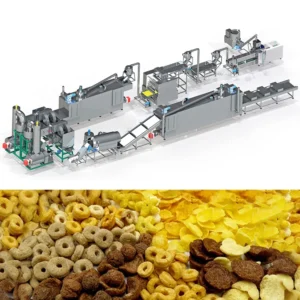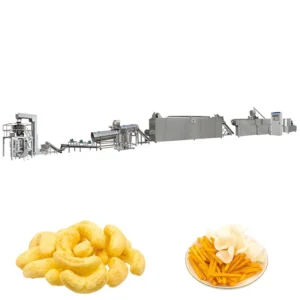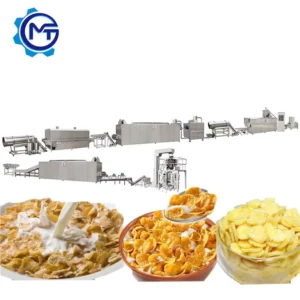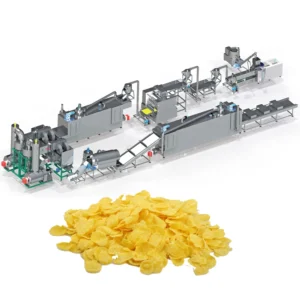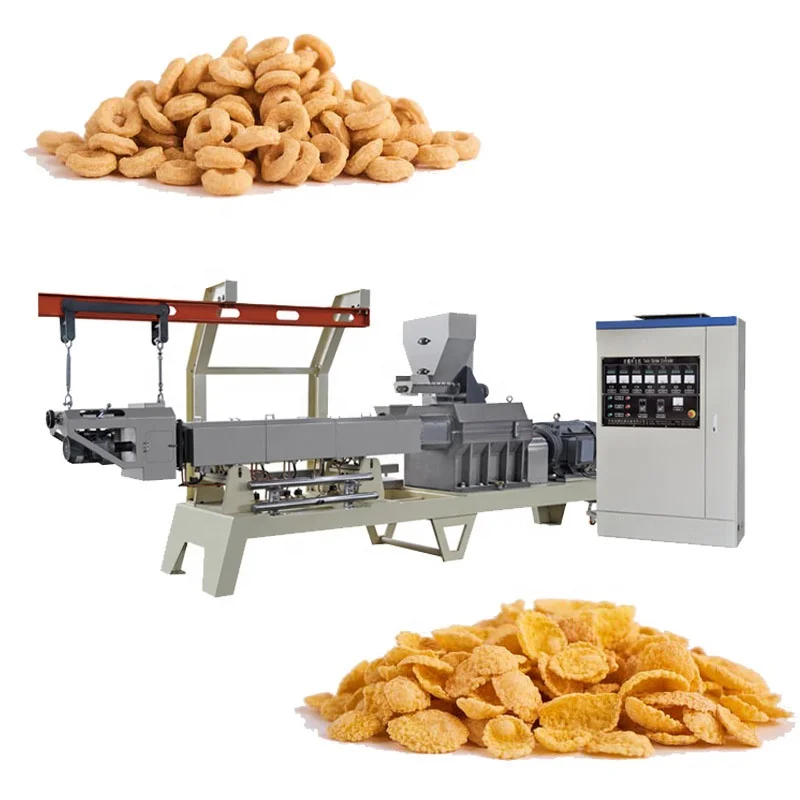
Matched Throughput Across Stations — Every unit from the mixer to the sugar spraying drum is sized so no single machine chokes the rest of the line.
Technical Specifications
| Parameter | Value |
|---|---|
| Product Type | Corn Flakes Production Line |
| Model Options | MT-65 / MT-70 / MT-75 / MT-85 |
| Output Capacity (MT-65) | 120–150 kg/h (basis not stated in source — confirm raw material, moisture content, and product specification) |
| Output Capacity (MT-70) | 200–250 kg/h (basis not stated in source — confirm raw material, moisture content, and product specification) |
| Output Capacity (MT-75) | 300–400 kg/h (basis not stated in source — confirm raw material, moisture content, and product specification) |
| Output Capacity (MT-85) | 400–500 kg/h (basis not stated in source — confirm raw material, moisture content, and product specification) |
| Installed Power Range | 84 kW (MT-65) to 239 kW (MT-85) |
| Real Power Range | 59 kW (MT-65) to 167 kW (MT-85) |
| Overall Dimensions (MT-65) | 12000 × 1200 × 2200 mm |
| Overall Dimensions (MT-85) | 28000 × 1500 × 2800 mm |
| Extruder Screw Type | Twin screw, co-rotating, sectional modules |
| Mixer Tank Size | φ600 × 500 mm |
| Corn Flakes Press Roller Size | 510 × 310 × 1050 mm |
| High-Temperature Oven Size | 4.5 × 1.4 × 1.8 m |
| Sugar Spraying System Roller | Ø600 × 2700 mm |
| Gearbox Lubrication | Oil forced automatic lubrication system |
| Self-Cleaning Function | Yes (twin screw extruder) |
| Cutting System | Special non-stop cutting system |
| Oven Heating Method | Gas, both-side baking system |
| Standards | CE, ISO |
| Warranty | 1 year complete warranty and life-time maintenance service |
Application Suitability
| Application | Material or Output |
|---|---|
| Corn flakes breakfast cereal | Corn grits, corn flour |
| Fortified breakfast cereal blends | Rice flour, wheat flour, soya bean with vitamin premix |
| Puffed extruded snacks | Corn flour, rice flour, wheat flour |
| Core-filled snack formats | Corn, wheat, peanut, walnut, sugar fillings |
| Sweetened coated cereal | Sugar spraying and coating on baked flakes |
Why "Capacity per Hour" Means Nothing Without the Full Line Context
A corn flakes machine full equipment range only delivers its rated output when every station is matched to the same throughput.
I once watched a line stall because the extruder pushed material faster than the press and oven could handle it. The flakes piled up, stuck together, and fed unevenly into the sugar spraying drum. Operators spent days adjusting conveyor speeds and oven temperatures just to keep the line from jamming. When stations are sourced from different vendors, nobody takes responsibility for the gaps between them [NEED_CITE: throughput matching across consecutive processing stations in cereal production]. The stated capacity of a single extruder tells you what that machine can do in isolation — not what the finished line will actually produce.
How Each Station Fits Into the Corn Flakes Line
The line follows a fixed sequence: mixer, screw conveyor, twin-screw extruder, corn flakes press machine, high-temperature oven, and sugar spraying system. Each station is specified so its processing window aligns with the output of the one before it. The mixer tank at φ600 × 500 mm batches raw material in quantities that match the extruder feed rate, preventing both starvation and overflow. The screw conveyor at 0.75 kW meters material steadily into the extruder barrel.
The twin-screw extruder cooks and shapes the dough using co-rotating sectional modules. From there, the hot extrudate moves directly into the corn flakes press machine, where the 510 × 310 mm roller pair flattens it into thin sheets. Adjustable roller distance controls flake thickness, while the integrated cooling system prevents sticking. This station is where many lines fail — if the roller speed does not match extruder output, flakes tear or bunch.
The Oven and Coating Stage That Determines Final Quality
After pressing, flakes enter the high-temperature oven measuring 4.5 × 1.4 × 1.8 m. The gas-fired both-side baking system ensures even heat distribution, which is critical for achieving uniform crispness without scorching edges. Oven residence time must be calibrated to the moisture content of the pressed flakes — too short and they stay chewy, too long and they shatter during packaging.
The sugar spraying system uses a Ø600 × 2700 mm roller with an integrated melting tank and temperature-keeping function. Total power for this station is 28.75 kW. Consistent coating depends on the sugar syrup viscosity, which the heated roller maintains throughout the run [NEED_CITE: sugar coating viscosity and temperature relationship in cereal finishing]. If the syrup cools below its working range, it crystallises unevenly and blocks the spray nozzles.
Reading the Specs That Actually Matter
The twin-screw co-rotating design is central to corn flakes processing because it handles the high-moisture, high-starch dough that single-screw extruders struggle with. Sectional screw modules allow configuration changes when switching between corn grits and multi-grain formulations. The oil forced automatic lubrication system protects the gearbox during extended runs, reducing unplanned downtime.
Real power consumption ranges from 59 kW on the MT-65 to 167 kW on the MT-85, which is notably lower than the installed power figures. This gap reflects the difference between peak motor rating and steady-state operating draw. Buyers planning electrical infrastructure should use the real power values for transformer and circuit sizing. The self-cleaning function in the extruder barrel cuts changeover time between product runs, which matters when a single line produces both plain corn flakes and sweetened variants.
What Happens When the Line Is Assembled From Separate Vendors
I worked on a project where the buyer sourced the extruder from one supplier and the oven from another. The oven had a shorter belt width than the press output, so flakes fell off the edges and accumulated on the oven floor, creating a fire hazard. The sugar spraying drum was too small for the line speed, so coated flakes exited still wet and clumped in the cooling conveyor. Fixing these mismatches required replacing two stations and rewiring the control logic [NEED_CITE: integration risks when combining food processing equipment from multiple OEMs]. These problems do not appear in any single machine’s spec sheet — they only surface when the machines run together.
Why Source the Corn Flakes Machine Full Equipment Range From One Supplier
The entire corn flakes machine full equipment range is configured under one line layout, so throughput calculations account for every transfer point between stations. Screw configuration and die design are specified to the buyer’s actual raw material rather than copied from a generic template. An in-house testing workshop runs trial production on the buyer’s own corn grits or multi-grain blend before the line ships, catching formulation issues early. Twin-screw expertise covers not just corn flakes but also puffed snacks and core-filled formats on the same extrusion platform. Pre-sales consultation extends through on-site installation, commissioning, and operator training so the line reaches stable production without the buyer troubleshooting alone.
Documentation & Verification
- Line layout drawing showing station-by-station throughput matching for your target capacity
- Machine specification sheet confirming voltage, frequency, and control language for your market
- Screw and die configuration record matched to your corn grit or multi-grain formulation
- Trial run report on your raw material conducted in the testing workshop before shipment
- Wear parts list covering extruder screws, dies, and press roller components with replacement intervals
- CE declaration of conformity and ISO certificate for customs and regulatory clearance
Installation, Commissioning & Support
- Floor plan review confirming the MT-65 footprint of 12 m length fits your workshop bay
- Dedicated electrical circuit sized to the real power draw of 59 kW to 167 kW depending on model
- Gas supply connection and ventilation planning for the both-side baking oven system
- On-site roller gap calibration on the press machine to match your target flake thickness
- Operator training covering extruder screw module changes and self-cleaning procedures
- First replacement set of screws and dies shipped with the line for scheduled maintenance
What to Prepare Before Requesting a Quote
To configure the right model from the corn flakes machine full equipment range, share your raw material type — whether standard corn grits, whole grain blends, or fortified formulations — along with your target hourly output. Specify your workshop’s available length and ceiling height, since the larger models extend to 28 m. Confirm the local voltage and frequency so the control panel and motor specifications match your facility’s supply before production begins.
Frequently Asked Questions
Q: How is output capacity verified for each model?
A: The stated output ranges for the MT-65 through MT-85 are based on specific raw material, moisture content, and product specification conditions that must be confirmed for your actual formulation. We run trial production on your raw material in our testing workshop before shipment, and the trial report documents the verified throughput under those exact conditions.
Q: What voltage and control panel options are confirmed before shipment?
A: Voltage, frequency, and control panel language are confirmed during the specification review stage before production begins. The electrical schematic is provided for your facility’s electrician to verify compatibility with local supply standards and circuit capacity requirements.
Q: How are the extruder, press, and oven matched to avoid bottlenecks?
A: Each station’s processing capacity is calculated against the others during line layout design. The mixer batch size, extruder throughput, press roller speed, oven belt length, and sugar spraying drum capacity are all sized so material flows continuously without accumulation or starvation at any transfer point.
Q: What spare wear parts ship with the line?
A: The initial wear parts set includes extruder screw sections, die plates, and press roller components. The wear parts list documents expected replacement intervals based on your production volume and raw material abrasiveness, so you can plan procurement before the first changeover is due.