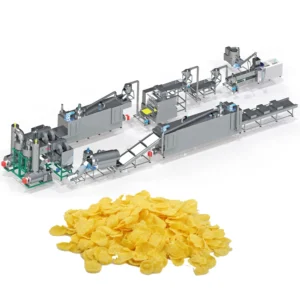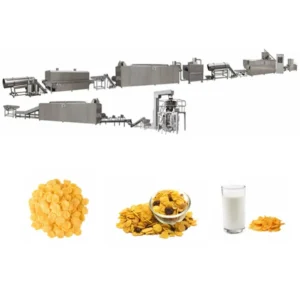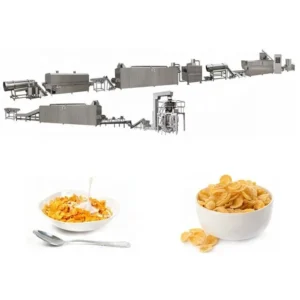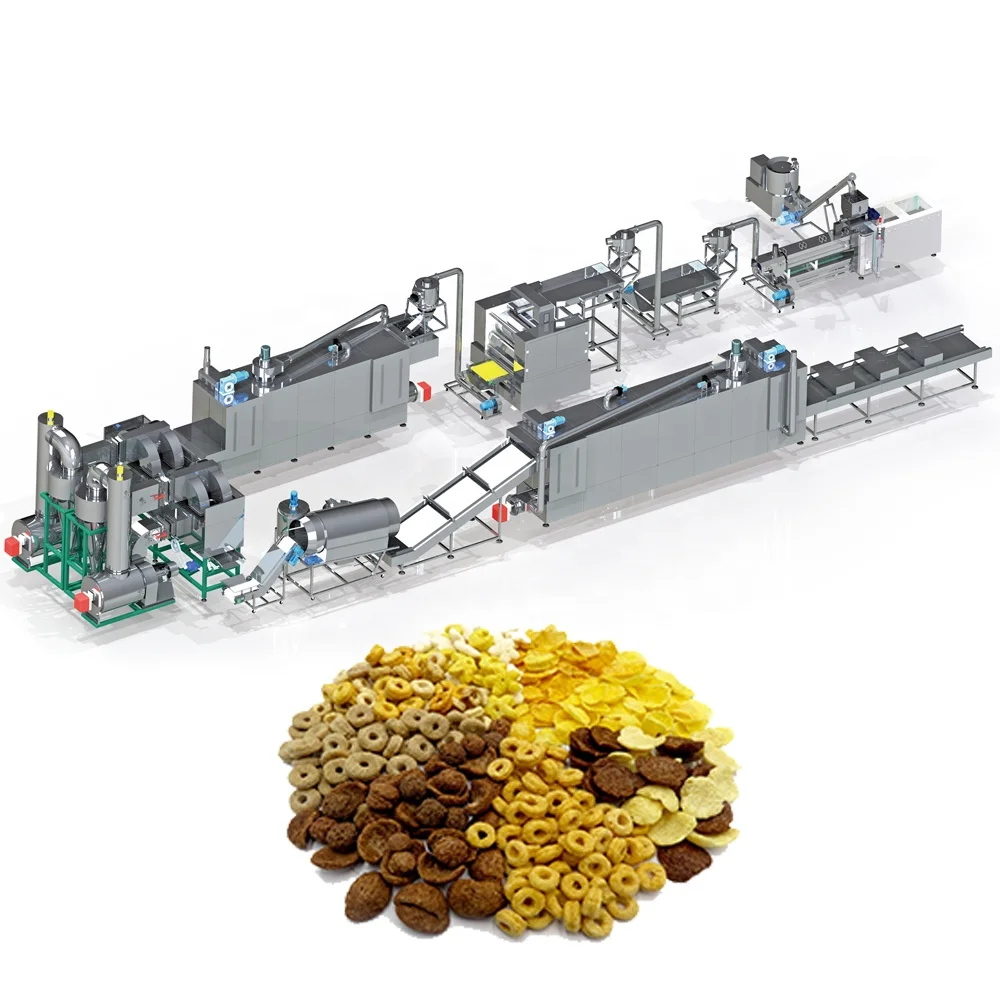
Station-to-station throughput engineering — every mixer, extruder, flaker, oven and coater in this corn flakes line is sized to the same real capacity so no single unit bottlenecks the rest.
Technical Specifications
| Parameter | Value |
|---|---|
| Product Type | Corn Flakes Production Line |
| Extruder Models Available | MT-65 / MT-70 / MT-75 / MT-85 |
| Screw Type | Twin screw, co-rotating sectional modules |
| Installed Power (MT-65) | 84 kW |
| Installed Power (MT-70) | 132 kW |
| Installed Power (MT-75) | 186 kW |
| Installed Power (MT-85) | 239 kW |
| Real Power Consumption (MT-65) | 59 kW |
| Real Power Consumption (MT-70) | 92 kW |
| Real Power Consumption (MT-75) | 140 kW |
| Real Power Consumption (MT-85) | 167 kW |
| Output Capacity (MT-65) | 120–150 kg/h (basis to be confirmed on buyer’s raw material and moisture) |
| Output Capacity (MT-70) | 200–250 kg/h (basis to be confirmed) |
| Output Capacity (MT-75) | 300–400 kg/h (basis to be confirmed) |
| Output Capacity (MT-85) | 400–500 kg/h (basis to be confirmed) |
| Overall Dimensions (MT-65 line) | 12000 × 1200 × 2200 mm |
| Overall Dimensions (MT-70 line) | 23000 × 1500 × 2200 mm |
| Overall Dimensions (MT-75 line) | 24000 × 1500 × 2800 mm |
| Overall Dimensions (MT-85 line) | 28000 × 1500 × 2800 mm |
| Control System | PLC and MCC control, language configurable per order |
| Mixer Tank Size | φ600 × 500 mm, 10–30 kg per load |
| Mixer Power | 4 kW |
| Screw Conveyor Power | 0.75 kW |
| Corn Flakes Press Machine Power | 16.12 kW |
| Press Roller Dimension | 510 × 310 × 1050 mm |
| High-Temperature Oven Size | 4.5 × 1.4 × 1.8 m |
| Oven Heating Method | Gas-fired, both-side baking |
| Sugar Spraying System Power | 28.75 kW |
| Sugar Spraying Roller Size | Ø600 × 2700 mm |
| Extruder Gear Box Lubrication | Oil forced automatic lubrication |
| Contact Materials | Food-grade stainless steel |
| Voltage & Frequency | Configurable per destination market, confirmed before production |
| Certification | CE, ISO |
| Warranty | 1 year, lifetime maintenance service |
| Lead Time | 5–30 days after advance payment |
Application Suitability
| Application | Material or Output |
|---|---|
| Corn flakes breakfast cereal | Corn grits, corn flour at controlled moisture levels |
| Corn puff snacks | Corn flour, rice flour, wheat flour blends |
| Core-filled snacks | Outer shell from grain flour; filling from sugar, chocolate, peanut, walnut paste |
| Fortified breakfast cereal | Grain flour blends with added vitamin and mineral premix |
| Multi-grain extruded cereal | Soya bean, rice, wheat and corn combinations |
Why "Nominal Line Capacity" Often Fails on Real Corn Grits
A quoted throughput figure only holds when every station on the line is matched to your actual raw material, not to a generic datasheet.
When I helped set up a corn flakes line for a breakfast cereal producer, we initially spec’d the flaker and oven to the extruder’s nominal output. The customer’s corn grits turned out coarser than expected, and flake formation rate dropped sharply. Material piled up in the oven section because the baking cycle could not keep pace with the uneven feed [NEED_CITE: material particle size influence on extrusion throughput]. The whole line stalled until we re-tuned the roller gap and oven curve. That situation repeats across the industry when buyers assemble a corn flakes production line full equipment range from separate vendors who each guarantee their own station without coordinating the overall flow.
How Each Station Connects in the Full Equipment Range
The batching stage starts with a mixer rated for 10–30 kg per load, feeding a screw conveyor that meters material into the twin-screw extruder at a controlled rate. Inside the extruder, co-rotating sectional screw modules handle gelatinisation, mixing, de-gassing and cooking in one continuous pass. The screw configuration is specified to the buyer’s flour type and moisture content, not copied from a generic build. This matters because corn flakes production line full equipment range configurations that skip this matching step often produce extrudate with inconsistent starch gelatinisation, leading to uneven flake texture downstream.
Flaking, Baking and Coating as One Coordinated Sequence
After extrusion, the corn flakes press machine uses a large-diameter roller with an integrated cooling system to flatten the cooked pellets into uniform flakes. The roller gap is adjustable so flake thickness can be dialled in precisely. Flakes then pass through the gas-fired high-temperature oven where a both-side baking system delivers even heat distribution across the full tray width. Finally, the sugar spraying system applies coating through a temperature-keeping roller approximately 600 mm in diameter [NEED_CITE: sugar coating temperature control in cereal finishing]. Because every station in this corn flakes production line full equipment range is sourced and balanced by one manufacturer, throughput at the flaker, oven and coater is calculated to keep pace with the extruder rather than creating a constraint.
What the Specification Sheet Tells You About Real Output
The twin-screw design across all four extruder sizes means the machine handles a wider range of raw material formulations than a single-screw equivalent. Sectional screw modules let the operator adjust the screw profile when switching between, for example, pure corn grits and a multi-grain blend. The oil-forced automatic lubrication system on the gear box reduces unplanned stops during long production runs. Installed power spans from 84 kW on the MT-65 to 239 kW on the MT-85, while real power consumption is noticeably lower, reflecting actual running load rather than peak motor rating. The PLC and MCC control system is configurable for the buyer’s local voltage, frequency and operator language, which eliminates commissioning delays that arise when a machine arrives with the wrong electrical setup.
What Happens When Stations Are Not Balanced
An extruder running at its rated output feeds flakes into an oven that cannot bake them fast enough; half-cooked product accumulates and must be discarded. Alternatively, a sugar spraying system with insufficient drum volume forces the operator to slow the entire line to maintain coating consistency. I have seen breakfast cereal installations where the buyer sourced each machine separately and the flaker became a permanent constraint, capping daily output well below what the extruder could deliver [NEED_CITE: throughput bottleneck effects in multi-vendor food processing lines]. These mismatches rarely appear during the quotation stage because each vendor quotes their own station in isolation.
Reasons Buyers Source the Complete Range Here
The line layout and capacity calculation are produced as one document, showing throughput matching across every station against the buyer’s specific raw material and target flake density. Screw configuration and die design records are specified to the customer’s flour type and moisture level, not pulled from a template. An in-house testing workshop runs trial production on the buyer’s actual raw material before shipment, so product development starts in the factory rather than after installation. Pre-sales consultation covers engineer-level line design, and support continues through on-site installation, commissioning and operator training. Every contact surface uses food-grade stainless steel, and CE plus ISO certification supports import compliance in regulated markets.
Documentation & Verification
- Line layout drawing with throughput calculation for your corn grits particle size and moisture
- Screw and die configuration record matched to your target flake density
- Electrical schematic confirming voltage, frequency and PLC language before production
- Trial run report on your raw material produced in the testing workshop before dispatch
- CE declaration of conformity and ISO certificate for customs and regulatory submission
- Wear parts list covering screws, dies and press roller shells with replacement intervals
Installation, Commissioning & Support
- Floor plan and utility layout provided based on the selected extruder model dimensions, up to 28 m line length
- Dedicated power circuit sized to the real running load, from 59 kW to 167 kW depending on model
- Line shipped in sectional modules with assembly sequence guide for on-site reconnection
- First-run parameter setting covers barrel temperature profile, roller gap and oven curve
- Operator training includes screw module changeover procedure for product switchovers
- Wear parts kit with initial spare screws, dies and roller shells included at delivery
What We Need to Configure Your Line
To spec the right extruder size and balance every downstream station, share your primary raw material type and its typical particle size, the target daily output in finished flake weight, and your workshop floor dimensions including ceiling height. Confirm the local voltage and frequency standard, preferred PLC operator language, and whether you plan to run additional products like corn puffs or core-filled snacks on the same extrusion platform. If you can send a sample of your raw material, we will run a trial in the testing workshop and include the results with the proposal.
Frequently Asked Questions
Q: What supporting equipment is included and how is throughput matched across every station?
A: The line covers mixer, screw conveyor, twin-screw extruder, corn flakes press machine, gas-fired oven and sugar spraying system. Each station is sized so its maximum throughput aligns with the extruder output on your specific raw material. The capacity calculation document shows the matched rate at every point rather than quoting individual machines in isolation.
Q: Can the same extrusion platform produce corn flakes, corn puffs and core-filled snacks?
A: Yes. The twin-screw extruder accepts sectional screw modules that can be reconfigured, and the die is swapped to match the target product shape. Corn puffs require a different die and screw profile; core-filled snacks add a filling injector. The downstream flaker and oven are used only for the corn flakes format.
Q: What heating method does the oven use and how does it affect flake quality?
A: The high-temperature oven is gas-fired with a both-side baking system. This arrangement delivers heat from above and below the flake layer simultaneously, producing uniform crispness and colour across the full batch. Gas heating also allows rapid temperature adjustment when switching between product recipes or adjusting for ambient humidity.
Q: How is the flaker roller gap adjusted to control final flake thickness?
A: The corn flakes press machine features an adjustable roller distance mechanism that lets the operator set the gap between the large-diameter rollers. The integrated cooling system maintains roller surface temperature during continuous operation, preventing the extrudate from sticking and ensuring consistent flake thickness throughout the production run.
Q: What spare wear parts are included and how are replacements sourced?
A: The initial delivery includes a wear parts kit covering screws, dies and press roller shells. The wear parts list provided with documentation specifies replacement intervals based on production hours. Replacement components are manufactured to the same configuration record used in your original build, so dimensional compatibility is maintained across every changeover.