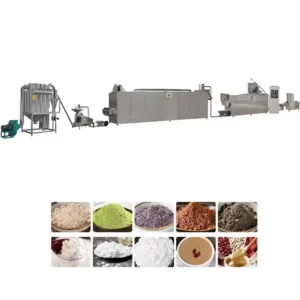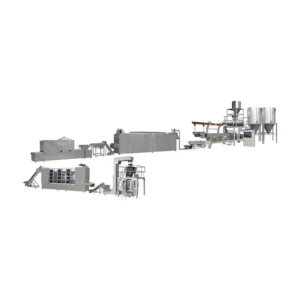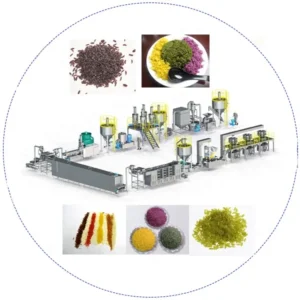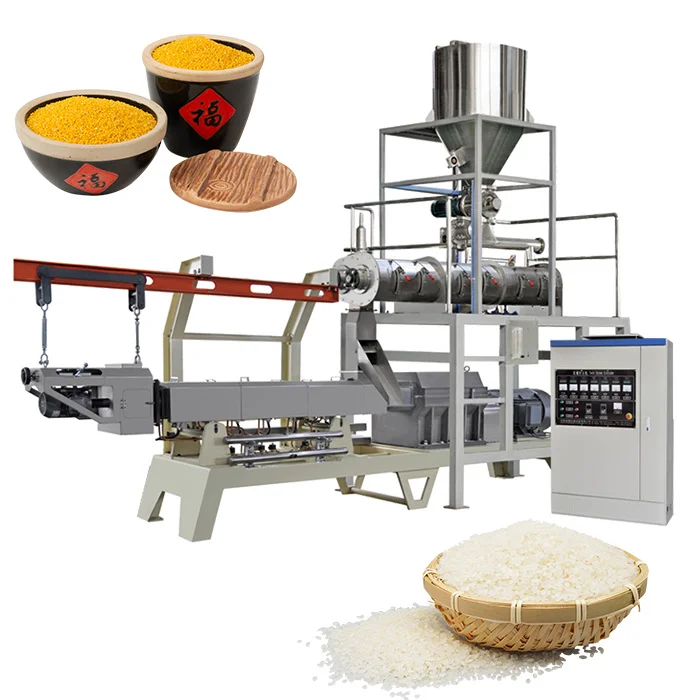
Integrated Throughput Matching — every station from mixer to fryer is sized against the extruder’s actual output on your grain formulation, preventing downstream bottlenecks common in multi-vendor lines.
Technical Specifications
| Parameter | Value |
|---|---|
| Product Type | Artificial Rice Production Line |
| Output Capacity | 70–300 kg/h (basis not stated in source — confirm raw material type, moisture content, and formulation before quoting) |
| Power Supply | 380V / 50Hz |
| Construction Material | Food-grade stainless steel (all product contact surfaces) |
| Control System | Automatic control (PLC / MCC / manual — confirm configuration before production) |
| Line Stations Included | Mixer, fryer, extrusion system |
| Raw Material Compatibility | Rice flour and grain-based formulations |
| Color | Silver |
| Customization Scope | Minor adjustments, drawing-based modification, and full line reconfiguration available |
Application Suitability
| Application | Material or Output |
|---|---|
| Fortified rice for nutrition programmes | Rice flour blended with vitamin and mineral premixes |
| Artificial rice from broken rice and grain fragments | Rice flour, corn flour, and mixed grain formulations |
| Reconstituted rice for institutional food supply | Grain-based starch blends with protein enrichment |
| Value-added rice products for retail packaging | Custom grain formulations targeting specific grain shape and cooking behaviour |
What the Capacity Plate Doesn’t Tell You About an Artificial Rice Production Line for Sale
Rated throughput means nothing until the raw material formulation is locked in.
I spent years moving between food plants across the Middle East, and one pattern repeats: a buyer specifies an artificial rice production line based on a brochure number, then discovers on commissioning day that their particular rice flour blend — lower starch, higher fibre — pushes the extruder to barely half that rate. The fryer downstream sits idle. The packing station crew waits. Every hour of mismatched throughput burns electricity and labour on stations that are not producing. I now refuse to finalise a line configuration without the buyer’s actual raw material report in hand [NEED_CITE: raw material variability impact on extrusion throughput].
How Every Station Connects in a Complete Artificial Rice Making Equipment Setup
An artificial rice production line for sale under one supplier means the mixer batch size, extruder screw speed, and fryer belt length are calculated together before steel is cut. When these stations come from separate vendors, each optimises for their own machine’s nameplate figure rather than the line’s actual bottleneck.
The food-grade stainless steel construction across all contact surfaces matters beyond hygiene audits. Grain-based formulations with added minerals can be abrasive, and contact wear on cheaper alloys changes the gap tolerances inside the extruder barrel over time, altering grain density and shape consistency batch after batch.
Why Screw and Die Choices Define the Final Rice Grain
The extrusion stage determines whether the reconstituted grain holds its shape during cooking or disintegrates into mush. Die geometry sets the cross-section, while screw configuration controls shear and residence time inside the barrel — both must match the specific starch gelatinisation behaviour of the buyer’s flour blend [NEED_CITE: twin-screw extrusion die design principles for rice-shaped products].
Rice flour behaves very differently from corn or wheat in the barrel. Its gelatinisation window is narrower, meaning temperature profiling along the barrel zones must be precise. A generic screw build copied from a snack application will produce grains that either fracture during drying or fail to hold together when boiled.
Reading the Specs That Actually Matter
The 380V / 50Hz power supply is standard across much of Asia and the Middle East, but buyers in regions running 60Hz or different voltage tiers must confirm transformer and motor compatibility before production starts. A motor wound for 50Hz running on 60Hz supply will overspeed, altering screw RPM and residence time — the two variables that directly control grain texture.
Output capacity listed at 70–300 kg/h spans a wide range because it depends entirely on formulation moisture, starch content, and target grain density. A line producing dense fortified rice with heavy mineral loading will sit at the lower end, while plain reconstituted rice from high-starch flour reaches the upper range. The automatic control system, once configured as PLC or MCC, governs barrel temperature zones and screw speed to maintain consistency across shifts.
The Hidden Cost of Skipping the Fryer Sizing Step
When a fryer is specified by its own nameplate capacity rather than matched to the extruder’s real-world output on the buyer’s formulation, two failures emerge. An oversized fryer burns oil and energy on partially loaded belts. An undersized fryer forces the extruder to slow down, and partially extruded material sitting in the die plate hardens, requiring full shutdowns for cleaning [NEED_CITE: downstream equipment sizing errors in extrusion lines].
I have watched plants lose entire shifts to this mismatch. The production manager blames the extruder supplier; the extruder supplier points to the fryer vendor. Under one supplier, that argument cannot happen because throughput matching is documented in the line layout before fabrication begins.
Why Buyers Source This Line Here
Complete line integration from mixer through fryer under one supplier eliminates the cross-vendor blame game when throughput falls short. Every station is documented in a single line layout with matched capacity calculations.
Screw and die configuration is specified to the buyer’s raw material report and target rice grain shape, not copied from a generic build. The in-house testing workshop runs trial production on the buyer’s actual flour blend before the line ships, generating a trial run report that confirms grain density, shape retention, and cooking behaviour.
Food-grade stainless steel across all contact surfaces meets the hygiene standards required for nutrition programme contracts. Customisation from minor specification changes to full drawing-based reconfiguration allows the line to fit specific factory floor constraints and utility layouts.
Documentation & Verification
- Line layout and capacity calculation showing throughput matching between mixer, extruder, and fryer
- Screw and die configuration record matched to your rice flour formulation
- Electrical schematic confirming voltage, frequency, and control language for your facility
- Trial run report on your raw material from the in-house testing workshop
- Factory test record documenting output and grain quality before dispatch
- Operation and maintenance manual with wear parts list for screws and dies
Installation, Commissioning & Support
- Floor space planning based on the complete line footprint including mixer, extruder, fryer, and conveying sections
- Dedicated electrical circuit sized for 380V / 50Hz supply with confirmed motor and control panel ratings
- Assembly state confirmed before shipment — modular or loose component delivery matched to site access
- First-run commissioning with screw speed and barrel temperature profiling on your grain formulation
- Operator training covering die changes, screw wear inspection, and fryer oil management
- Wear parts inventory list with reorder lead times for screws, dies, and fryer belt sections
What to Include in Your Inquiry
Send your raw material report — rice flour type, starch and moisture content, any vitamin or mineral premix ratios — along with your target daily output and the voltage and frequency at your facility. Include factory floor dimensions and ceiling height so the line layout can be drafted around existing equipment. Specify whether you need a trial run on your material before shipment to verify grain shape and cooking behaviour.
Frequently Asked Questions
Q: How is output capacity verified, and what conditions does the 70–300 kg/h range assume?
A: The listed range depends on raw material formulation, moisture content, and target grain density. Capacity is confirmed only after reviewing your specific rice flour blend and running a trial in the testing workshop. Without your material report, any quoted number remains an estimate rather than a guaranteed throughput figure.
Q: Which stations are included, and how is throughput balanced between them?
A: The line includes a mixer, extrusion system, and fryer as standard. Throughput is balanced by calculating each station’s real capacity against the extruder’s output on your formulation, then sizing the fryer belt and mixer batch volume to match. This prevents downstream bottlenecks and idle equipment.
Q: Can voltage, frequency, and control language be configured before shipment?
A: Yes. The standard 380V / 50Hz configuration is adjusted to your facility’s supply during the specification confirmation stage. Motor windings, transformer ratings, and control panel language are all set before production begins, avoiding on-site rewiring delays during commissioning.
Q: What customisation options are available for this line?
A: Options range from minor specification changes such as control system selection between PLC and MCC, to full drawing-based line reconfiguration for specific factory layouts. Station count, conveyor routing, and fryer length can all be adjusted to fit your production targets and floor space.
Q: Is a trial run conducted on my raw material before delivery?
A: A trial run using your actual rice flour formulation is conducted in the in-house testing workshop before shipment. The resulting report documents grain shape, density, and cooking behaviour, allowing any screw or die adjustments to be completed at the factory rather than during on-site commissioning.