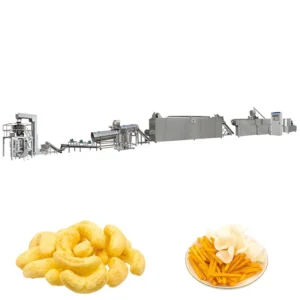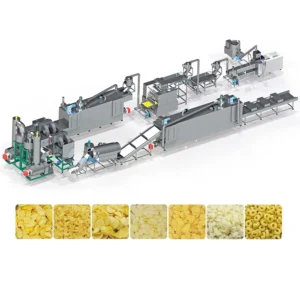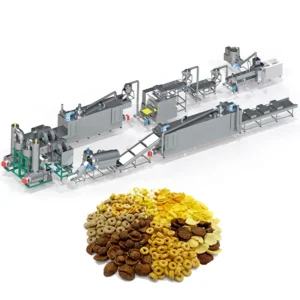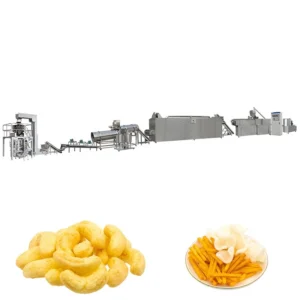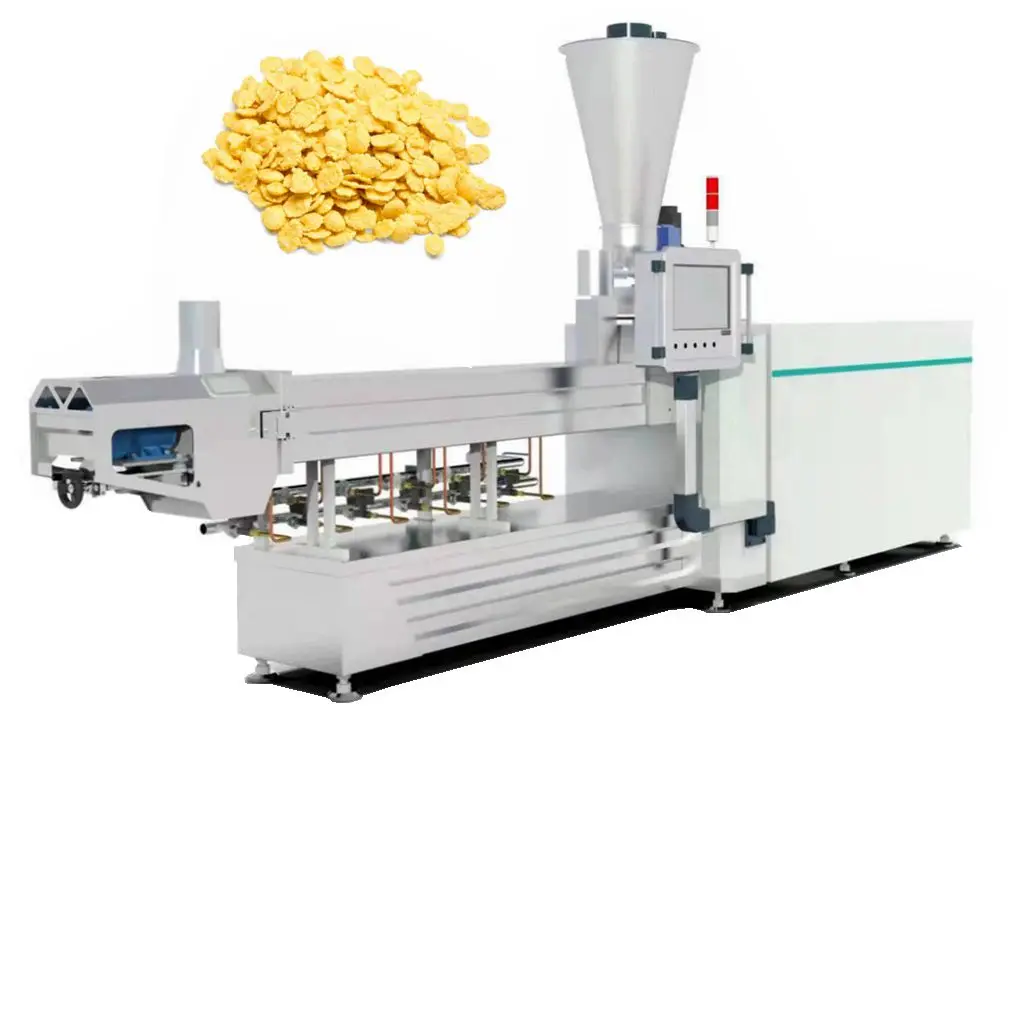
Capacity-Matched Line Design — Every station from the mixer to the packing conveyor is sized to the extruder’s actual throughput on your raw material, preventing the mid-line bottlenecks that stall cereal production.
Technical Specifications
| Parameter | Value |
|---|---|
| Product Type | Corn Flakes Production Line |
| Twin Screw Extruder Model | MT-75 |
| Model Options | MT70 / MT85 / MT75 |
| Screw Type | Twin screw |
| Installed Power (MT70) | 160 kW |
| Installed Power (MT85) | 190 kW |
| Installed Power (MT75) | 210 kW |
| Power Consumption (MT70) | 120 kW |
| Power Consumption (MT85) | 140 kW |
| Power Consumption (MT75) | 150 kW |
| Output Capacity (MT70) | 150–200 kg/h (basis not stated in source — confirm raw material and moisture content) |
| Output Capacity (MT85) | 300–400 kg/h (basis not stated in source — confirm raw material and moisture content) |
| Output Capacity (MT75) | 300–500 kg/h (basis not stated in source — confirm raw material and moisture content) |
| Extruder Capacity (MT-75 Detail) | 200–300 kg/h (basis not stated in source — confirm raw material and moisture content) |
| Overall Dimensions (MT70) | 41 × 1.5 × 2.2 m |
| Overall Dimensions (MT85) | 43 × 1.5 × 3.2 m |
| Overall Dimensions (MT75) | 45 × 1.5 × 3.5 m |
| Extruder System | Feeding, extruding, cutting, heating, gearing, controlling |
| Extruder Screw Feature | Automatic lubricating and cooling function; wear-resistant screw material |
| Flaking Machine Control | PLC control system |
| Flaking Machine Roller Drive | Hydraulic system for double rollers; double motors for separate roller driving |
| Flaking Machine Temperature Control | Infrared sensor |
| Dryer Heating Source | Gas / Electric |
| Roasting Oven | Hot air roasting with vibrating pan, high temperature spraying tubes, conciliation burner, two separate circulating fans, cyclone dust removal device |
| Coating System | Double tumble for sugar melting, elevator, coating drum, spraying nozzle |
| Control System | PLC |
| Voltage & Frequency | Customized to local voltage (confirmed pre-production) |
| Assembly State | Complete line, turnkey |
| Standards | CE; ISO |
Application Suitability
| Application | Material or Output |
|---|---|
| Natural corn flakes production | Powder of corn, rice, wheat, oat, barley |
| Sugar-coated breakfast cereals | Corn grits with sugar syrup coating |
| Shaped cereal variants | Ball, tube, stick, ring, fruit loop, star, wheel, flower, heart (by adjusting mould) |
| Multi-grain cereal expansion | Blended grain powders processed through twin-screw extrusion |
| Existing line de-bottlenecking | Standalone dryer, flaker, or roaster integration |
Why "Nominal Capacity" Fails a Corn Flakes Line
A corn flakes machine full equipment range only performs when every station is calculated against the same material behaviour, not just the extruder nameplate.
Buyers often receive a line quote built around an extruder’s maximum output figure, only to discover during commissioning that the actual raw material — with its specific moisture content and starch profile — runs at a different rate. The flaking mill then receives more material than it can press, or the dryer cannot remove moisture fast enough. I have walked into workshops where half-pressed flakes sat in bins absorbing humidity because the oven belt width was never matched to the extruder’s real-world throughput [NEED_CITE: throughput matching across cereal line stations]. The result is a line that technically runs but never reaches the intended daily volume.
Station-by-Station Flow Logic
The natural corn flakes flow moves from mixing through extruding, flaking, drying, hot air roasting, and cooling before packing. Each transition point represents a moisture and temperature shift that the next machine must absorb. A corn flakes machine full equipment range configured under one supplier ensures the dryer’s belt length and the roasting oven’s residence time are calculated from the same throughput baseline as the extruder, rather than sourced as standalone units with mismatched ratings.
Sugar Coating Integration
Producing sugar-coated variants adds a sugar spraying and coating stage after roasting, followed by a secondary drying pass. The double tumble system for sugar melting and the coating drum must handle the full output of the roasting oven without creating a backlog. When the coating drum is undersized, the roasted flakes cool below the temperature needed for syrup adhesion, resulting in uneven coverage and product that fails the market’s visual expectation.
Reading the Extruder Specifications
The MT-75 twin-screw extruder features an automatic lubricating and cooling function that manages barrel temperature across the extruding and cutting systems. In corn flake production, barrel temperature profile directly controls starch gelatinisation — too little heat and the grits do not cook through, too much and the dough becomes sticky before reaching the flaking mill. The hydraulic double-roller flaking machine uses separate motors for each roller and an infrared sensor for temperature feedback, maintaining consistent flake thickness even as the rollers wear over a production run [NEED_CITE: hydraulic roller pressure and flake thickness consistency]. The PLC control system ties the flaking machine to the extruder’s feed rate so that roller gap adjustments respond to real-time throughput changes.
The Cost of Misaligned Supporting Equipment
When a line is assembled from separate vendors, the dryer and roasting oven are often selected by catalog model rather than calculated against the extruder’s actual output on the buyer’s specific grain blend. An undersized dryer leaves excess moisture in the flakes, which then blister unevenly in the roasting oven or fail to achieve the crispness the packaging promises. An oversized roaster wastes gas or electricity while the flakes over-toast on the edges of the belt. These mismatches do not show up in a factory acceptance test run on standard material — they surface weeks into production when the buyer’s actual corn source behaves differently [NEED_CITE: raw material variability in breakfast cereal extrusion].
Why This Equipment Range Is Configured Together
Every station in this corn flakes line is specified under one engineering scope, meaning the mixing system’s batch cycle, the extruder’s screw configuration, the flaking mill’s roller speed, and the roasting oven’s fan capacity are all calculated from the same capacity model. The screw configuration and die design are matched to the buyer’s raw material and target flake density before production begins. An in-house testing workshop runs trial production on the customer’s actual raw material so that product development starts before shipment rather than during commissioning. Voltage, frequency, and control language are confirmed at the quotation stage, preventing the delays that arise when a PLC panel arrives with the wrong operating language or a motor rated for a frequency the local grid does not supply.
Documentation & Verification
- Line layout and capacity calculation confirming throughput at every station
- Screw and die configuration record matched to your grain blend
- Electrical schematic with voltage and frequency confirmation for your facility
- Trial run report on customer raw material from the testing workshop
- CE declaration of conformity and ISO certificate
- Operation and maintenance manual with wear parts list
Installation, Commissioning & Support
- Foundation and floor space planning based on the 45 × 1.5 × 3.5 m MT75 line footprint
- Dedicated electrical circuits sized to the 210 kW installed power requirement
- On-site assembly with mechanical and electrical alignment of all conveyor transfer points
- First-run parameter setting for barrel temperature, roller gap, and oven residence time
- Operator training covering PLC interface, screw replacement, and hydraulic roller maintenance
- Wear parts supply including replacement screws, dies, and flaking roller sleeves
Preparing Your Line Inquiry
To configure a corn flakes line that holds its rated output on your material, provide the specific grain or grain blend you intend to process, the target daily production volume, and the moisture content of your raw material supply. Include your facility’s voltage and frequency, the available floor space and ceiling height, and whether you need the sugar coating stations or will run natural flakes only. If you have existing upstream or downstream equipment that must integrate, share the make and model so the transfer conveyors can be matched.
Frequently Asked Questions
Q: How is the capacity of each station matched across the full line?
A: Every station — mixer, extruder, flaker, dryer, roaster, coater, and cooler — is calculated from the same throughput model based on your raw material and target flake density. The line layout document shows the capacity of each machine so you can verify that no station creates a bottleneck before the equipment is built.
Q: What supporting equipment is included and where does each station fit?
A: The full range covers mixing and batching, twin-screw extrusion, flaking, drying, hot air roasting, optional sugar spraying and coating, cooling, and packing. Each station’s position in the process flow is mapped in the line layout, showing material transfer points and moisture reduction targets at every stage.
Q: Can individual machines be ordered to upgrade an existing line?
A: Standalone stations such as the flaking machine, roasting oven, or dryer can be supplied separately. The unit’s capacity and control interface are matched to your existing line’s throughput and PLC platform so that integration does not require replacing adjacent equipment.
Q: How are screw and die configurations selected for different grains?
A: The screw profile and die geometry are specified to the buyer’s raw material — whether corn, rice, wheat, oat, or a multi-grain blend — and the target flake density. A trial run on the customer’s actual material is conducted in the testing workshop before the extruder ships.
Q: What electrical specifications must be confirmed before production?
A: Voltage, frequency, and control panel language are confirmed at the quotation stage. The electrical schematic is reviewed with the buyer to ensure motor ratings, heating elements, and PLC components match the facility’s power supply, preventing commissioning delays caused by utility mismatches.