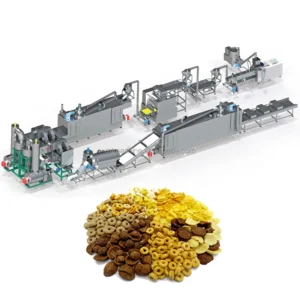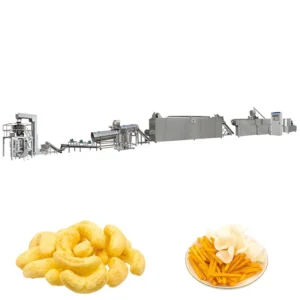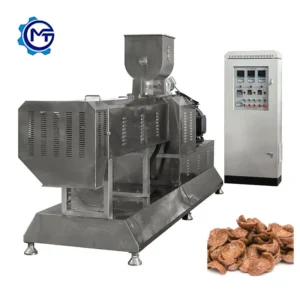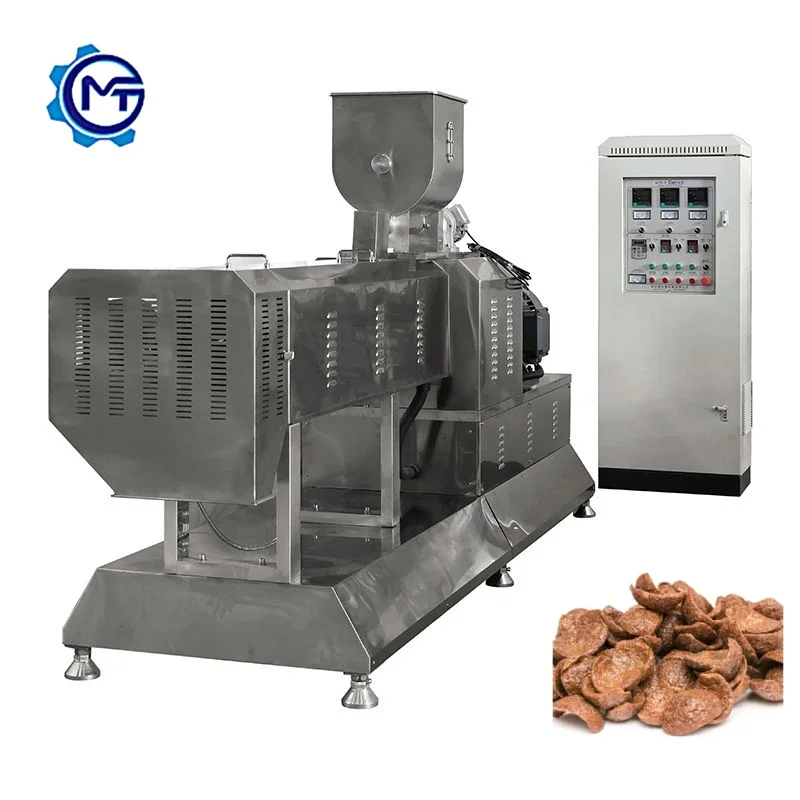
Complete Line Under One Supplier — Every station from mixing to packing is capacity-matched and documented, so buyers surveying the full breakfast cereal production line equipment can verify throughput alignment before specifying a configuration.
Technical Specifications
| Parameter | Value |
|---|---|
| Product Type | Twin Screw Extrusion Breakfast Cereal Production Line |
| Model Options | MT70 / MT85 / MT75 |
| Installed Power | MT70: 160 kW; MT85: 190 kW; MT75: 210 kW |
| Power Consumption | MT70: 120 kW; MT85: 140 kW; MT75: 150 kW |
| Output Capacity | MT70: 150–200 kg/hr; MT85: 300–400 kg/hr; MT75: 300–500 kg/hr (basis not stated in source — confirm raw material type, moisture content, and specific end-product) |
| Overall Dimensions | MT70: 41 × 1.5 × 2.2 m; MT85: 43 × 1.5 × 3.2 m; MT75: 45 × 1.5 × 3.5 m |
| Screw Type | Twin screw |
| Extruder Lubrication & Cooling | Automatic lubricating and cooling function |
| Control System | PLC control (flaking machine); line-level control available with PLC or MCC |
| Flaking Machine Drive | Double motors for separate roller driving |
| Flaking Machine Pressure | Hydraulic system for double rollers |
| Flaking Temperature Sensing | Infrared sensor for even temperature pipe control |
| Dryer Heating Source | Gas / Electric / Steam (multi-fuel option) |
| Hot Air Roasting Oven | Vibrating pan, high-temperature spraying tubes, two circulating fans, cyclone dust removal |
| Coating System | Double tumble for sugar melting, elevator, coating drum, spraying nozzle |
| Certification | CE, ISO |
Application Suitability
| Application | Material or Output |
|---|---|
| Natural corn flakes production | Corn grits and corn flour |
| Sugar-coated and cocoa-flavored flakes | Corn base with sugar syrup or cocoa flour coating |
| Multi-grain shaped cereals | Rice, wheat, oat, and barley powder blends |
| Shaped puffed cereal variants | Ball, tube, stick, ring, fruit loop, star, wheel, flower, heart shapes via die change |
| Pilot or mid-scale cereal manufacturing | Lines configured for 150 kg/hr through 500 kg/hr throughput tiers |
What "300 kg/hr" Actually Means for Your Corn Flakes Formula
Capacity figures are only meaningful when tied to your specific raw material, moisture content, and target flake density.
A corn flakes machine full range quoted at a nominal throughput may not hold that rate once your formulation enters the barrel. Corn grits behave differently from oat or barley blends under twin-screw shear, and moisture variance shifts both expansion ratio and flaking consistency [NEED_CITE: extrusion throughput dependency on raw material moisture and starch composition]. Buyers surveying breakfast cereal production line equipment should request a capacity calculation based on their actual recipe, not a generic benchmark. Without this verification, downstream stations like the flaking machine and roasting oven may operate below design capacity or create a bottleneck.
Station-by-Station Survey for Corn Flakes and Shaped Cereals
The full corn flakes machine full range spans nine stations: mixing, extruding, flaking, drying, hot air roasting, sugar spraying or coating, secondary drying, cooling, and packing. Each station is selected to match throughput with the extruder model chosen. The flaking machine uses hydraulic double-roller pressure and infrared temperature sensing to maintain consistent flake thickness across long production runs.
Dryer and Roasting Configuration for Cereal Processing
Multi-fuel drying options — gas, electric, or steam — allow the line to adapt to local utility availability and cost structures. The hot air roasting oven includes a vibrating pan with high-temperature spraying tubes, two separate circulating fans, and a cyclone dust removal device [NEED_CITE: hygienic design requirements for food processing thermal equipment]. This configuration keeps particulate out of the cereal stream while achieving the surface toast that defines a quality corn flake.
How Screw Design and Die Selection Shape the Final Cereal
Twin-screw extrusion provides the shear and residence time needed for starch gelatinisation across corn, rice, wheat, oat, and barley formulations. The screw configuration and die design are specified to the buyer’s raw material and target product shape — whether flat flakes for the flaking station or 3D shapes like rings and fruit loops. Automatic lubricating and cooling in the extruder barrel section supports continuous operation without unplanned thermal shutdowns, which matters when running high-starch cereal recipes that demand steady barrel temperature profiles.
The Hidden Cost of Mismatched Station Throughput
When stations are assembled from separate vendors, the extruder may outpace the dryer or the flaking machine may not accept the output volume. This creates material queuing, inconsistent moisture reduction, and flake breakage [NEED_CITE: production line bottleneck analysis in food extrusion systems]. Sourcing the breakfast cereal production line equipment from a single supplier ensures each station’s throughput is calculated against the same capacity basis, reducing the risk of idle upstream equipment or starved downstream stations.
Why Source the Full Line Here
Capacity matching across every station means the extruder, flaking machine, dryer, and roasting oven are specified as a coordinated system rather than assembled from separate catalogs. Screw configuration and die design are documented against your raw material, so the extrusion output matches what the flaking rollers can handle. An in-house testing workshop runs trial production on your cereal formulation before shipment, generating a test record you can review. Twin-screw expertise covers corn flakes, multi-grain shaped cereals, and cocoa-flavored variants within the same equipment platform. Pre-sales consultation extends through engineer layout design, on-site installation, commissioning, and operator training.
Documentation & Verification
- Line layout and capacity calculation matched to your cereal formulation and target throughput tier
- Screw and die configuration record for your specific corn, oat, wheat, or cocoa flour blend
- Electrical schematic with voltage and frequency confirmation for your target market
- Trial run report on your raw material from the in-house testing workshop before shipment
- Factory test record covering extruder, flaking machine, and dryer performance
- Wear parts list covering screws, dies, and flaking roller components
Installation, Commissioning & Support
- Overall line footprint of up to 45 m length requires level concrete flooring with drainage provisions for the drying and cooling sections
- Power supply must accommodate installed loads up to 210 kW with dedicated circuit protection for the extruder and roasting oven
- Flaking machine with hydraulic double-roller system requires on-site pressure calibration and infrared sensor alignment during commissioning
- PLC control language and HMI interface configured to operator preference before installation begins
- Twin-screw extruder barrel and screw segments inspected and reassembled after transit with lubrication system verified
- Spare wear parts package including replacement screw elements and die plates supplied at commissioning for first maintenance cycle
What to Include in Your Equipment Inquiry
Provide your primary raw material — corn grits, multi-grain blend, or cocoa flour formulation — along with target moisture content and the specific cereal format you intend to produce. Confirm your workshop floor area and ceiling height so the line layout can be dimensioned to your facility. Specify local voltage, frequency, and preferred control language to ensure electrical and PLC documentation matches your site conditions before dispatch.
Frequently Asked Questions
Q: How is output capacity verified against my specific cereal formulation?
A: Capacity verification starts with your raw material type, moisture content, and target product shape. The testing workshop runs your formulation through the twin-screw extruder before shipment, generating a trial run report that documents actual throughput. This report becomes the basis for confirming that downstream stations — flaking, drying, roasting — are matched to realistic output rather than a nominal catalog figure.
Q: Is throughput matched across every station or assembled from separate vendors?
A: Every station from mixing through packing is specified under one supplier. The extruder model selected determines the throughput tier, and each downstream station — flaking machine, multi-fuel dryer, hot air roasting oven, coating drum, cooling conveyor — is sized to that same capacity basis, eliminating bottlenecks caused by mismatched vendor equipment.
Q: Which voltage, frequency, and control language options are available?
A: Electrical specifications are confirmed during the proposal stage. The electrical schematic, voltage, and frequency are documented for your target market. The PLC control interface language is set to match your operators’ preference, and all documentation reflects the confirmed configuration before production begins.
Q: Can the same line produce natural flakes and sugar-coated variants?
A: Yes. The line includes a coating system with double tumble sugar melting, elevator, coating drum, and spraying nozzle. By engaging or bypassing the sugar spraying and secondary drying stations, the same extruder and flaking machine produce both natural corn flakes and coated variants. Die changes on the extruder also enable shaped cereals like rings and fruit loops.
Q: What spare wear parts are included and how are reorders handled?
A: A wear parts list is provided covering twin-screw elements, die plates, and flaking roller components. Initial spare parts are typically supplied at commissioning. Reorders are processed against the screw and die configuration record held on file, ensuring replacement parts match the geometry originally specified for your cereal formulation.