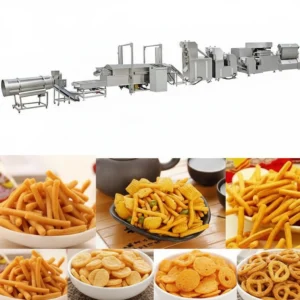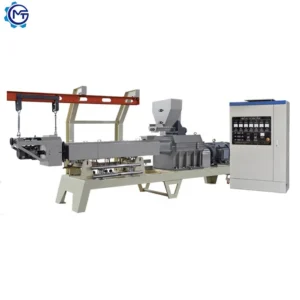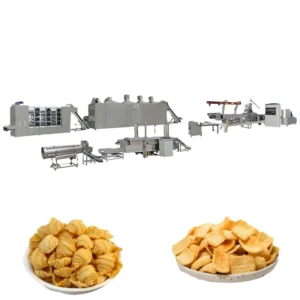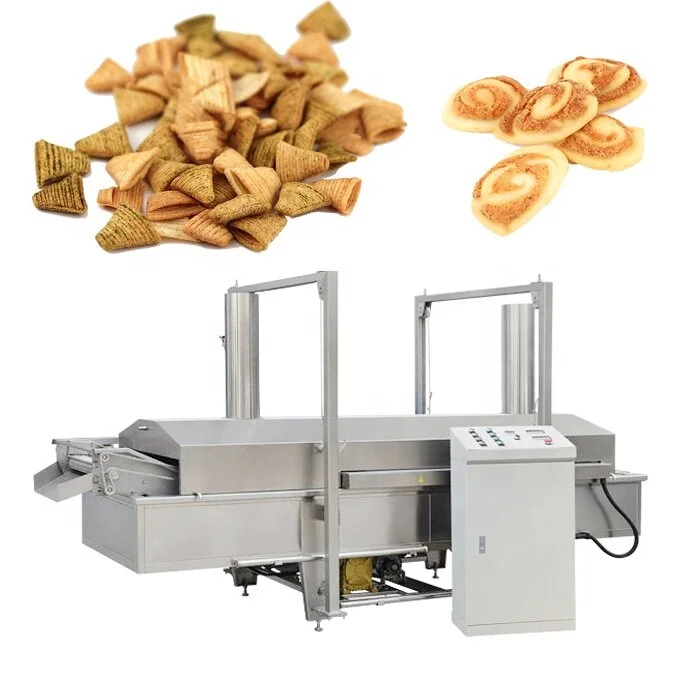
Full Equipment Coverage — every station in this fried snack food processing line, from the mixer through the 60 kW fryer to the flavoring drum, is sourced and throughput-matched by MT under one supply contract.
Technical Specifications
| Parameter | Value |
|---|---|
| Product Type | Fried Snack Food Extrusion and Frying Production Line |
| Line Stations | Mixer → Extruder (press machine) → Cutting Machine → Fryer → Flavoring Machine |
| Fryer Power | 60 kW |
| Flavoring Drum Power | 0.37 kW |
| Voltage & Frequency | Three-phase 380V/50Hz; Single-phase 220V/50Hz (customizable to buyer’s local grid) |
| Control System | Available with PLC and MCC control (automation level per station to be confirmed) |
| Output Capacity | (basis to be confirmed — dependent on product format and raw material recipe) |
| Screw Type | (basis to be confirmed — single or twin screw depending on configuration) |
| Product Formats | Rice crust chips, bugles, pizza rolls, pillow snacks, puffed snacks |
| Assembly State | Complete line with throughput-matched stations |
| Certification | CE |
Application Suitability
| Application | Material or Output |
|---|---|
| Rice crust chip production | Rice flour, starch blends, corn grits |
| Bugle and horn-shaped snack extrusion | Corn meal, wheat flour, starch-based dough |
| Pizza roll and filled pillow snack | Corn-starch base with savory or sweet filling |
| Fried puffed snack expansion | Pre-extruded pellets or direct-expanded dough |
| Snack line capacity addition | Upstream puffed snack output feeding into frying and seasoning stages |
Why the Fryer Capacity Must Match the Extruder Before You Sign
A fried snack food processing line full equipment range only works when every station’s throughput is calculated against the others — not quoted as isolated numbers.
I spent years running trial batches before moving to the project side, and one failure pattern comes up more than any other: the extruder pushes product faster than the fryer can handle, and semi-finished pieces pile up on the belt waiting for oil temperature to recover. The line stops, operators scramble, and two shifts vanish before anyone finds the right parameter window [NEED_CITE: throughput mismatch between extrusion and frying stages in snack plants]. That is why I now ask every buyer for their actual raw material recipe before I put a number on output. The corn-to-starch ratio, moisture content, and target expansion all shift what the fryer can absorb per hour.
How Each Station Fits the Next
The sequence on this fried snack food processing line full equipment range runs from the mixer through the extruder, cutting machine, fryer, and flavoring drum. Each station is specified so its cycle time aligns with the one before and after it. The mixer batch size is set to feed the extruder hopper continuously, the cutter slices at a rate the fryer belt can accept, and the flavoring drum rotates at a speed that seasons every piece without backing up the discharge conveyor.
Raw Material Dictates the Configuration
Corn meal, rice flour, and starch blends behave differently inside the extruder barrel. The screw configuration and die geometry must be chosen for the buyer’s specific recipe — a generic build designed for one starch type will produce the wrong density when run on another. We conduct trial runs in the testing workshop using the buyer’s actual raw material before the line ships, so product development starts before installation, not after [NEED_CITE: importance of pre-shipment trial runs for extruded snack lines].
Reading the Specs That Matter
The fryer draws 60 kW, which tells you the oil heating capacity and therefore the maximum product load it can sustain per hour without temperature drop. The flavoring drum runs at 0.37 kW — a low-draw motor suited to tumbling lightweight puffed snacks without crushing them. Voltage is configurable between three-phase 380V/50Hz and single-phase 220V/50Hz as a baseline, but local grids in Southeast Asia and parts of Africa fluctuate outside these ranges, so confirming your site supply before production starts avoids commissioning delays. The control system is available with PLC and MCC options, and the automation level at each station should be confirmed to match your operator skill set.
What Happens When Stations Are Mismatched
An extruder running at full output into a fryer that cannot keep up forces semi-finished product to accumulate on the transfer belt. Oil temperature drops when overloaded pieces enter the bath, producing uneven color and texture. Downstream, the flavoring drum receives surges rather than a steady flow, leaving some pieces over-seasoned and others bare [NEED_CITE: effects of line imbalance on snack quality consistency]. These are not parameter tweaks — they are design-level mismatches that require hardware changes to fix.
Why Buyers Source This Line From One Supplier
The fried snack food processing line full equipment range is built so throughput is matched across every station under a single supply contract, removing the finger-pointing that happens when a mixer vendor blames the extruder vendor for a bottleneck. Screw configuration and die design are specified to the buyer’s raw material and target snack format rather than copied from a generic template. An in-house testing workshop allows trial runs on the customer’s actual recipe before shipment, so the first production run at your facility starts from a known parameter set. Twin-screw expertise across puffed and fried snack applications means the extrusion stage is configured by engineers who understand how dough rheology affects fryer performance. Pre-sales consultation carries through to on-site installation, commissioning, and ongoing maintenance under the same project team.
Documentation & Verification
- Line layout showing throughput calculation at each station from mixer to flavoring drum
- Trial run report on your raw material recipe conducted before shipment
- Screw and die configuration record specific to your snack format
- Electrical schematic with confirmed voltage, frequency, and control language
- CE declaration of conformity covering the complete line assembly
- Wear parts list with reorder codes for screws, dies, and fryer mesh belt
Installation, Commissioning & Support
- Foundation must support the 60 kW fryer with level tolerance for oil bath stability
- Dedicated three-phase circuit sized for combined extruder and fryer draw
- Line arrives in station modules requiring belt alignment and utility hookup on site
- First-run parameter setting based on pre-shipment trial report data
- Operator training covers PLC interface navigation and emergency stop sequences
- Spare screw elements and fryer mesh belt sections stocked for first replacement cycle
- Routine maintenance schedule tied to fryer oil filtration and extruder barrel inspection
What We Need to Configure Your Line
Send your raw material recipe — including the flour-to-starch ratio and moisture percentage — along with the target snack format you plan to produce first. Confirm your site voltage, frequency, and whether you need the HMI in a language other than English. If you have existing upstream or downstream equipment you want to integrate, share the model and throughput so we can match the interface.
Frequently Asked Questions
Q: How is output capacity verified, and what is it based on?
A: Capacity depends on your raw material recipe, moisture content, and the specific snack format. We run trial batches in our testing workshop using your actual ingredients and document the sustainable output before quoting. The number on the proposal will reference those trial conditions, not a generic catalog figure.
Q: How do you prevent the fryer from bottlenecking the extruder?
A: Each station’s throughput is calculated against the others during line design. The 60 kW fryer capacity is matched to the extruder output based on your product’s oil absorption rate and required fry time, so pieces move through without accumulating on transfer belts.
Q: Can voltage, frequency, and control language be confirmed before production?
A: Yes — we confirm your site’s three-phase or single-phase supply, exact frequency, and HMI language during the specification stage. The electrical schematic is signed off before the line enters production, preventing commissioning delays caused by mismatched power standards.
Q: Is a trial run on our raw material done before shipment?
A: Every line goes through a trial run in our testing workshop using the buyer’s actual raw material. The resulting trial report documents screw speed, barrel temperature, and die settings, so your first production run starts from proven parameters rather than trial and error.
Q: What spare wear parts are included with the first shipment?
A: The initial shipment includes screw elements, die plates, and fryer mesh belt sections sized for your first replacement cycle. A wear parts list with reorder codes is provided so your procurement team can plan lead times before the first changeover is due.