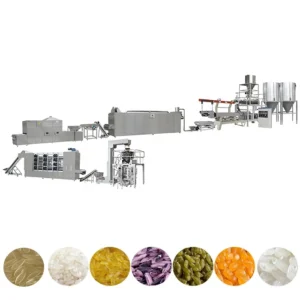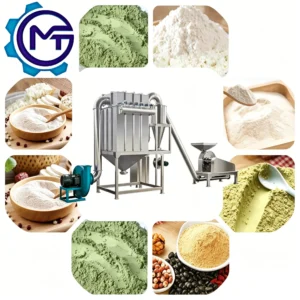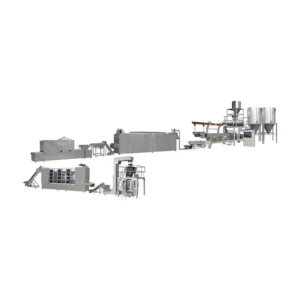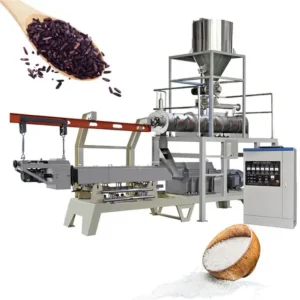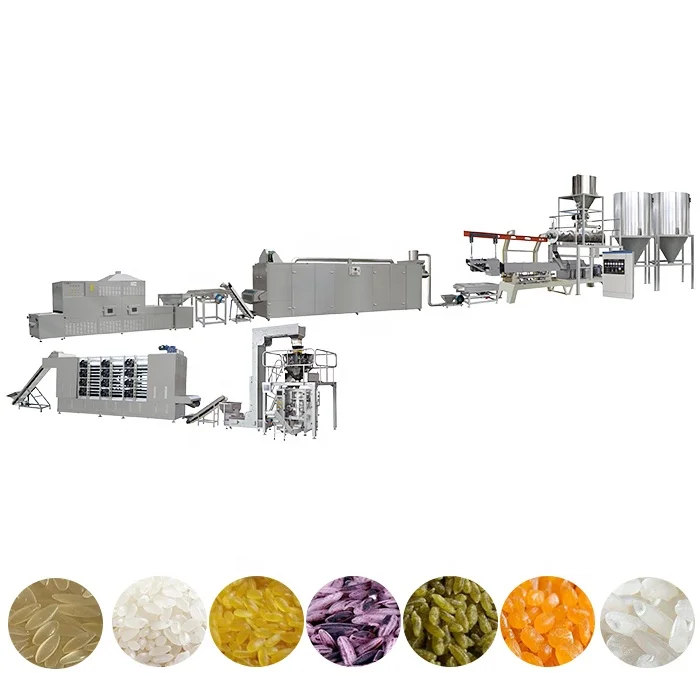
Integrated station matching — Every mixer, extruder, screen, dryer, cooler, and packer in the nutritional powder workflow is specified as a standalone unit so throughput balances across the line rather than bottlenecking at one stage.
Technical Specifications
| Parameter | Value |
|---|---|
| Product Type | Twin Screw Nutritional Powder Processing Line |
| Screw Type | Twin-screw |
| Line Stations | Mixing, feeding, extruding, screening, drying, cooling, packing |
| Control System | PLC (basis not stated in source — confirm brand, language, HMI model) |
| Output Capacity | Basis to be confirmed on raw material and moisture |
| Voltage & Frequency | Configurable to target market standard |
| Raw Material Handling | Powder mixer with preset ratio blending |
| Drying System | Vibrating screen with fan and drying box |
| Conveying | Feeder, air conveyor, lifting machine |
| Assembly State | Complete integrated line |
| Standards | CE and ISO certification available on request |
Application Suitability
| Application | Material or Output |
|---|---|
| Nutritional powder production | Blended grain, legume, and vitamin premix powders |
| Infant formula base processing | Rice flour, soy isolate, and micronutrient blends |
| Fortified rice grain extrusion | Broken rice flour with iron and folic acid fortification |
| Breakfast ingredient granulation | Oat, corn, and multigrain flour blends |
What a Bottlenecked Nutritional Powder Processing Line Actually Costs You
Matching every station’s throughput before the line ships prevents the dryer or packer from choking the extruder’s output.
I once saw a nutritional powder line where the extruder was rated well above what the downstream dryer could handle. The result was wet product piling up on the vibrating screen, sticking together, and forcing the operator to cut extruder speed in half just to keep the line running. A nutritional powder processing line manufacturer that quotes only the extruder capacity without verifying the drying and cooling stages is leaving a hidden constraint inside your factory. [NEED_CITE: throughput balancing across extrusion line stations]
How Each Station Connects in the Nutritional Powder Workflow
The powder mixer blends raw materials — rice flour, soy isolate, vitamin premixes — in preset ratios before the feeder meters a steady stream into the twin-screw extruder. Consistent blending at this first stage is what keeps the nutritional profile uniform across every batch. The extruder then softens and forms the material into the target granule or grain shape, after which the vibrating screen separates oversized or undersized particles before the drying box and fan reduce moisture to the specification your packing station requires.
Why the Twin-Screw Extruder Sits at the Centre of the Line
A twin-screw configuration handles the wide range of particle sizes and moisture levels typical in nutritional and infant formula powder production. The intermeshing screws provide the shear and residence time needed to gelatinise starches evenly without scorching heat-sensitive vitamins. When the nutritional powder processing line is configured correctly, the extruder output arrives at the vibrating screen at a moisture level the drying box can bring down to packing specification in a single pass, eliminating re-circulation loops that degrade product quality. [NEED_CITE: twin-screw extrusion behaviour with vitamin-fortified powder blends]
Reading the Specs That Matter for Nutritional Powder Output
The screw type — twin-screw versus single-screw — determines how well the line handles low-moisture, high-starch blends common in infant formula and fortified rice production. Twin-screw extruders maintain self-cleaning action and uniform shear across varying formulations, which matters when you switch from a rice-based recipe to a legume-based one. The control system, specified here as PLC, governs barrel temperature zones and screw speed; the exact PLC brand, HMI language, and zone count should be confirmed to match your operators’ requirements and local electrical codes. The drying system pairs a vibrating screen with a fan and drying box, a combination that prevents granule clumping while controlling final moisture. Voltage and frequency must be set to your target market before production begins, since rewiring a control panel on site adds days to commissioning.
The Hidden Cost of Skipping a Station-by-Station Capacity Check
When a line is assembled from separate vendors, each station may perform well in isolation yet fail to match its neighbours. A dryer that cannot keep pace with the extruder forces operators to run the extruder below its rated output, wasting installed capacity. A vibrating screen set to the wrong mesh size lets fines reach the packer, producing underweight bags and triggering rejects at your customer’s warehouse. These mismatches rarely show up in a brochure — they surface only after the line is bolted to your factory floor and your first production run falls short of plan. [NEED_CITE: common causes of throughput mismatch in multi-station extrusion lines]
Why Buyers Survey Equipment Here Before Locking a Line Layout
Every station from the powder mixer to the packing conveyor is listed as a standalone machine, so you can compare capacity, footprint, and utility demand before committing to a full layout. Screw configuration and die design are specified to your raw material and target granule shape rather than copied from a generic build. The testing workshop runs your actual premix formulation before shipment, confirming expansion, density, and moisture on each station. Electrical schematics arrive with voltage, frequency, and control language confirmed to your market, so the panel matches your local supply on day one. Spare wear parts — screws, dies, screen meshes — are documented with part numbers in the wear parts list so replacements ship without delay when the first changeover is due. [NEED_CITE: CE machinery directive requirements for food processing equipment]
Documentation & Verification
- Machine specification sheet listing each station’s throughput and utility demand
- Screw and die configuration record matched to your premix formulation
- Electrical schematic with voltage, frequency, and HMI language confirmed
- Factory test record on your actual raw material before dispatch
- CE declaration of conformity and ISO certificate provided with shipment
- Wear parts list with part numbers for screws, dies, and screen meshes
Installation, Commissioning & Support
- Foundation plan drawn to the integrated line’s overall footprint and weight distribution
- Dedicated power circuit sized to the PLC-controlled extruder motor and dryer heater load
- Line arrives in station modules for sequential assembly on pre-set anchor points
- First-run parameter setting covers barrel temperatures, screw speed, and dryer airflow
- Operator training on the PLC interface in the confirmed control language
- Wear parts shipment schedule aligned to your first screw and die changeover
What We Need to Configure Your Line
Share your raw material formulation, including base flours and premix ratios, along with the target granule size and final moisture specification. Provide your local voltage, frequency, and preferred HMI language so the control panel ships ready for your electrical supply. If you have existing upstream mixing or downstream packing equipment, send the make and model so we match interface heights and conveyor speeds.
Frequently Asked Questions
Q: Which stations are included in the nutritional powder processing line and what does each do?
A: The line covers a powder mixer for preset ratio blending, a feeder for metering, a twin-screw extruder for gelatinisation and forming, a vibrating screen for particle separation, a drying box with fan for moisture reduction, a cooler, and a packing station. Each machine is listed individually so you can verify capacity and utility demand before the layout is locked.
Q: How is throughput matched between the extruder, dryer, and packing station?
A: Every station’s rated throughput is calculated on your raw material and target moisture. The drying box capacity and vibrating screen area are sized so the extruder output passes through without accumulation. A line layout document shows each station’s matched rate so you can confirm balance before the order is placed.
Q: What voltage, frequency, and control language options are available?
A: Voltage and frequency are configurable to your target market standard, and the PLC HMI language is set before shipment. Provide your local electrical code and preferred operator language during the specification stage so the panel and motor ratings arrive correct on day one.
Q: How do I select the right extruder model for my capacity target?
A: Share your target output in kg/h along with the raw material blend and moisture content. The extruder is then selected based on screw diameter, L:D ratio, and motor power that match those inputs. A machine specification sheet confirms the chosen model’s rated capacity on your specific formulation.
Q: What spare wear parts are stocked and how are they shipped?
A: Screws, dies, and screen meshes are documented in a wear parts list with individual part numbers. Replacement sets are prepared before shipment and can be re-ordered using those numbers. International courier or consolidated sea freight options are arranged based on your production schedule urgency.