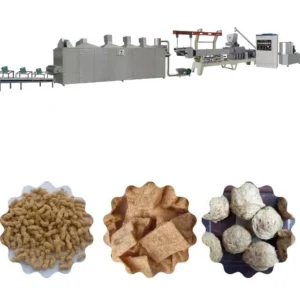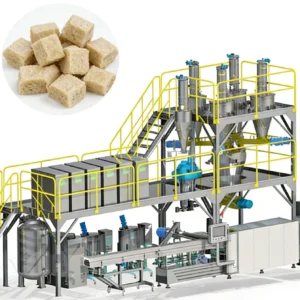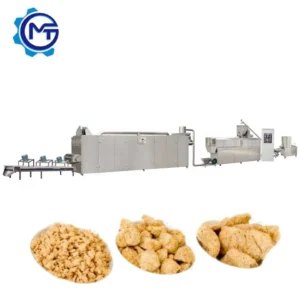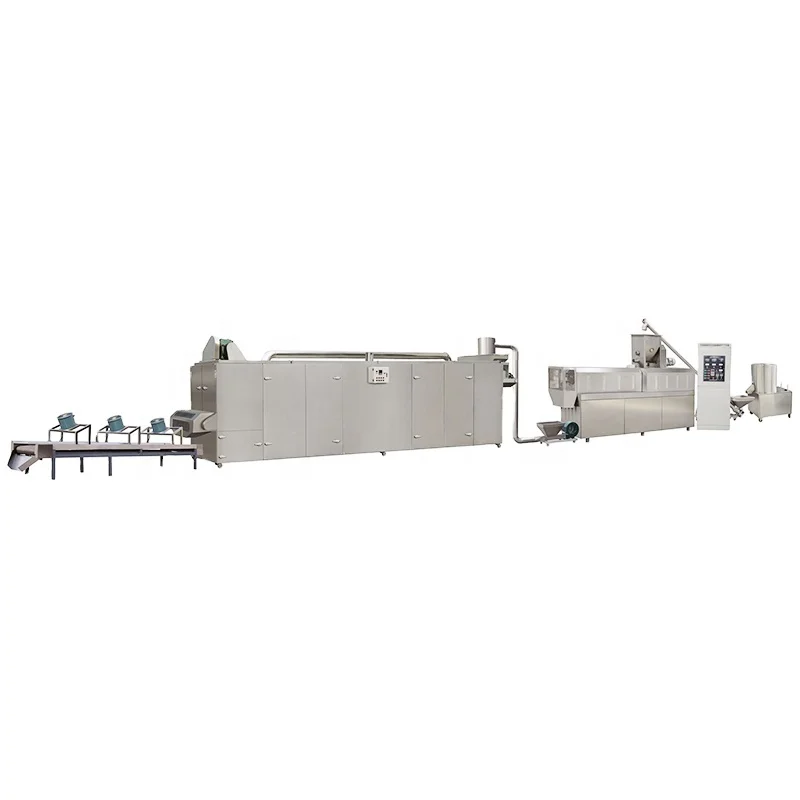
Integrated Throughput Engineering — Every station on this MT65 textured vegetable protein line is balanced for continuous flow, preventing the dryer or cooling bottleneck that typically stalls extruder output.
Technical Specifications
| Parameter | Value |
|---|---|
| Model | MT65 |
| Product Type | Textured Vegetable Protein Processing Line |
| Screw Type | Twin-screw |
| Installed Power | 85 kW |
| Real Power Consumption | 65 kW |
| Output Capacity | 150–200 kg/h (basis not stated in source — confirm raw material type, moisture content, protein source) |
| Overall Dimensions (MT65) | 18000 × 1300 × 2300 mm |
| Alternative Models | MT70 / MT85 |
| Control System | PLC and MCC |
| Construction Material | Stainless steel (food-grade contact materials) |
| Powder Mixer Output | 300–600 kg/h |
| Powder Mixer Tank Volume | 150 kg |
| High-temperature Roaster Effective Belt Length | 3.5 m |
| High-temperature Roaster Dimensions | 4500 × 1500 × 1600 mm |
| Cooling Machine Capacity | 200–300 kg/h |
| Assembly State | Complete line |
| Standards | CE, ISO |
| Warranty | 1 year complete warranty; lifetime maintenance service |
Application Suitability
| Application | Material or Output |
|---|---|
| Soy meat analogue production | Low-temperature soybean meal |
| Plant-based meat alternatives | Peanut meal and protein blends |
| Ingredient supply for sausages and canned food | Textured soy protein chunks and strips |
| Quick-frozen meal component manufacturing | Minced meat analogues |
The Density Trap: Why Your Protein Source Dictates the Screw Profile
A generic screw build will fail the moment your isolate ratio deviates from the standard test formula.
When sourcing a textured vegetable protein production line for sale, buyers often see capacity figures based on a standard soy concentrate. However, if your actual formulation relies heavily on soy protein isolate or a custom blend, the shear profile inside the barrel changes completely. The material may gelatinize too early or fail to form the necessary fibrous structure, resulting in a product that falls apart during hydration. This mismatch is the primary cause of commissioning delays [NEED_CITE: extrusion screw configuration and protein isolate behavior]. Specifying the screw elements and die geometry to your exact raw material blend is the only way to guarantee the target texture.
Station-by-Station Equipment Breakdown
This catalogue entry details the complete sequence of machinery required to transform raw protein powder into finished, shelf-stable TVP. The process begins with a powder mixer operating at 385 rpm to ensure uniform hydration before the material enters the twin-screw extruder. The MT65 extruder serves as the core reactor, where temperature zones and screw speed dictate the degree of protein texturization.
Following extrusion, the product moves to a high-temperature roaster equipped with far-infrared heaters and a 3.5-meter effective belt length. This station is critical for reducing moisture content and setting the fiber structure. The line concludes with a cooling machine that brings the product to a safe temperature for packing, ensuring the entire textured vegetable protein production line for sale operates without manual transfer bottlenecks.
Matching Mixer and Extruder Throughput
A common failure in line assembly is the imbalance between the batching station and the extruder feed rate. The powder mixer listed here processes batches of 150 kg with a mixing time of approximately 10 minutes, yielding a throughput that supports continuous extrusion. If the mixer is undersized, the extruder starves, causing temperature spikes and inconsistent expansion [NEED_CITE: continuous extrusion feed rate stability]. Conversely, an oversized mixer leads to material settling and moisture migration before it reaches the hopper.
How Barrel Temperature Profiles Affect Fiber Formation
The twin-screw configuration allows for precise control over the thermal and mechanical history of the protein dough. The installed power of 85 kW on the MT65 provides the torque necessary to maintain screw speed against the high viscosity of concentrated protein pastes. Independent heating zones along the barrel enable the operator to create a gradient that unfolds the protein molecules gradually. If the temperature rises too sharply, the surface of the extrudate case-hardens, trapping steam and causing post-extrusion collapse rather than the desired layered meat-like texture.
The Hidden Cost of Ignoring Utility Planning
One of the most frequent reasons for stalled commissioning is the failure to confirm local voltage and frequency before production begins. A textured vegetable protein production line for sale configured for 380V/50Hz will suffer immediate motor damage or control system failure if connected to a 440V/60Hz supply without transformer adjustment. Furthermore, the control language on the PLC interface must match the operators’ proficiency; a mismatch here leads to incorrect parameter inputs during the critical first week of production. These issues are entirely preventable but regularly cost buyers weeks of downtime [NEED_CITE: industrial machinery voltage and frequency compatibility].
Why Source the Full Line from One Supplier
- Throughput Balancing: The roaster capacity (300–400 kg/h) and cooling machine capacity (200–300 kg/h) are calculated to handle the maximum output of the MT65 extruder, preventing wet product pile-ups on the conveyor.
- Process-Specific Configuration: The screw and die design are not generic; they are selected based on the buyer’s specific protein source (soy or peanut) to ensure correct fiber alignment.
- Pre-Shipment Verification: Every line undergoes a trial run in our testing workshop using the customer’s actual raw material, validating the texture and density before the machine leaves the factory.
- Unified Documentation: You receive a single set of electrical schematics, PLC logic diagrams, and maintenance manuals that cover the entire sequence from mixer to packer.
- Integrated Control: The PLC and MCC systems are wired to communicate across stations, allowing the extruder speed to automatically adjust if the downstream dryer detects a moisture deviation.
Documentation & Verification
- Line layout and capacity calculation confirming throughput match across every station.
- Screw and die configuration record specified to the buyer’s actual raw material.
- Trial run report on customer raw material executed in the testing workshop.
- Electrical schematic and voltage confirmation for the target market grid.
- Operation and maintenance manual covering all line stations.
Installation, Commissioning & Support
- Foundation must support the 18-meter length of the MT65 line with level tolerances for the extruder and roaster.
- Power supply must accommodate the 85 kW installed load with dedicated breakers for the main extruder motor.
- Stainless steel contact parts are pre-assembled, but the roaster belt and cooling conveyors require on-site tensioning.
- PLC parameters are calibrated during commissioning to match local ambient humidity and cooling water temperature.
- Spare wear parts list includes specific screw elements and die plates for the MT65 twin-screw configuration.
Project Scoping Requirements
To provide an accurate proposal for a textured vegetable protein production line for sale, we require details on your specific formulation. Please supply the ratio of soy concentrate to isolate, the target moisture content of the finished product, and your daily production target in tons. Additionally, confirm your factory’s available voltage and the preferred language for the HMI interface. This data allows us to configure the screw profile and select the correct downstream drying capacity to match your market requirements.
Frequently Asked Questions
Q: How is the output capacity verified, and on which raw material is it based?
A: The listed capacity of 150–200 kg/h for the MT65 is a baseline. Actual throughput depends on your specific protein blend and moisture content. We verify the real output by running a trial with your raw material in our testing workshop before shipment, ensuring the line meets your production targets.
Q: Can the screw configuration handle high-isolate formulations?
A: Yes, but the screw profile must be adjusted. Standard screws are designed for soy meal; high isolate ratios require specific shear elements to prevent the material from dispersing. We design the screw and die set based on the exact formulation you provide during the inquiry stage.
Q: What voltage and control options are available for export markets?
A: The line is configurable for various industrial voltage and frequency standards. The PLC and MCC control systems can be specified to match your local grid, and the HMI language is selected to ensure your operators can manage the process parameters effectively.
Q: Is it possible to run a trial on my raw material before the line ships?
A: We mandate a trial run using your supplied raw material in our in-house testing workshop. This step confirms the fiber structure, density, and color of the TVP, allowing us to finalize the screw configuration and temperature settings before the equipment is packed.
Q: How do you ensure the dryer matches the extruder output?
A: We calculate the moisture load based on the extruder’s maximum throughput and select a roaster with sufficient belt length and heating power. This prevents the bottleneck where wet product accumulates because the drying station cannot keep pace with the extrusion rate.