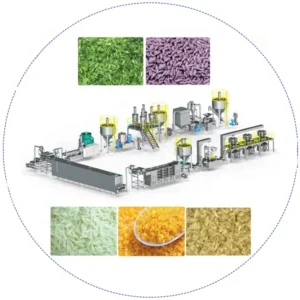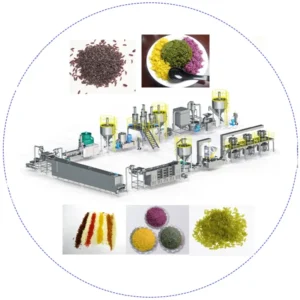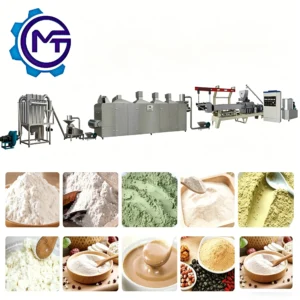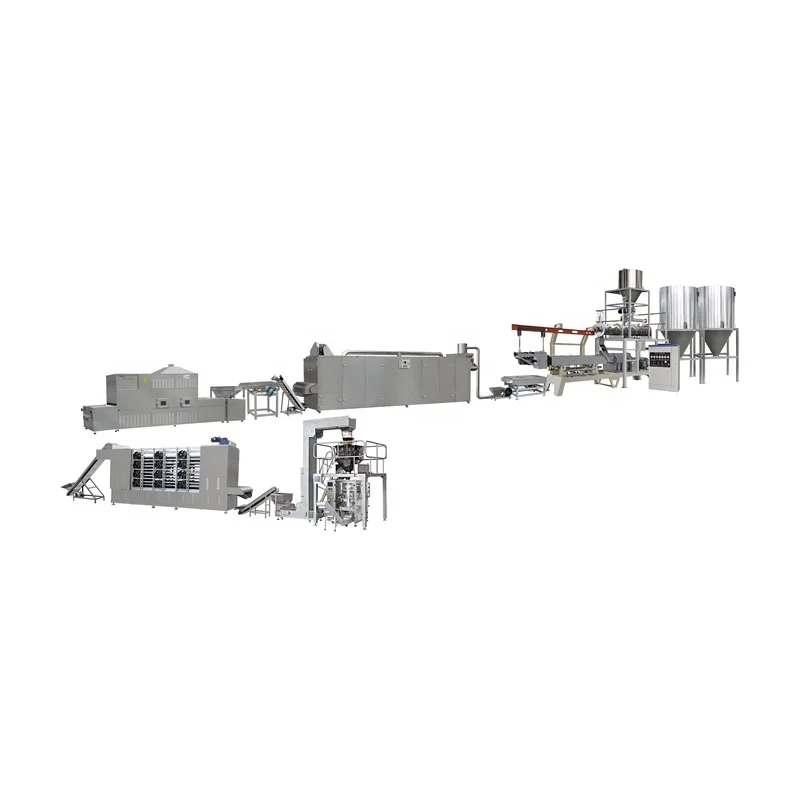
Integrated Throughput Matching — every station from mixing to packing is sized to the extruder’s actual output on your grain formulation, eliminating single-machine bottlenecks in fortified rice kernel production.
Technical Specifications
| Parameter | Value |
|---|---|
| Product Type | Fortified Rice Kernel Extrusion Line |
| Models Available | MT65, MT70, MT85, MT75, MT95 |
| Screw Type | Twin-screw |
| Installed Power | MT65: 85 kW | MT70: 120 kW | MT85: 235 kW | MT75: 180 kW | MT95: 260 kW |
| Power Consumption | MT65: 60 kW | MT70: 85 kW | MT85: 165 kW | MT75: 135 kW | MT95: 195 kW |
| Output Capacity | MT65: 80–100 kg/h | MT70: 100–120 kg/h | MT85: 200–300 kg/h | MT75: 300–500 kg/h | MT95: 800–1000 kg/h (basis not stated in source — confirm raw material formulation and moisture content) |
| Overall Dimensions (L×W×H) | MT65: 28 × 1.2 × 2.2 m | MT70: 30 × 1.5 × 2.2 m | MT85: 34 × 3.5 × 4.3 m | MT75: 32 × 3.5 × 4.3 m | MT95: 36 × 3.5 × 4.3 m |
| Control System | Frequency speed control with high automation |
| Feeding System | Single or double screw feeding, selectable by material characteristics |
| Screw Material | Special wear-resistant alloy |
| Lubrication | Automatic lubricating and cooling system |
| Heating Source (Dryer) | Electric or gas |
| Dryer Feature | Circulation drying with frequency motor controlled mesh belt speed |
| Certification | CE |
Application Suitability
| Application | Material or Output |
|---|---|
| Nutritionally fortified rice kernels | Broken rice and rice bran with added micro-nutrients (vitamins, minerals) |
| Artificial rice manufacturing | Grain-based formulations using corn, millet, wheat, oats, buckwheat, bean, and starch |
| Food fortification and nutrition programmes | Fortified kernels blended with natural rice at specified ratios |
| Instant rice production | Extruded kernels retaining viscosity, elasticity, and taste characteristics of natural rice |
What "Rated Capacity" Means When the Formulation Changes
The number on the nameplate only holds if your raw material behaves like the test material.
I learned this the hard way on a fortified rice project a couple of years back. The line was configured for standard broken rice flour, and the extrusion parameters were locked in accordingly. When the client sent their actual blended powder — rice flour cut with millet and a vitamin premix — the kernel formation rate dropped noticeably. The starch gelatinisation window had shifted, and the screw speed that worked for pure rice was generating too much shear for the mixed grain. This is why a Fortified Rice Kernel Making Machine full equipment range must be specified against the buyer’s real formulation, not a benchmark flour [NEED_CITE: starch gelatinisation behaviour across mixed grain formulations].
Matching Each Station to Your Grain Formulation
When surveying the full machinery catalogue for a fortified rice line, the extruder is only one variable. The feeding system determines whether your premix — often a blend of broken rice powder, starch, and micro-nutrient additives — enters the barrel with consistent density. Single screw feeding suits uniform, free-flowing powders, while double screw feeding handles blends that tend to bridge or segregate. Selecting the wrong feeder type introduces fluctuating load into the barrel, which directly affects kernel shape consistency downstream.
How the Drying Sequence Protects Kernel Integrity
The drying stage in this Fortified Rice Kernel Making Machine full equipment range follows a deliberate thermal sequence. Low temperature drying removes surface moisture without case-hardening the kernel, then a cooling stage stabilises the structure before high temperature roasting develops the final colour and texture. The circulation dryer uses a frequency-controlled mesh belt, so residence time is adjustable to the moisture profile of your specific formulation [NEED_CITE: multi-stage drying sequence for extruded grain products]. Skip or compress any of these stages and the kernels crack during storage or fail to cook evenly when the end consumer prepares them.
Reading the Specs Against Your Production Target
The twin-screw configuration across the MT65 through MT95 series provides the shear and mixing intensity required for starch gelatinisation in grain-based formulations. The screw material — a wear-resistant alloy — matters because fortified rice blends often contain mineral premixes that accelerate barrel and screw wear compared to plain starch extrusion. Installed power ranges from 85 kW on the MT65 to 260 kW on the MT95, and power consumption figures sit noticeably lower, reflecting actual running load rather than peak draw. The automatic lubricating and cooling system keeps the gearbox within safe thermal limits during continuous runs, which is critical when producing nutrition programme volumes where batch interruptions are costly.
The Cost of Mismatched Stations
When an extruder is paired with an undersized dryer, the line backs up and kernels sit in the vibratory conveyor longer than intended, absorbing ambient moisture and losing shape definition. An undersized cooling conveyor downstream of the roasting stage means kernels enter the packing station still warm, which creates condensation inside sealed bags and shortens shelf life. These are not theoretical problems — they show up as product complaints months after commissioning, and tracing them back to station mismatch takes time most producers cannot afford [NEED_CITE: post-extrusion moisture management in grain kernel production].
Why Procurement Through One Equipment Supplier Matters
Sourcing the full Fortified Rice Kernel Making Machine full equipment range from a single supplier means throughput calculations are performed across every station before the line is built. The screw configuration and die design are specified to the buyer’s raw material and target kernel shape, not copied from a generic build. An in-house testing workshop allows trial runs on the client’s actual formulation before the equipment leaves the factory. Electrical schematics and voltage specifications are confirmed against the destination facility’s power supply before production starts. CE-certified construction and ISO-aligned processes provide a documented baseline for quality assurance. Pre-sales engineering consultation carries through to on-site installation, commissioning, and operator training, so the team running the line understands how each station interacts with the next.
Documentation & Verification
- Line layout showing throughput matching across mixing, extruding, drying, and packing stations
- Screw and die configuration record matched to your grain blend and target kernel dimensions
- Trial run report on your raw material conducted in the testing workshop before shipment
- Electrical schematic with voltage and frequency confirmed to your facility’s local supply
- Operation and maintenance manual with station-specific parameter ranges for your formulation
- Wear parts list specifying screw segments, dies, and feeder components with replacement intervals
Installation, Commissioning & Support
- Floor plan review against overall line dimensions (up to 36 m length on the MT95 configuration)
- Dedicated power circuit sized to installed power, up to 260 kW depending on model selected
- Frequency speed control system calibrated on-site to match your formulation’s extrusion behaviour
- Dryer heating source configured for electric or gas based on local utility availability
- Automatic lubrication system checked and filled before first continuous production run
- Operator training covering feeder selection, barrel temperature profile, and mesh belt speed adjustment
Preparing Your Line Specification Inquiry
To move from equipment survey to a matched configuration, share your raw material list with formulation ratios, target daily output, and the physical dimensions you need for the finished kernel. Confirm your facility’s voltage, frequency, and available floor space including ceiling height. If you have existing upstream milling or downstream packing equipment, note the interface requirements so the line integrates cleanly. Requesting a trial run on your actual blended material is strongly recommended before finalising the order.
Frequently Asked Questions
Q: How is each model’s output capacity rated, and what formulation is it based on?
A: Published capacity ranges across the MT65 to MT95 series are reference figures. Actual throughput depends on the specific grain blend, moisture content, and target kernel density. Capacity confirmation requires sharing your raw material formulation so the extruder and supporting stations can be sized against real processing behaviour rather than a benchmark material.
Q: Which supporting stations are included in the full line sequence?
A: The complete line covers mixing, extruding, vibrating, low temperature drying, cooling, high temperature roasting, a second cooling stage, and packing. Each station is throughput-matched to the extruder model selected, so no single unit constrains the line. Station specifications are documented in the layout proposal before order confirmation.
Q: Can the dryer be configured for electric or gas heating?
A: Yes. The circulation drying oven supports both electric and gas heating sources. The selection depends on local utility availability and cost structure at the installation site. Heating source configuration is confirmed during the specification phase before production begins.
Q: What determines whether single or double screw feeding is specified?
A: The choice depends on raw material flow characteristics. Uniform, free-flowing powders such as milled broken rice work well with single screw feeding. Blends containing multiple grain types, starches, and micro-nutrient premixes that tend to bridge or segregate require double screw feeding for consistent barrel loading. Material testing during trial runs confirms the correct selection.
Q: How are machine dimensions mapped to factory layout planning?
A: Overall line dimensions range from approximately 28 m to 36 m in length depending on the model, with widths from 1.2 m to 3.5 m. A detailed layout drawing is produced showing each station’s footprint, utility connection points, and operator access zones, allowing the buyer to verify fit against available floor space and ceiling height before committing to the order.