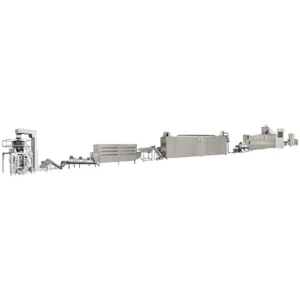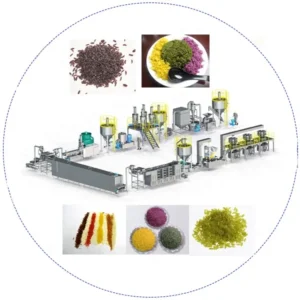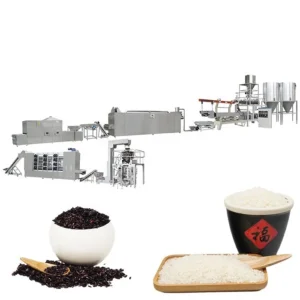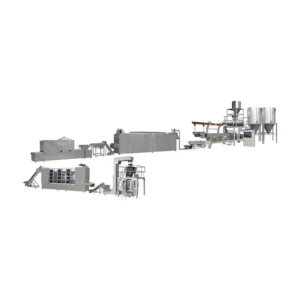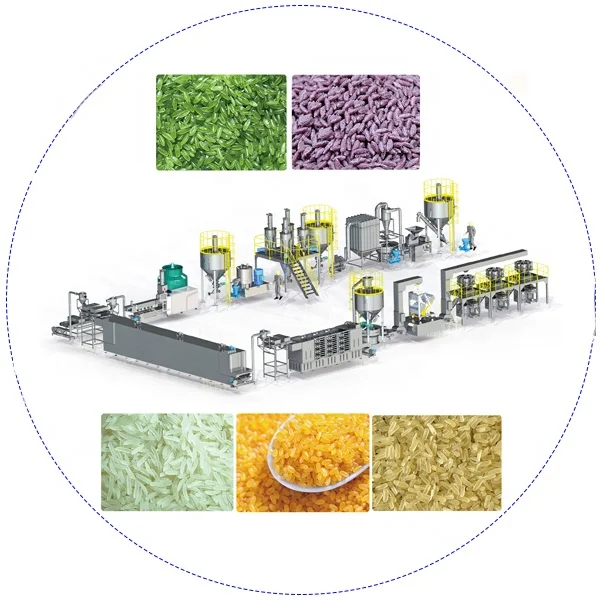
Throughput-matched line design — every station from mixing to packing is sized to hold the extruder’s rated output without bottlenecking the fortified rice processing line full equipment range.
Technical Specifications
| Parameter | Value |
|---|---|
| Product Type | Fortified Rice Processing Line / Artificial Rice Extruder |
| Models Available | MT65, MT70, MT85, MT75, MT95 |
| Screw Type | Twin-screw |
| Installed Power (MT65) | 85 kW |
| Power Consumption (MT65) | 60 kW |
| Capacity (MT65) | 80–100 kg/hr (basis not stated in source — confirm raw material formulation and moisture content) |
| Dimensions (MT65) | 28 × 1.2 × 2.2 m |
| Installed Power (MT70) | 120 kW |
| Power Consumption (MT70) | 85 kW |
| Capacity (MT70) | 100–120 kg/hr (basis not stated in source — confirm raw material formulation and moisture content) |
| Dimensions (MT70) | 30 × 1.5 × 2.2 m |
| Installed Power (MT85) | 235 kW |
| Power Consumption (MT85) | 165 kW |
| Capacity (MT85) | 200–300 kg/hr (basis not stated in source — confirm raw material formulation and moisture content) |
| Dimensions (MT85) | 34 × 3.5 × 4.3 m |
| Installed Power (MT75) | 180 kW |
| Power Consumption (MT75) | 135 kW |
| Capacity (MT75) | 300–500 kg/hr (basis not stated in source — confirm raw material formulation and moisture content) |
| Dimensions (MT75) | 32 × 3.5 × 4.3 m |
| Installed Power (MT95) | 260 kW |
| Power Consumption (MT95) | 195 kW |
| Capacity (MT95) | 800–1000 kg/hr (basis not stated in source — confirm raw material formulation and moisture content) |
| Dimensions (MT95) | 36 × 3.5 × 4.3 m |
| Control System | Frequency speed control |
| Heating System (Dryer) | Electric or gas |
| Lubrication | Automatic |
| Cooling System | Automatic |
| Feeding System | Single or double screw feeding, selectable by material |
| Line Stations | Mixing → Extruding → Vibrating → Low-temperature Drying → Cooling → High-temperature Roasting → Cooling → Packing |
Application Suitability
| Application | Material or Output |
|---|---|
| Fortified rice kernel production | Broken rice, rice bran blended with vitamins and minerals |
| Artificial rice for nutrition programmes | Rice flour, corn, millet with micro-nutrient additives |
| Value-added rice products | Wheat, oats, buckwheat, bean, starch formulations |
| Institutional food supply | Extruded rice kernels with solidified micro-nutrients |
What the Stated Capacity Figures Leave Out About Your Fortified Rice Processing Line Full Equipment Range
A capacity number without a raw material premise is just a motor rating.
When I first started surveying extrusion lines for buyers across Latin America, I watched a fortified rice project stall for weeks because the extruder was quoted on standard rice flour, but the buyer’s actual formulation included high-fiber buckwheat and local bean varieties. The starch gelatinisation behaviour was entirely different, and the machine could not hold its nameplate throughput on that mix. The dryer downstream was then oversized for the actual output, wasting energy on empty belt space [NEED_CITE: raw material formulation impact on extrusion throughput]. This is why every capacity figure in the table above carries a confirmation note — the fortified rice processing line full equipment range must be validated against your specific grain blend, moisture content, and micro-nutrient loading before the line is finalized.
How Each Station Connects in the Fortified Rice Line
The fortified rice processing line full equipment range begins with a mixing station that blends broken rice, starches, and micro-nutrient premix into a uniform feed. The feeding system offers single or double screw options, chosen based on how freely your specific formulation flows — sticky, high-moisture blends typically need the positive displacement of a double screw feeder to maintain consistent extruder intake.
From extrusion, the product moves through a vibrating station that separates and aligns the freshly formed rice kernels before they enter the drying sequence. The low-temperature drying stage removes surface moisture gently, preventing case hardening that would trap steam inside the kernel and cause cracking during storage.
The Multi-Stage Drying Sequence Explained
After the initial low-temperature drying, the kernels pass through a cooling conveyor that equalises their internal temperature before the high-temperature roasting stage. This roasting step develops the final texture and colour that buyers expect from fortified rice kernels, while a second cooling conveyor brings them to a safe packing temperature [NEED_CITE: multi-stage drying principles for extruded grain products]. The drying oven uses a frequency motor-controlled mesh belt, so belt speed adjusts to match whatever throughput the extruder is actually delivering — not just the nominal figure.
Reading the Power and Capacity Spread Across the MT Series
The MT65 draws 85 kW installed and suits smaller production runs where a buyer is testing a new fortified rice product for a regional nutrition programme. Stepping up, the MT75 and MT85 occupy the middle range where most commercial rice processors operate, with the MT75 delivering higher throughput in a slightly more compact footprint than the MT85. The MT95, at 260 kW installed and 36 metres in line length, addresses large-scale institutional supply contracts. Across all models, the twin-screw configuration provides the shear and mixing intensity needed to fully gelatinise starches from diverse grain sources — rice, corn, millet, buckwheat, and bean — while distributing added vitamins and minerals evenly through every kernel. Automatic lubrication and cooling reduce the manual intervention required during long production runs, which matters when operators are managing a multi-station line rather than a single machine.
What Happens When the Dryer Cannot Keep Up
An extruder running at full output means little if the drying oven is undersized. Kernels pile up on the mesh belt, residence time drops, and moisture leaves the line unevenly. Some kernels arrive at packing still soft in the centre, inviting mould growth within weeks. Others over-dry on the surface while remaining wet inside [NEED_CITE: moisture uniformity requirements for extruded rice storage stability]. This bottleneck is the reason the fortified rice processing line full equipment range is configured as a matched set — extruder throughput, dryer belt area, and cooling conveyor length are calculated together rather than sourced from separate vendors who size their equipment in isolation.
Why Sourcing the Full Range From One Supplier Matters
Screw configuration and die design are specified to the buyer’s actual grain formulation and target kernel density, not copied from a generic build. An in-house testing workshop runs trial production on your raw material before shipment, so gelatinisation degree, kernel shape, and drying behaviour are confirmed while there is still time to adjust screw elements. The line layout and capacity calculation document shows every station’s throughput matched to its neighbours, giving you a single reference for utility planning and floor space allocation. CE and ISO certification documentation accompanies each shipment, supporting customs clearance and local regulatory registration [NEED_CITE: CE machinery directive requirements for food processing equipment]. Frequency speed control across the line lets operators fine-tune each station independently when raw material batches vary seasonally.
Documentation & Verification
- Line layout drawing showing station-by-station throughput balance for your chosen model
- Screw and die configuration record matched to your grain blend and kernel specification
- Trial run report produced on your raw material in the testing workshop before dispatch
- Electrical schematic confirming voltage, frequency, and control language for your facility
- Machine specification sheet covering installed power, dimensions, and utility connections
- Packing photographs and customs documentation support for international shipment
Installation, Commissioning & Support
- Foundation requirements based on the selected model’s footprint, from 28 m to 36 m line length
- Dedicated electrical circuit sized to the model’s installed power, ranging from 85 kW to 260 kW
- Equipment arrives in modular sections for sequential assembly along the production hall
- First-run parameter setting covers barrel temperature profile, screw speed, and dryer belt frequency
- Operator training addresses feeding system selection between single and double screw for your formulation
- Wear parts list identifies screw elements, dies, and mesh belt sections for initial spare stock
- Maintenance schedule covers automatic lubrication checks and cooling system inspection intervals
What to Prepare Before Requesting a Quotation
To size the fortified rice processing line full equipment range accurately, share your grain formulation including the percentage of each raw material, the micro-nutrient premix composition, and the target moisture content of the finished kernel. Specify your local voltage and frequency, the preferred control language for the operator interface, and the available floor space with ceiling height in your production hall. If you have existing upstream batching or downstream packing equipment that must integrate with the new line, include those machine specifications so the layout can account for connection points.
Frequently Asked Questions
Q: How do I select the right extruder model from the MT65 to MT95 range for my target capacity?
A: Start by confirming your raw material formulation and the moisture content you plan to run. Each model’s capacity figure is tied to specific material behaviour, so the correct model depends on your actual grain blend rather than a generic output target. Share your daily production requirement and formulation details, and the line configuration will be matched accordingly.
Q: What is the capacity premise — which raw material formulation are the stated outputs based on?
A: The published capacity figures are based on standard formulations that may not match your specific blend of broken rice, corn, millet, or buckwheat with vitamin and mineral additives. A confirmation trial on your actual raw material in the testing workshop establishes the real throughput before the line is finalised and shipped.
Q: How are dryer and cooling stations sized to match extruder throughput and avoid line bottlenecks?
A: The dryer belt area, mesh belt speed range, and cooling conveyor length are calculated from the extruder’s confirmed output on your material. This ensures kernels receive adequate residence time at each stage without queuing or rushing through, maintaining uniform moisture and texture at the packing station.
Q: What voltage and frequency options are available for the target market?
A: The electrical system is configured to your facility’s voltage and frequency before production begins. The control interface language is also set during this stage. Confirm these details early so the electrical schematic and component sourcing align with local standards and your maintenance team’s requirements.
Q: Which raw materials can this line handle, and how does the feeding system adapt?
A: The line processes broken rice, rice, corn, millet, wheat, oats, buckwheat, bean, and starch with vitamin and mineral additives. The feeding system is available as single or double screw, selected based on your material’s flow characteristics — cohesive or high-moisture blends typically require the double screw option for consistent extruder feed.