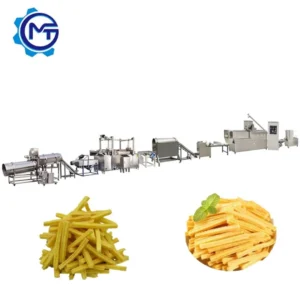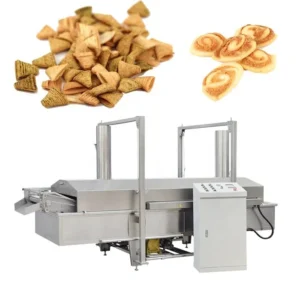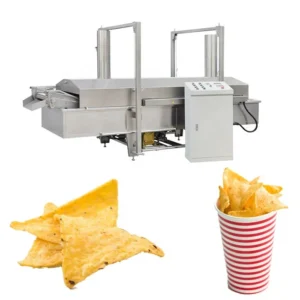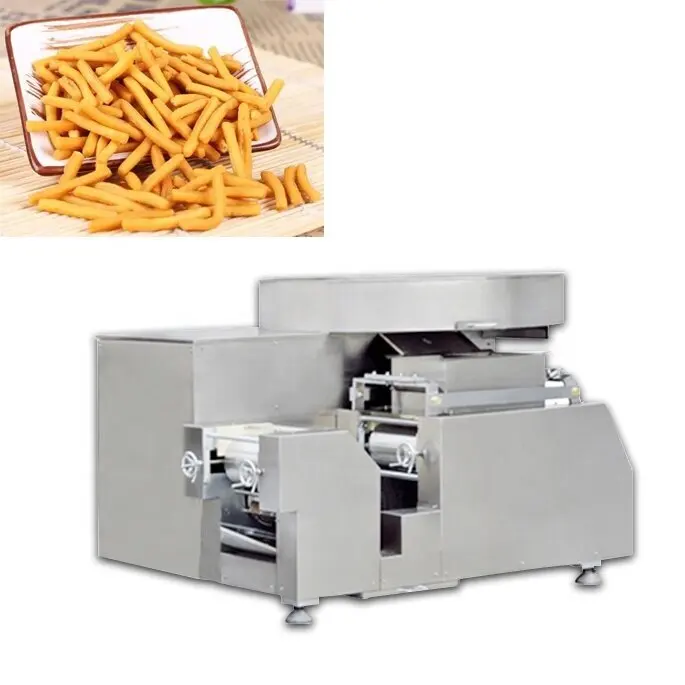
Integrated Line Station Sizing — This continuous fryer is configured to hold throughput matched to your upstream extruder and downstream cooling capacity on your specific snack formulation.
Technical Specifications
| Parameter | Value |
|---|---|
| Product Type | Automatic Continuous Deep Fryer |
| Heating Method | Electricity / Gas (configurable) |
| Heating Tube Power | 60 kW |
| Drive Motor Power | 2.6 kW |
| Voltage & Frequency | 380V / 50Hz (configurable per market) |
| Control System | PLC |
| Overall Dimensions (L×W×H) | 6700 × 2200 × 1200 mm |
| Net Weight | 2000 kg |
| Oil Capacity | 320 L |
| Capacity Range | 100–1000 kg/h (basis to be confirmed) |
| Belt Speed Control | Variable frequency stepless speed regulation |
| Mesh Belt Type | Upper and lower double-layer mesh belt |
| Oil Filtration | Continuous oil circulation filtration system |
| Slag Discharge | Bottom slag discharge system |
| Lifting System | Automatic lifting system for upper hood and mesh belt |
| Construction Material | Food-grade 304 stainless steel |
| Assembly State | Fully assembled, skid-mounted unit |
| Warranty | 1 Year (core components: 1 Year) |
Application Suitability
| Application | Material or Output |
|---|---|
| Fried pasta snacks production | Extruded wheat or corn-based pasta shapes |
| Puffed and extruded snack frying | Corn, rice, and multigrain extrudates |
| Snack food manufacturing | Potato chips, corn chips, pellet chips |
| Pet food processing lines | Kibble and treat formats requiring post-extrusion frying |
Why the Upstream Extruder Output Must Define Your Fryer Purchase
An extruder running at full capacity against a fryer that cannot hold the same throughput creates the most expensive bottleneck on the line.
I have stood in snack plants where the extrusion room is running smoothly, but the product piles up before the fryer because the frying stage was spec’d on a generic capacity number rather than the actual density, moisture content, and fry time of the material coming off the die. When an Automatic Continuous Frying Machine for snack production line integration is selected without this upstream-to-downstream calculation, the result is idle extruder time and product degradation waiting at the infeed. [NEED_CITE: snack line throughput matching between extrusion and frying stages]
How Variable-Frequency Belt Speed Controls Fry Colour and Texture
Frying time is not a fixed value across products. A light-density extruded pasta pellet needs a different residence time in the oil bath compared to a dense corn chip. The variable-frequency stepless belt speed control on this Automatic Continuous Frying Machine for snack production line integration lets the operator dial in exact fry duration to match the product’s expansion behaviour and target moisture at exit.
Oil Circulation Filtration and Its Role in Per-Unit Frying Cost
Continuous oil circulation filtration removes particulate matter and slows the rise of acid value in the frying medium. On high-throughput snack lines, oil degradation directly affects both product colour consistency and operating cost. A filtration system that runs continuously rather than on a batch schedule keeps oil quality within acceptable parameters throughout the shift. [NEED_CITE: oil acid value thresholds in continuous snack frying operations]
Reading the Specification Sheet for Real Production Conditions
The 60 kW heating tube power must be evaluated against the actual oil volume of 320 L and the product load entering the bath. A higher product throughput draws heat from the oil faster; the heating system must recover temperature between loads to avoid under-frying at the centre of the belt. The PLC control manages this recovery loop, but the set points must be established on your specific raw material during a pre-shipment trial run. The 380V / 50Hz electrical specification is a baseline — many export markets require different voltage and frequency combinations, and confirming this before production avoids rewiring on site. The double-layer mesh belt sandwiches the product, preventing buoyant items from floating to the surface and frying unevenly, which is a common defect in single-belt fryers processing low-density extrudates.
What Happens When Fryer Capacity Is Spec’d Without the Line Context
Selecting a frying station based solely on a nominal kilogram-per-hour figure, without confirming the product type, moisture level, and required frying time, leads to either under-utilised capital or a hard production ceiling. On pasta snack lines I have commissioned, the difference between a wheat-based formulation and a tapioca-based formulation changed the required fry time enough to shift the effective hourly output of the same machine by a considerable margin. [NEED_CITE: raw material moisture and composition effect on frying residence time]
Why Procurement From a Line-Integrated Supplier Matters
The fryer is one station among many. Sourcing from a supplier that builds the complete line from batching through extrusion to packing means the throughput at each station is calculated against the same product specification rather than quoted independently. The screw configuration on the extruder and the fryer belt speed are set to complement each other on your raw material. Pre-shipment trial runs using your actual formulation confirm that expansion, colour, and texture meet market expectations before the line ships. Documentation covers the full sequence — line layout, electrical schematics, and trial run reports — so the installing engineer has a single reference set. Spare wear parts such as mesh belt segments and filter elements are listed at order stage, so replacements are available when the first changeover falls due.
Documentation & Verification
- Line layout showing fryer station positioned and matched to upstream extruder output
- Machine specification sheet confirming heating method, voltage, and control language
- Electrical schematic with PLC program language verified before dispatch
- Factory trial run report on customer raw material demonstrating fry colour and texture
- CE declaration of conformity with machinery directive compliance
- Wear parts list with mesh belt segments and filter elements itemised
Installation, Commissioning & Support
- 6700 × 2200 mm footprint requires levelled floor with drainage channel for oil service access
- 380V three-phase dedicated circuit with confirmed frequency before electrical hookup
- Skid-mounted unit arrives fully assembled; only utility connections and belt tensioning required
- PLC parameter set loaded during commissioning based on trial run data from your product
- Operator training covers belt speed adjustment, oil filtration cycle, and automatic hood lifting
- Wear parts register with reorder lead times provided at shipment
What to Prepare Before Requesting a Quotation
Provide the specific snack formulation and raw material data sheet, including moisture content after extrusion. Confirm the target hourly throughput based on your extruder’s verified output, not its nameplate rating. Share your factory’s available voltage, frequency, and whether gas or electric heating suits your utility infrastructure. Specify the PLC language preference for your operating team.
Frequently Asked Questions
Q: How is the 100–1000 kg/h capacity range defined for this fryer?
A: The range depends on product type, entering moisture content, and required frying time. A low-density extruded pasta pellet with short fry time will reach the upper end, while a denser product requiring longer oil residence will sit lower. The exact capacity for your product is confirmed during a pre-shipment trial run.
Q: Can the heating method be confirmed to match my factory’s utility plan?
A: Yes. The fryer is configurable for electric or gas heating. Your factory’s available utility supply, including gas pressure if applicable, must be confirmed before production so the correct heating assembly is fitted and tested at the factory.
Q: How does the PLC control language get confirmed for the target market?
A: The PLC interface language is specified during the order confirmation stage. The program and HMI labels are set to your preferred language before the machine is shipped, avoiding commissioning delays caused by operators unable to navigate the control screen.
Q: How is fryer throughput matched to upstream and downstream equipment?
A: The line layout calculation takes the extruder’s verified output on your raw material and sizes the fryer belt speed and oil recovery capacity to hold that volume. Downstream cooling and packing stations are matched to the same figure so no single station bottlenecks the line.
Q: What spare wear parts are included, and what is the reorder lead time?
A: Mesh belt segments, heating elements, and filter elements are listed on the wear parts schedule provided at shipment. Reorder lead times are confirmed at order stage so replacement inventory arrives before the first scheduled changeover.