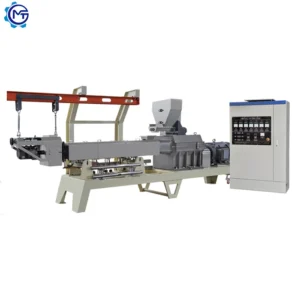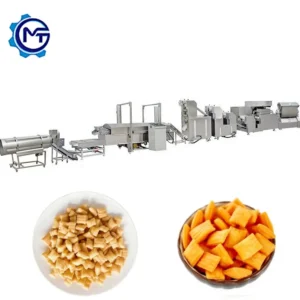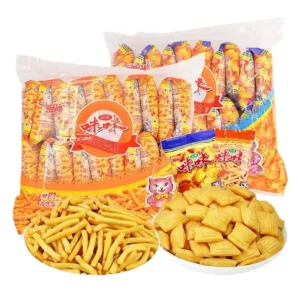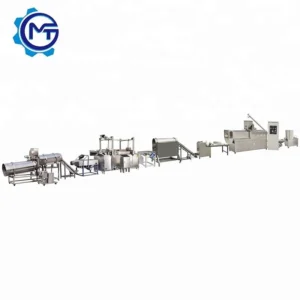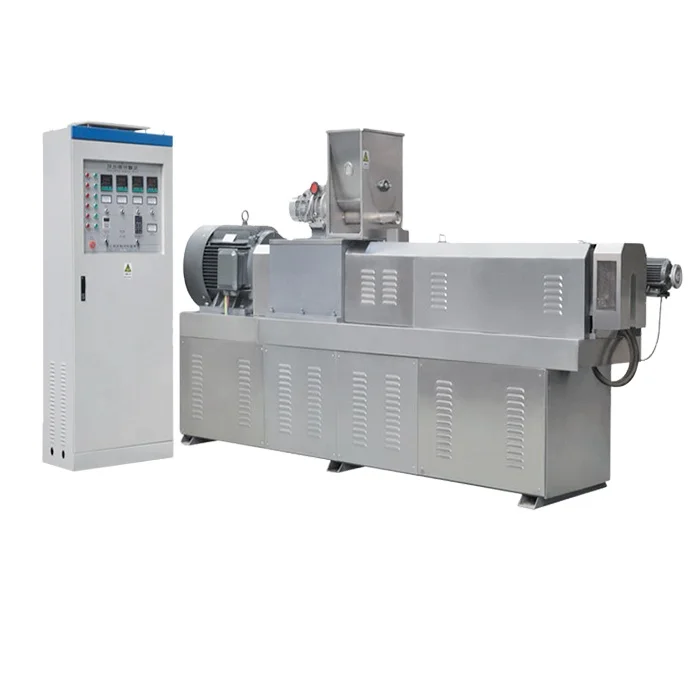
Screw Configuration Matched to Your Flour Blend — die profiles and barrel heating zones are selected only after testing your actual corn, wheat, or rice formulation in our workshop before shipment.
Technical Specifications
| Parameter | Value |
|---|---|
| Product Type | Fried Snack Extrusion Production Line (Bugles / Crisp Corn Chips) |
| Models Available | MT65 / MT70 / MT85 / MT75 / MT95 |
| Screw Type | Twin-screw |
| Installed Power Range | 142 kW (MT65) to 370 kW (MT95) |
| Real Power Consumption | 100 kW (MT65) to 280 kW (MT95) |
| Extruder Main Motor | 30 kW |
| Extruder Actual Power Draw | 30–35 kW |
| Mixer Tank Volume | 150 kg per batch |
| Mixer Rotary Speed | 385 rpm |
| Mixer Mixing Cycle | 10 min per batch |
| Mixer Power | 4 kW |
| Fryer Temperature Range | 0–260 °C |
| Fryer Dimension | 4500 × 1350 × 2350 mm |
| Flavor Line Power | 1.5 kW |
| Construction Material | Food-grade stainless steel on all contact surfaces |
| Control System | PLC and MCC |
| Standards | CE, ISO |
| Warranty | 1 year complete line |
Application Suitability
| Application | Material or Output |
|---|---|
| Bugles (crisp corn horns) | Corn flour and wheat flour blends |
| Tortilla chips and corn chips | Corn masa and rice flour formulations |
| Shaped fried snacks (duck, fish, gourd, Christmas tree) | Starch-based dough with customized die profiles |
| Rice crust and puffed crisps | Rice flour and mixed grain blends |
| Triangle and small fish crisps | Corn, wheat, or composite starch recipes |
What Nominal Output Leaves Out of a frying chips making machine Quotation
A capacity figure is meaningless without the raw material and moisture content it was measured on.
I once walked into a plant in East Africa where a Bugles line was running at barely half the nameplate throughput. The supplier had quoted capacity on a standard corn flour blend at a specific moisture level, but the buyer was sourcing locally milled corn with a completely different particle size and water content. The fryer belt speed and temperature profile had never been adjusted for that formulation, and the extruder die was producing shapes that collapsed in hot oil [NEED_CITE: raw material variability impact on extrusion output]. That is exactly the kind of mismatch we eliminate by running your flour through our testing workshop before the line ships.
Twin-Screw Configuration That Follows the Recipe
Every fried snack processing line equipment we build starts with the screw and die selection. The twin-screw extruder allows operators to adjust the screw element sequence — kneading blocks, conveying sections, and reverse elements — so that shear, residence time, and gelatinisation match the starch behaviour of corn, wheat, or rice flour. A bugle shape demands a different die land length and moisture exit profile than a flat tortilla chip, and the configuration is documented before production begins.
Throughput Matching Across Every Station
A frying chips making machine is only as productive as its weakest link. If the mixer batches 600 kg per hour but the fryer can only handle 300 kg per hour, dough sits in the conveyor and moisture migrates. We size the mixer tank volume, extruder throughput, fryer belt width, and flavouring drum capacity as a single coordinated system. The result is a line where each station feeds the next without buffering or starvation [NEED_CITE: line balancing principles in extrusion plants].
What the Power Numbers Actually Tell You
The installed power and real power figures in our specification sheet reveal something most catalogues hide. Installed power is the sum of every motor and heater at peak draw; real power is what the line consumes during steady-state production. For the MT85, that gap between 240 kW installed and 180 kW real means your electrical infrastructure must handle the peak, but your energy cost calculation should be based on the operating figure. The extruder main motor at 30 kW drives the twin screws through a heavy-duty gearbox, and the actual draw of 30–35 kW confirms the motor is working near its rated point rather than oversized and inefficient. The fryer temperature range of 0–260 °C covers everything from low-temperature drying of delicate rice crust to high-heat flash frying of corn-based bugles. Mixer output at 150 kg per batch with a 10-minute cycle means the upstream batching station can keep pace with mid-range extruders without requiring a second mixer in parallel.
The Hidden Cost of a Mismatched Fryer
When the fryer capacity is not aligned with extruder output, the consequences compound. Dough pieces arrive faster than the oil can transfer heat, so surface temperature drops and oil absorption rises. The snacks come out greasy, colour turns uneven, and oil degradation accelerates, forcing more frequent oil changes. Buyers who treat the fryer as a commodity component often discover this problem only after commissioning, when re-engineering the oil circulation and belt speed becomes expensive [NEED_CITE: oil absorption rate and fryer residence time correlation].
Why Procurement Decisions Land Here
Our testing workshop runs your raw material through the extruder and fryer before the line is crated, so the screw configuration record and trial run report reflect your actual flour, not a generic recipe. The line layout document shows throughput calculations at every station, proving the mixer, extruder, fryer, flavouring drum, and dryer are balanced. Electrical schematics confirm voltage and frequency for your facility before a single panel is wired. PLC and MCC control is specified with the operator language your team speaks. Spare wear parts — screws, dies, seals — are listed with part numbers so your first reorder does not require a factory visit.
Documentation & Verification
- Line layout drawing showing throughput balance between mixer, extruder, fryer, and flavouring stations
- Screw and die configuration record matched to buyer’s flour formulation and target snack shape
- Trial run report on customer-supplied raw material from in-house testing workshop
- Electrical schematic with voltage, frequency, and control language confirmation
- Factory test record covering full line run before dispatch
Installation, Commissioning & Support
- Foundation plan accounts for the line length ranging from 22 to 30 metres depending on model
- Dedicated electrical circuit sized to installed power up to 370 kW for the largest model
- Fryer arrives with oil circulation system pre-assembled; only utility hookups required on site
- PLC program uploaded with operator interface in confirmed language during commissioning
- Wear parts kit includes spare screw elements, die plates, and mixer seals for first-year operation
- Preventive maintenance schedule covers gearbox oil, fryer filtration, and conveyor belt tension checks
Preparing Your Inquiry
To size the right fried snack processing line equipment, we need your target snack shape, the flour type and source you plan to use, and the daily output your market demands. Tell us your facility voltage and frequency, available floor space, and whether you already have packing equipment downstream. If you can ship a sample of your raw material, we will run it through our extruder and fryer and return a trial report with the recommended screw and die configuration.
Frequently Asked Questions
Q: On what basis is the output capacity quoted for each model?
A: Every capacity figure we provide is tied to a specific raw material type, moisture content, and target snack shape. Before quotation, we request a sample of your flour blend and run it in our testing workshop. The trial report documents the actual throughput achieved, so the number you see in the contract reflects your recipe, not a generic benchmark.
Q: How do you select the screw and die configuration for my product?
A: The twin-screw extruder uses interchangeable screw elements and die plates. We match the kneading block sequence, compression ratio, and die land length to your flour’s starch gelatinisation behaviour and the target shape — whether bugles, triangles, or 3D forms. The chosen configuration is recorded and shared with you before production.
Q: Can voltage and control language be confirmed before the line is built?
A: Yes. During the specification stage we confirm your site voltage, frequency, and preferred PLC interface language. The electrical schematic reflects these choices and is approved before panel wiring begins. This prevents commissioning delays caused by incompatible power supply or untranslated operator screens.
Q: What does the in-house trial run include?
A: You send a representative batch of your raw material to our workshop. We run it through the extruder and fryer at production-relevant settings, measure output rate, moisture loss, oil absorption, and product density. The resulting report includes screw configuration, temperature profile, and recommended line settings for your facility.
Q: Which spare wear parts should I plan to stock for the first year?
A: The standard first-year kit includes replacement screw elements for the high-wear zones, spare die plates for each shape you produce, mixer shaft seals, and fryer belt sections. The wear parts list in your documentation specifies part numbers and recommended reorder intervals based on your operating hours.