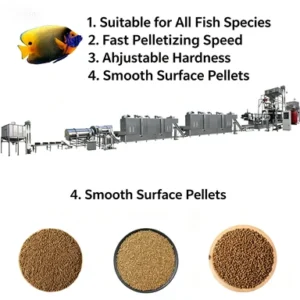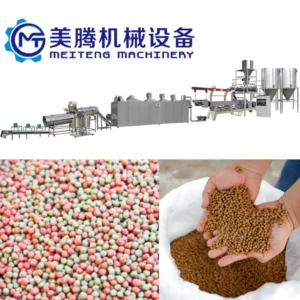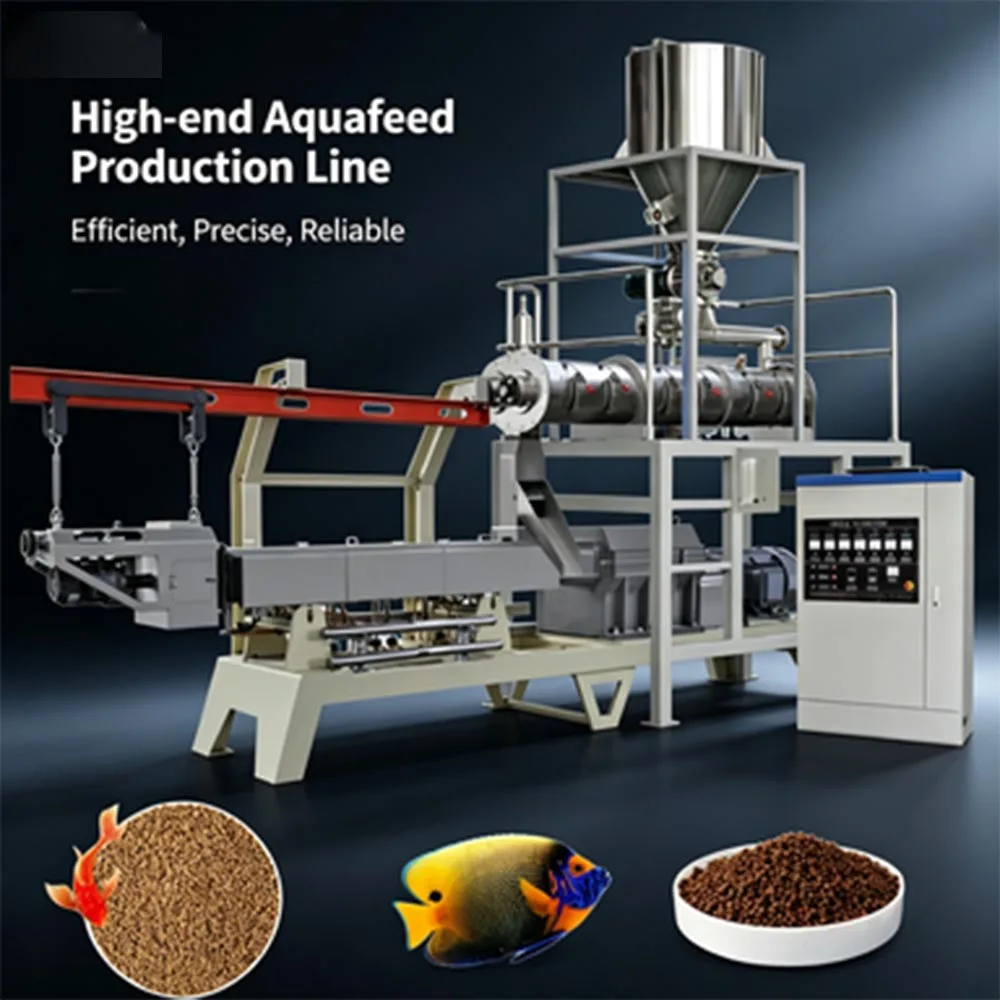
Integrated Line Matching — Every coating drum is specified against the extruder and dryer throughput to eliminate mid-line bottlenecks.
Technical Specifications
| Parameter | Value |
|---|---|
| Product Type | Seasoning and Coating Machine for Extruded Pellets |
| Control System | PLC automatic control |
| Contact Material | Food-grade 304 stainless steel |
| Coating Function | Oil spraying and dry seasoning |
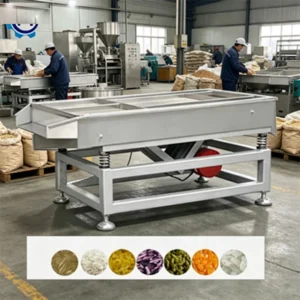
| Line Configuration | Mixer → extruder → dryer → seasoning drum → vibrating sieve → conveyor |
| Operating Mode | Full continuous automatic production |
| Output Capacity | (basis not stated in source — confirm throughput and pellet size) |
| Standards | CE, ISO |
Application Suitability
| Application | Material or Output |
|---|---|
| Floating aquatic feed | Fish meal, soybean meal, corn powder with oil attractants |
| Sinking aquatic feed | Compound additives for koi, goldfish, and tropical fish pellets |
| Dry pet food kibble | Meat meal and grain blends with surface fat and flavor coatings |
| Extruded pet treats | Small-format bites requiring uniform dry powder seasoning |
Why the Upstream Extruder Dictates Your Coating Drum Choice
A seasoning station is only as effective as the line feeding it.
When buyers evaluate a Fish Feed Seasoning Coating Machine full equipment range, the focus often lands on the drum itself. But the real constraint sits upstream. If the extruder pushes more volume than the dryer can handle, or the dryer discharges faster than the coating drum can tumble, pellets accumulate on the conveyor. The result is uneven oil distribution, clumped seasoning, and product waste [NEED_CITE: line throughput synchronization in continuous extrusion systems]. I have seen operations where the coating station was perfectly engineered in isolation, yet the entire aquatic pellet line stalled because the upstream stations were never calculated as a single system.
Matching Every Station in the Equipment Catalogue
The core challenge in specifying a Fish Feed Seasoning Coating Machine full equipment range is ensuring that no single station outpaces or starves the next. The mixer must deliver conditioned material at the exact rate the extruder consumes it. The extruder must discharge into the dryer at a moisture level and volume the dryer can reduce within its residence time. Finally, the dried pellets must enter the seasoning drum at a flow rate the drum can tumble and coat uniformly. When all stations are sourced from one catalogue and calculated together, these handoff points are engineered rather than improvised.
Oil Spraying and Dry Seasoning in One Continuous Pass
Aquatic feed producers often need both liquid fat coating and dry flavor application on the same pellet. The seasoning drum in this line handles both operations sequentially or simultaneously, depending on the recipe. Oil nozzles atomize fats or attractants onto the tumbling pellet bed, while dry powder dispensers add palatability enhancers. Food-grade 304 stainless steel contact surfaces resist corrosion from both oil-based and acidic dry seasonings, maintaining hygiene standards across long production runs [NEED_CITE: food-grade stainless steel requirements in feed processing equipment].
Reading the Specs That Actually Matter
The PLC automatic control system governs the entire sequence from mixing through coating to discharge, meaning drum speed, oil flow rate, and conveyor feed rates are interlocked. This prevents the common failure mode where a manual operator adjusts one station without compensating at the next. The food-grade 304 stainless steel construction is not merely a compliance checkbox — it directly affects how well the drum interior resists pitting from salt-based seasonings and oxidized fats over hundreds of production cycles. The complete matched line configuration, spanning mixer, extruder, dryer, seasoning drum, vibrating sieve, and conveyors, removes the integration risk that arises when each station is sourced and commissioned independently.
What Happens When the Drum Is Undersized
The most frequent consequence of treating the coating station as an afterthought is pellet buildup. When the drum cannot process the volume arriving from the dryer, pellets queue on the transfer conveyor. They cool below the optimal coating temperature, causing oil to congeal on the surface rather than absorb. Dry seasoning then sticks to the oily exterior in uneven patches. Downstream, the vibrating sieve cannot separate clumped pellets, and the packing station receives out-of-spec product. This is not a drum failure — it is a line calculation failure [NEED_CITE: bottleneck analysis in continuous food processing lines].
Why Sourcing the Full Range Matters Here
Every supporting station — from the batching mixer to the packing conveyor — is configured under one supplier, so throughput calculations account for the actual material behavior of your recipe. Screw and die configurations on the extruder are matched to the same raw material that the coating drum will season, ensuring pellet density and porosity are correct for oil absorption. An in-house testing workshop runs your specific raw material through the line before shipment, generating a trial report that confirms coating uniformity. Electrical schematics and voltage are confirmed to your facility’s supply before production begins, avoiding commissioning delays. Documentation, spare wear parts lists, and maintenance schedules are issued for the integrated line rather than assembled from separate vendor manuals.
Documentation & Verification
- Line layout and capacity calculation confirming drum throughput against extruder output
- Machine specification sheet with drum dimensions, motor power, and confirmed voltage
- Electrical schematic and voltage confirmation matched to your facility supply
- Trial run report on your raw material and coating recipe before dispatch
- CE declaration of conformity and ISO certificate for the complete line
Installation, Commissioning & Support
- Foundation and floor space planning based on the full line footprint from mixer to packing conveyor
- Dedicated power circuit sizing confirmed against the PLC panel and all station motors
- Assembly and alignment of the seasoning drum with upstream dryer discharge and downstream sieve
- First-run parameter setting for drum speed, oil pressure, and powder feed rate on your recipe
- Operator training covering PLC interlocks, cleaning procedures, and seasoning changeover
- Wear parts list covering oil nozzles, drum scrapers, and conveyor belt sections with replacement schedule
How to Scope Your Inquiry
To configure the right Fish Feed Seasoning Coating Machine full equipment range for your facility, start by sharing your target pellet specification — including diameter, buoyancy requirement, and coating formulation. Provide your local voltage and frequency, along with any existing upstream or downstream equipment the new line must integrate with. If you have a preferred raw material blend or oil type, submitting a sample for trial runs allows the line configuration to be verified before production begins.
Frequently Asked Questions
Q: How is the coating drum throughput matched to the extruder to prevent line bottlenecks?
A: The line layout calculation maps material flow from the mixer through the extruder, dryer, and into the seasoning drum. Each station’s capacity is verified against your specific raw material and pellet size, ensuring the drum tumble rate and oil application volume align with the upstream discharge rate.
Q: Can the seasoning station apply both oil and dry powder in a single pass?
A: Yes. The drum is configured with atomizing oil nozzles and dry powder dispensers that can operate simultaneously or sequentially. The PLC control coordinates both applications to your recipe specifications, ensuring uniform coverage across the pellet bed.
Q: What electrical specifications are confirmed before the line enters production?
A: Your facility’s voltage, frequency, and phase configuration are verified during the specification stage. An electrical schematic and voltage confirmation document are issued for your approval before manufacturing begins, preventing commissioning delays caused by mismatched motor or PLC panel ratings.
Q: Are trial runs performed on our specific raw material before the line ships?
A: The in-house testing workshop runs your raw material blend through the extruder and coating drum before dispatch. A trial run report documents pellet density, coating uniformity, and throughput, allowing recipe adjustments to be made before the equipment reaches your facility.
Q: What spare parts are included with the first delivery?
A: A wear parts list is issued with the line documentation, covering items such as oil spray nozzles, drum interior scrapers, and conveyor belt sections. Replacement schedules and reorder specifications are included in the operation and maintenance manual.