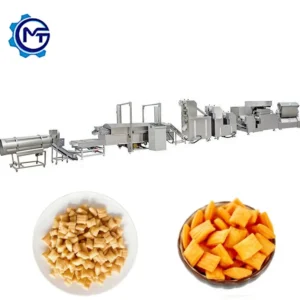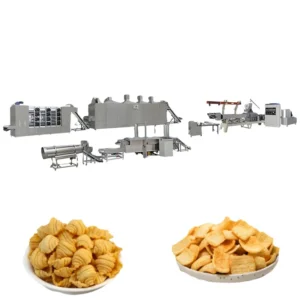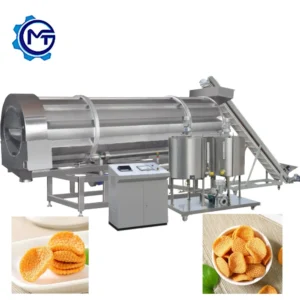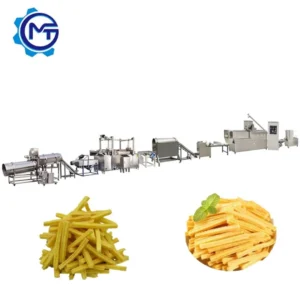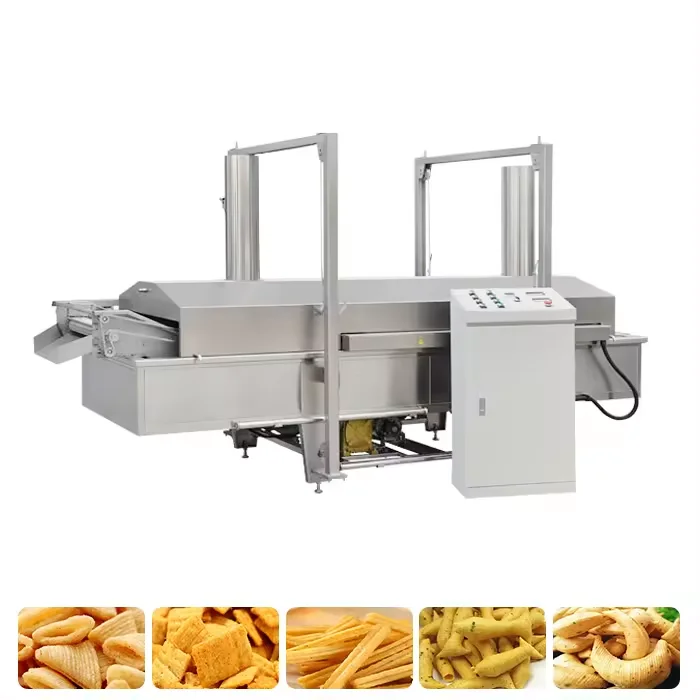
Matched throughput across frying stations — every unit sized to extruder output and raw material behaviour, eliminating bottleneck risk in snack food lines.
Technical Specifications
| Parameter | Value |
|---|---|
| Product Type | Continuous Deep Fryer for Snack Food Production Line |
| Rated Power | 60 kW heating tube; 2.6 kW connected drive load |
| Voltage & Frequency | 380V / 50Hz (configurable for target market) |
| Control System | PLC with automatic temperature control |
| Overall Dimensions (L×W×H) | 6700 × 2200 × 1200 mm |
| Net Weight | 2000 kg |
| Oil Capacity | 320 L |
| Output Capacity | 100–1000 kg/h (basis to be confirmed) |
| Heating Method | Electric heating (coal or natural gas options available) |
| Conveyor System | Double-layer mesh belt with frequency conversion stepless speed regulation |
| Material | Food-grade 304 stainless steel |
| Oil Filtration | Continuous circulation filtration system |
| Assembly State | Fully assembled with automatic lifting system for hood and mesh belt |
| Slag Discharge | Bottom-mounted automatic residue discharge system |
| Key Features | CE and ISO certified facility production; PLC-controlled temperature and speed; automatic oil filtration |
Application Suitability
| Application | Material or Output |
|---|---|
| Fried corn chip production | Extruded corn masa pellets or sheeted corn dough, fried to crisp texture |
| Salad bugle and horn snack frying | Extruded corn-based bugle shapes requiring uniform oil immersion |
| Pellet snack finishing | 2D and 3D pellet snacks expanded through hot oil contact |
| Integrated snack line station | Positioned downstream of twin-screw extruder and upstream of de-oiling and flavouring drums |
Why Frying Capacity Must Follow the Extruder, Not the Brochure
A Continuous Deep Fryer for snack food production line that cannot hold the extruder’s actual output turns your highest-value station into a choke point.
I once watched a fried corn chip line stall because the fryer was quoted on a nominal throughput figure that assumed a standard corn grits formulation. The buyer’s actual masa had a coarser grind and higher moisture content, which changed frying time and oil absorption entirely. The mesh belt had to run slower to achieve target colour, and the extruder upstream was forced to idle for several minutes every cycle [NEED_CITE: extruder-fryer throughput matching in snack food lines]. When frying capacity is specified without reference to your raw material and target product density, the bottleneck is not the machine — it is the quotation process.
Sizing the Frying Station to Your Actual Formulation
The Continuous Deep Fryer for snack food production line must be matched to the extruder’s real output on the buyer’s specific raw material, not a generic capacity figure. Corn masa at higher moisture requires longer residence time in oil, which reduces effective belt throughput. A fryer sized only on dry pellet assumptions will underperform the moment actual product enters the oil bath.
Double-Layer Mesh Belt and Uniform Oil Contact
The double-layer mesh belt sandwiches the product between upper and lower screens, preventing lighter snack pieces from floating to the surface before they are fully fried. This is especially important for hollow shapes like bugles and thin corn chips that tend to rise prematurely. Stepless speed regulation via frequency conversion lets operators adjust frying time without stopping the line, accommodating different product formats on the same equipment [NEED_CITE: mesh belt frying uniformity for extruded snack formats].
Oil Filtration, Temperature Control and Product Consistency
The 60 kW heating tube bank brings 320 litres of oil to target temperature, while the continuous circulation filtration system removes particulate and free fatty acids that accumulate during production. Without this filtration, oil acid value rises across a shift, altering flavour and colour of later batches. The PLC automatic temperature control maintains consistent heat input, reducing the variation between the first kilogram of chips fried and the last.
Reading the Specifications That Matter
The 6700 mm overall length determines oil immersion time at a given belt speed — a longer fryer allows slower throughput at higher quality, while a shorter unit demands faster belt travel and risks uneven colour. The 380V / 50Hz supply specification must match the facility’s electrical infrastructure; a mismatch discovered at commissioning delays startup by weeks while transformers or panels are sourced locally. Food-grade 304 stainless steel construction throughout the oil contact zone resists corrosion from hot oil and cleaning chemicals, extending the service interval between major teardowns. The 2.6 kW drive load powers the mesh belt conveyor and filtration pump — this is separate from the 60 kW heating load, so the total electrical demand on the facility must account for both circuits independently.
The Cost of Skipping the Line-Level Calculation
When a fryer is sourced as a standalone unit without reference to the upstream extruder or downstream cooling conveyor, the result is a station that either starves or floods the rest of the line. Oversized fryers waste oil and energy running below capacity, while undersized units force the extruder to cycle on and off, damaging screw and barrel wear life. I have seen operators manually throttle extruder feed rates to match a fryer that was never calculated against their actual recipe [NEED_CITE: consequences of mismatched station capacity in snack food lines]. The hidden cost is not the machine price — it is the daily throughput loss and the accelerated wear on upstream equipment forced to run off-design.
Why Source the Frying Station Here
Complete line configuration from batching through extrusion, frying, seasoning and packing under one supplier means the Continuous Deep Fryer for snack food production line is sized against the same capacity calculation as every other station. Screw configuration and die design for the extruder are specified to the buyer’s raw material, so the product entering the fryer is consistent in density and moisture. An in-house testing workshop runs trial production on the customer’s actual formulation before shipment, confirming frying time and oil absorption rather than guessing from a datasheet. Twin-screw extrusion expertise across snack, cereal and protein applications means the frying station recommendation accounts for how different formulations behave in hot oil. Pre-sales engineering through on-site installation and ongoing maintenance keeps one technical team accountable for the entire line’s performance.
Documentation & Verification
- Line layout and capacity calculation showing fryer throughput matched to extruder output
- Machine specification sheet with confirmed voltage, frequency and heating method
- Screw and die configuration record linked to your raw material trial results
- Factory test record on your actual product formulation before dispatch
- CE declaration of conformity and ISO certificate for customs and compliance
- Operation and maintenance manual with wear parts list for the mesh belt and filtration system
Installation, Commissioning & Support
- 6700 × 2200 mm footprint requires level concrete floor with oil containment bund
- 380V / 50Hz supply with dedicated circuit separating 60 kW heating and 2.6 kW drive loads
- Fully assembled delivery with automatic lifting hood for first-day oil fill and startup
- PLC interface configured to operator language before commissioning begins
- Mesh belt tension and filtration flow calibrated during on-site trial runs
- Wear parts list covering belt sections, heating elements and filter media provided at handover
What We Need to Specify Your Frying Station
To size a continuous fryer that actually holds your target output, we need your raw material type and moisture content, the extruded product shape and target fried density, and your daily production target in kilograms of finished product. Confirm the facility voltage and frequency, the available heating energy source, and whether the fryer will integrate with existing upstream and downstream equipment or form part of a new line build.
Frequently Asked Questions
Q: How is frying capacity matched to extruder output on my specific raw material formulation?
A: We run a trial on your actual raw material in the testing workshop, measuring the extruded product’s moisture, density and expansion. Frying time and belt speed are then calculated from those results, not from a generic capacity table, so the Continuous Deep Fryer for snack food production line is sized to your real throughput.
Q: What voltage, frequency and heating energy options are available for my target market?
A: The standard configuration is 380V / 50Hz with electric heating, but voltage and frequency are configurable to match your facility supply. Coal and natural gas heating options are available where electricity cost or availability makes alternative energy sources more practical for continuous frying operations.
Q: How does the PLC control panel language and interface get configured before shipment?
A: The PLC interface language is confirmed during the specification stage and loaded before the factory test. Operators see their own language on the temperature and speed displays when the machine is first powered on at your site, removing a common commissioning delay.
Q: What supporting stations are needed downstream and how are they sized?
A: De-oiling, cooling and flavouring stations must each match the fryer’s actual output rate. We calculate de-oiling belt length, cooling conveyor residence time and seasoning drum capacity from the same line throughput figure, so no downstream station becomes a new bottleneck.
Q: Can the fryer be supplied as a standalone unit or only as part of a complete snack line?
A: The Continuous Deep Fryer for snack food production line can be supplied standalone to integrate with your existing extruder and downstream equipment. We still request your upstream output data and product specification to confirm the fryer will match your current line capacity.