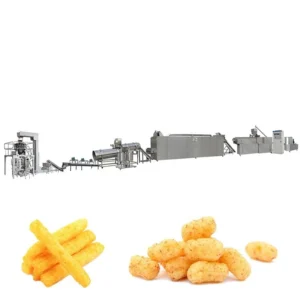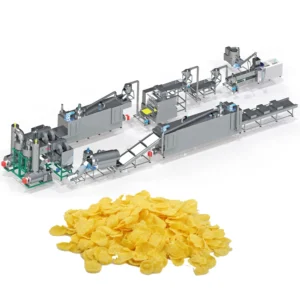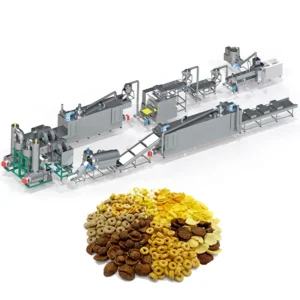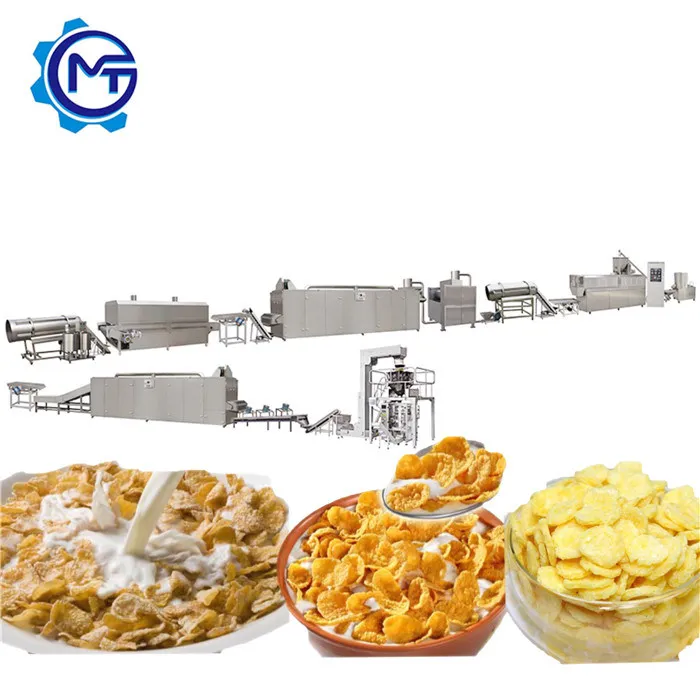
Complete Line Matching — every station from mixing through packing is specified under one supplier, preventing throughput imbalances that occur when a corn flakes line is assembled from separate vendors.
Technical Specifications
| Parameter | Value |
|---|---|
| Product Type | Corn Flakes Breakfast Cereal Production Line |
| Available Models | MT70, MT85, MT75 |
| Extruder Type | Twin Screw |
| MT70 Installed Power | 160 kW |
| MT70 Power Consumption | 120 kW |
| MT70 Capacity | 150-200 kg/hr (basis not stated in source — confirm raw material / moisture content) |
| MT70 Overall Dimensions | 41 × 1.5 × 2.2 m |
| MT85 Installed Power | 190 kW |
| MT85 Power Consumption | 140 kW |
| MT85 Capacity | 300-400 kg/hr (basis not stated in source — confirm raw material / moisture content) |
| MT85 Overall Dimensions | 43 × 1.5 × 3.2 m |
| MT75 Installed Power | 210 kW |
| MT75 Power Consumption | 150 kW |
| MT75 Capacity | 300-500 kg/hr (basis not stated in source — confirm raw material / moisture content) |
| MT75 Overall Dimensions | 45 × 1.5 × 3.5 m |
| Control System | PLC control with automatic lubricating and cooling system |
| Screw Material | Special wear-resistant technology |
| Flaking Machinery | Hydraulic double-roller system, independent dual-motor drive, infrared sensor temperature control |
| Dryer Heating Source | Gas or Electric |
| Roasting Oven | Conciliation burner, dual circulating fans, cyclone dust removal, vibrating pan |
| Coating System | Double tumble for sugar melting, elevator, coating drum, spraying nozzle |
| Basic Materials | Corn, rice, wheat, oat, barley powder |
| Final Products | Natural corn flakes, sugar-coated corn flakes, shaped cereals |
| Assembly State | Complete line from mixing through packing |
| Voltage & Frequency | Customized to local requirements |
| Standards | CE, ISO |
Application Suitability
| Application | Material or Output |
|---|---|
| Natural corn flakes manufacturing | Corn grits and corn flour at controlled moisture |
| Sugar-coated corn flakes production | Corn base with sugar syrup coating and secondary drying |
| Multi-grain breakfast cereal processing | Blends of rice, wheat, oat, and barley powder |
| Shaped cereal production | Rings, balls, stars, loops, tubes, flowers via die change |
| Fortified breakfast cereal lines | Grain base with added nutritional premix |
Why Nominal Capacity Figures Fail at Commissioning
A corn flakes production line full equipment range quoted at a fixed output number rarely holds that figure when the buyer switches from the supplier’s test grain to the actual local corn variety, which often arrives at a different moisture content and starch profile than the material used during factory trials.
Throughput must be verified against your specific grain blend before the line ships.
I spent five days on-site at an Indonesian corn flakes plant last year where the extruder was rated for a certain hourly output on imported corn flour, but the factory switched to a local high-moisture corn source once production started. The extrudate came out dense and unexpanded, and no amount of dryer adjustment could recover the flake texture. The screw combination and feed moisture had to be reworked entirely on the factory floor [NEED_CITE: starch gelatinisation behaviour in local corn varieties versus imported grits]. This is why confirming the corn flakes production line full equipment range against the buyer’s real material matters more than the number on the quotation sheet.
Matching Every Station to Prevent Downstream Bottlenecks
An extruder that outputs at a certain rate is only useful if the flaking rolls, dryer, and roasting oven can each handle that same volume without product pile-up or under-utilisation. The corn flakes production line full equipment range addresses this by specifying each station — from the hydraulic double-roller flaker through the hot air roaster with dual circulating fans — as a matched set rather than individual machines sourced independently. When the roaster cannot keep pace with the extruder, wet flakes accumulate on the conveyor and begin to clump before they reach the oven belt.
Dual Production Paths on One Base Line
The line supports both natural and sugar-coated corn flakes on the same extrusion and flaking base. For sugar-coated variants, the process extends through a sugar spraying station, coating drum, and secondary dryer before cooling and packing. This modular arrangement means a producer can start with natural corn flakes and add the coating section later without replacing upstream equipment. The coating drum uses a spraying nozzle system for even syrup distribution, and the double tumble setup for sugar melting maintains consistent syrup viscosity throughout the production run [NEED_CITE: sugar coating uniformity requirements for breakfast cereal shelf appearance].
Reading the Specifications for Your Grain Profile
The twin screw extruder design directly affects how different grains behave under heat and shear. Corn requires a specific screw configuration and barrel temperature profile to achieve proper starch gelatinisation without over-cooking the extrudate, while rice and wheat demand different moisture windows and residence times. The wear-resistant screw material extends service intervals when processing abrasive grains like corn grits. The hydraulic double-roller flaker uses independent dual-motor drive so that roller pressure and speed can be adjusted separately, which controls flake thickness — a critical factor in how the final product toasts in the roasting oven. Infrared sensor temperature control on the flaker monitors roller surface heat to prevent sticking or tearing of the extrudate sheet. The roasting oven’s conciliation burner and cyclone dust removal device work together to deliver consistent surface blistering while managing fine particulate that would otherwise scorch and affect flavour [NEED_CITE: roasting temperature profiles for corn flake surface blistering].
The Hidden Cost of Unmatched Supporting Equipment
When the dryer capacity falls short of extruder output, partially dried flakes enter the roasting oven carrying excess moisture, which prevents proper crisping and creates uneven colour across the batch. Similarly, an undersized cooling conveyor means flakes are packed while still warm, trapping residual moisture inside the bag and shortening shelf life. These mismatches rarely show up in the quotation — they only surface during the first week of production, when the line cannot hold a steady rhythm and operators are constantly adjusting downstream settings to compensate for upstream surplus [NEED_CITE: moisture migration in packed breakfast cereal flakes].
Why Source the Full Range from One Supplier
Every station in this corn flakes production line full equipment range is specified and balanced under one supplier, eliminating the coordination gaps that appear when a buyer pieces together machines from different vendors. Screw configuration and die design are matched to the buyer’s actual corn, rice, or multi-grain blend rather than copied from a generic build. The in-house testing workshop runs trial production on the buyer’s own raw material before shipment, so product development happens at the factory rather than on the buyer’s floor during commissioning. Electrical schematics, voltage, and control language are confirmed against the target facility before production begins. The PLC control system manages the entire line from batching through packing, giving operators a single interface rather than separate controls at each station.
Documentation & Verification
- Line layout and capacity calculation matched to your grain blend and target flake density
- Screw and die configuration record specific to your corn or multi-grain raw material
- Trial run report on your actual raw material from the in-house testing workshop
- Electrical schematic with voltage and frequency confirmation for your facility
- CE declaration of conformity and ISO certificate for the complete line
- Wear parts list covering screws, dies, and flaking roller surfaces
Installation, Commissioning & Support
- Foundation plan accounts for the 41–45 m line length and vibrating pan load points
- Power supply must match confirmed voltage and frequency before the 160–210 kW extruder is energised
- Line arrives in sectional modules for staged assembly within the available workshop footprint
- Commissioning includes screw combination fine-tuning against your local grain moisture content
- Operator training covers PLC interface navigation and flaking roller pressure adjustment
- Spare wear parts inventory includes replacement screws and die plates for initial production runs
What to Include in Your Inquiry
To configure the right corn flakes production line full equipment range for your facility, share your primary grain type and its typical moisture content on arrival, your target daily output in finished product weight, and the local voltage and frequency standard. If you plan to produce both natural and sugar-coated variants, specify the coating ratio and sugar type. Samples of your actual raw material allow a trial run in the testing workshop before the line enters production.
Frequently Asked Questions
Q: How is line capacity verified against my specific grain blend and moisture content?
A: Capacity is confirmed through a trial run on your actual raw material in the in-house testing workshop before shipment. The screw configuration, barrel temperature profile, and feed moisture are adjusted during this run to match your grain’s starch behaviour, and a trial run report documents the achievable throughput under those specific conditions.
Q: Which supporting stations are matched to extruder output to prevent bottlenecks?
A: The dryer, roasting oven, flaking machinery, and cooling conveyor are each sized to handle the extruder’s verified output on your material. The roaster’s dual circulating fans and the dryer’s heating capacity are calculated against the moisture removal required per kilogram of extrudate, so no station holds up the next.
Q: Can the same line produce both natural and sugar-coated corn flakes plus other cereal shapes?
A: Yes. The base line handles extrusion, flaking, drying, and roasting for natural corn flakes. A modular coating section — sugar spraying, coating drum, and secondary dryer — is added for coated variants. Shape changes such as rings, balls, or stars are achieved by swapping the extruder die without modifying downstream stations.
Q: What documentation is provided before and after shipment?
A: Before shipment, you receive the line layout drawing, capacity calculation, screw configuration record for your material, trial run report, and electrical schematic with voltage confirmation. After shipment, the package includes the CE declaration, ISO certificate, operation and maintenance manual, wear parts list, and customs documentation support.
Q: How are voltage, frequency, and control language confirmed before production?
A: Your facility’s electrical specifications and preferred PLC interface language are confirmed during the design phase, before the control panels are built. This ensures the motor ratings, heating elements, and PLC display match local standards, avoiding rewiring or reprogramming delays during on-site commissioning.