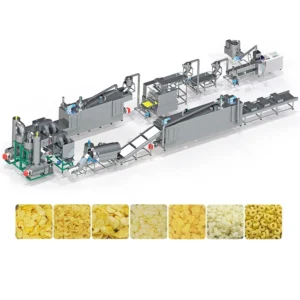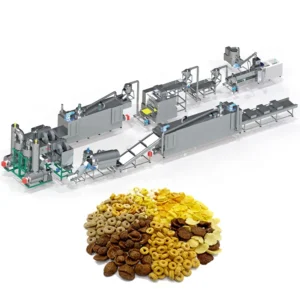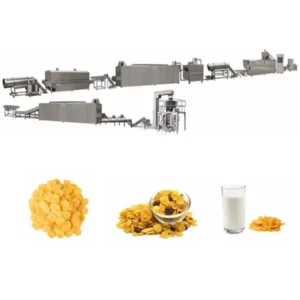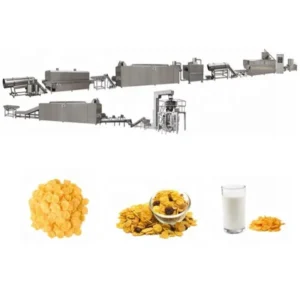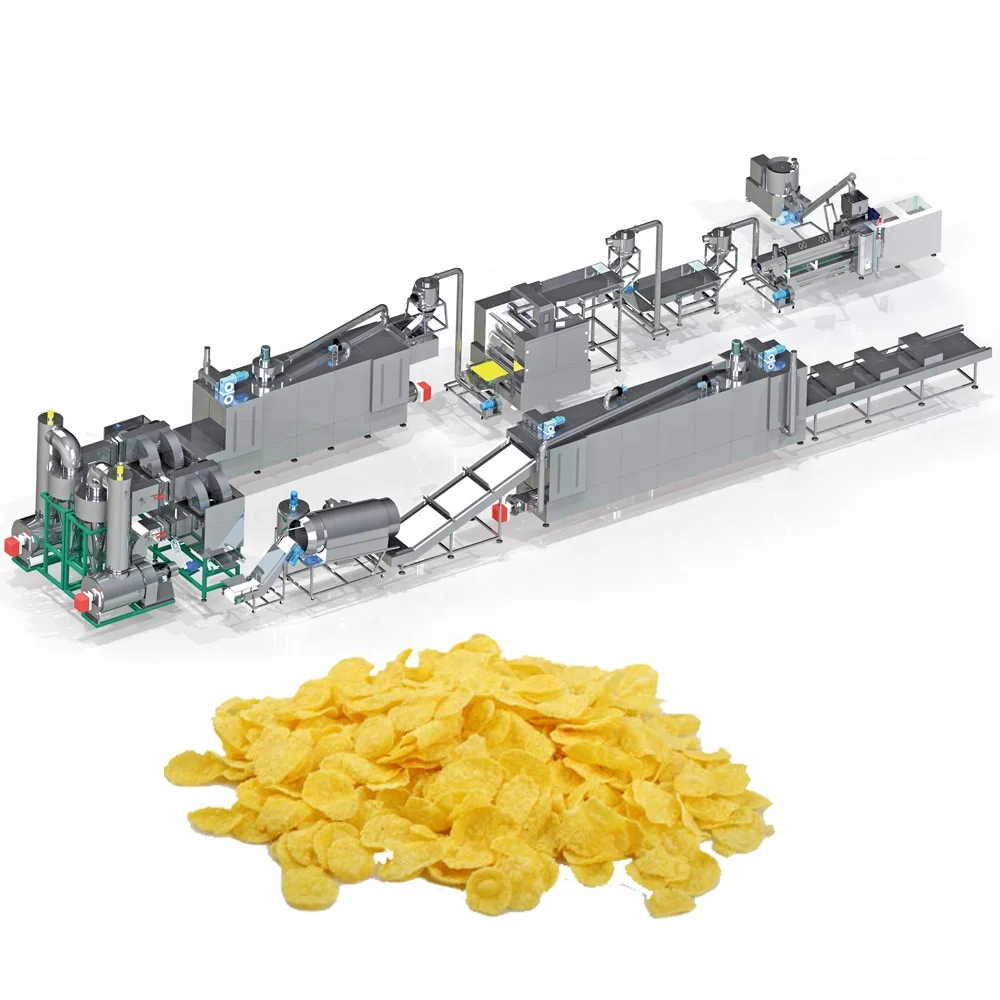
Throughput-Matched Engineering — Every station from batching to packing is specified under one roof, so your corn flakes line runs at balanced capacity instead of bottlenecking at the weakest link.
Technical Specifications
| Parameter | Value |
|---|---|
| Product Type | Corn Flakes Production Line |
| Screw Type | Twin Screw |
| Available Models | MT70 / MT85 / MT75 |
| Installed Power | 160 kW (MT70) / 190 kW (MT85) / 210 kW (MT75) |
| Power Consumption | 120 kW (MT70) / 140 kW (MT85) / 150 kW (MT75) |
| Output Capacity | 150–200 kg/h (MT70) / 300–400 kg/h (MT85) / 300–500 kg/h (MT75) (basis not stated in source — confirm raw material, moisture content and product format) |
| Voltage | 380V / 220V |
| Overall Dimensions (L×W×H) | 41 × 1.5 × 2.2 m (MT70) / 43 × 1.5 × 3.2 m (MT85) / 45 × 1.5 × 3.5 m (MT75) |
| Control System | PLC control |
| Raw Material Compatibility | Corn flour, rice, wheat, oat, barley powder |
| Flaking Machinery | Hydraulic double-roller system with independent motor drive and infrared sensor temperature control |
| Dryer Heating Source | Gas / Electric (configurable) |
| Roasting Oven | Conciliation burner, dual circulating fans, cyclone dust removal |
| Coating System | Double tumble melter, elevator, coating drum, spraying nozzle |
| Material Construction | Stainless Steel |
| Warranty | 1 Year (core components: 1 Year) |
Application Suitability
| Application | Material or Output |
|---|---|
| Natural corn flakes production | Corn flour with controlled moisture content |
| Sugar-coated corn flakes | Corn flour base with sugar slurry coating |
| Multi-shape breakfast cereals | Rice, wheat, oat, barley powder blends formed into rings, balls, stars, tubes, wheels, fruit loops |
| Fortified breakfast cereal lines | Grain blends with added vitamin and mineral premix |
| High-volume cereal manufacturing | Continuous twin-screw extrusion with downstream flaking and roasting |
Why Matching Every Station Matters More Than Extruder Capacity Alone
A corn flakes machine full equipment range quoted on extruder output alone will cap your real production the moment the flaker, dryer, or roaster cannot keep pace. The line stalls, product backs up on conveyors, and operators manually shuttle material between stations just to avoid spoilage.
I saw this firsthand when a Middle Eastern client signed for a corn flakes line based on nominal extruder capacity. Their corn flour particle size differed from the test standard, expansion failed to reach target, and the flakes came out dense and hard. The client nearly rejected the entire line. That project made it clear: asking about raw material fineness and moisture content before configuration is not optional — it is the foundation of a working line [NEED_CITE: raw material particle size effect on extrusion expansion rate]. When throughput is mismatched between stations, no amount of extruder power compensates for a dryer that cannot remove moisture fast enough or a flaking roll set that compresses too slowly.
Station-by-Station Equipment Breakdown
Selecting a corn flakes machine full equipment range means understanding how each station performs its role. The mixing system meters corn flour and minor ingredients into a uniform blend before extrusion. The twin-screw extruder applies shear, heat, and pressure to gelatinize starch and form a continuous dough rope. Downstream, the hydraulic flaking unit compresses cooked pellets between independently driven rollers, with infrared sensors monitoring surface temperature to hold flake thickness within tolerance.
Each piece of supporting equipment carries its own specification sheet that ties back to the extruder output band. This station-level visibility lets buyers compare individual units rather than accepting a bundled package where one undersized component limits the whole line.
Drying, Roasting and Coating in Sequence
The dryer removes bulk moisture from freshly flaked material, available with gas or electric heating depending on local utility cost and availability. The hot air roasting oven then develops the crispness and surface blistering that define traditional corn flakes, using a conciliation burner and dual circulating fans for even heat distribution. A cyclone dust removal device captures fine particles before they can settle back onto product surfaces [NEED_CITE: cyclone separator efficiency in cereal roasting applications].
When sugar coating is required, the optional coating station adds a double tumble melter, an elevator, and a rotating coating drum with spraying nozzles. The sugar slurry is applied at a rate matched to extruder output so that coated flakes exit the drum at the same cadence they entered.
Reading the Specifications That Shape Flake Quality
The twin-screw extruder configuration matters more than motor size alone. Screw elements are selected to match raw material composition — higher fat or fiber content changes how starch gelatinizes inside the barrel, and the wrong element arrangement produces under-cooked or over-sheared dough. The die design then determines whether the extrudate exits as a rope for flaking or as a shaped piece for ring and star cereals.
Hydraulic pressure on the flaking rollers controls how thin each flake becomes. Independent motor drive on each roller prevents slip and keeps thickness uniform across the full roller width. Infrared temperature sensing on the flaking station prevents the rollers from running too hot, which would cause sticking, or too cold, which would crack the flake surface.
The roasting oven specification — conciliation burner with dual fans — is not a generic feature listing. Even heat distribution across the oven bed prevents some flakes from scorching while others remain under-roasted, and the cyclone dust removal keeps the oven interior clean between shifts [NEED_CITE: heat distribution uniformity requirements in continuous cereal roasters].
The Hidden Cost of Undersized Supporting Equipment
When a flaker runs slower than the extruder pushes material, cooked pellets pile up and cool before reaching the rollers. Cold pellets do not flatten cleanly — they crack or fold, producing waste that must be re-ground or discarded. A dryer with insufficient residence time leaves moisture trapped inside the flake, and the roaster then has to work harder to drive that moisture off, creating uneven browning.
These failures do not show up in a factory acceptance test run on the supplier’s standard corn flour. They appear weeks after installation when the buyer switches to locally sourced grain with different moisture content or particle size distribution. By then, the line is already paid for and the cost of rework is mounting [NEED_CITE: post-installation commissioning failures in extruded food lines].
Sourcing a Complete Line Under One Supplier
Every station in this corn flakes line — from the batching mixer through extrusion, flaking, drying, roasting, optional sugar coating, cooling, and packing — is specified and matched by a single engineering team, so throughput calculations hold across the full sequence. Screw configuration and die design are selected based on your raw material blend and target flake density rather than copied from a generic build.
An in-house testing workshop runs trial production on your actual corn flour before shipment, confirming expansion rate and flake texture before the line leaves the factory. Electrical schematics, voltage confirmation, and control language are verified during the specification stage, preventing commissioning delays on site. CE and ISO certifications accompany the documentation package for export compliance.
Documentation & Verification
- Line layout and capacity calculation showing station-by-station throughput matching for corn flakes production
- Screw and die configuration record tied to your specific corn flour particle size and moisture content
- Trial run report produced on your raw material in the testing workshop before shipment
- Electrical schematic with voltage and frequency confirmed against your local grid standard
- CE declaration of conformity and ISO certificate included in the export documentation package
- Operation and maintenance manual with wear parts list for flaking rollers, screws, and dies
Installation, Commissioning & Support
- Floor space planning based on the 41–45 m line length and 1.5 m width to allow maintenance access on both sides
- Dedicated electrical circuit sized for 120–150 kW operating load with voltage and frequency matched to local supply
- Factory pre-assembly with station-by-station disassembly for container shipping and on-site reconnection
- First-run parameter setting covering barrel temperature profile, hydraulic flaking pressure, and roaster fan speed
- Operator training on PLC interface, screw element changes, and flaking roller gap adjustment
- Spare wear parts package including replacement screw elements, die plates, and flaking roller sleeves
Preparing Your Inquiry
To configure a corn flakes production line that matches your actual conditions, share your raw material specification including corn flour type, particle size, and typical moisture content. Confirm your target daily output and whether you plan to run natural flakes, sugar-coated flakes, or both on the same line. Include your local voltage and frequency standard, preferred control language, and available workshop dimensions with ceiling height so the layout can be drafted before quotation.
Frequently Asked Questions
Q: How is line capacity verified against my actual raw material and moisture content?
A: Before production begins, your corn flour sample runs through the twin-screw extruder in the testing workshop. The trial measures expansion rate, flake density, and surface texture under controlled moisture conditions. A written trial run report documents the results and confirms which screw configuration and die setup produced acceptable flakes on your specific material.
Q: How is throughput matched between the extruder, flaker, dryer and roaster?
A: Each station is sized based on the extruder output band rather than selected from a standard catalogue. The flaking roller speed, dryer belt length, and roaster residence time are calculated so that material flows continuously without accumulation. The capacity calculation document shows this matching across every station before the quotation is finalized.
Q: What voltage, frequency and control language options are confirmed before production?
A: The electrical schematic is reviewed with the buyer during the specification stage. Voltage and frequency are set to match the destination grid. The PLC interface language is confirmed so that operators can read menus, alarms, and parameter labels in their working language from day one of commissioning.
Q: Which spare wear parts are included and how are replacements sourced?
A: The initial shipment includes a wear parts list covering screw elements, die plates, and flaking roller sleeves sized for your line configuration. Replacement parts are manufactured to the same specification and can be ordered directly using part numbers from the documentation package provided at delivery.
Q: Can the line produce both natural and sugar-coated corn flakes?
A: Yes. The coating station — consisting of a double tumble melter, elevator, coating drum, and spraying nozzle — is added as an optional module downstream of the roaster. When sugar coating is not required, flakes bypass that station and proceed directly to cooling and packing, keeping the line layout flexible for both product formats.