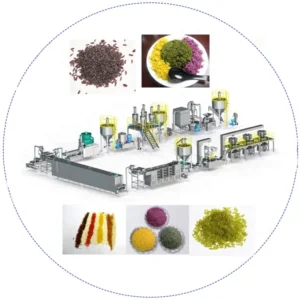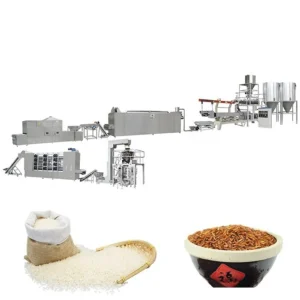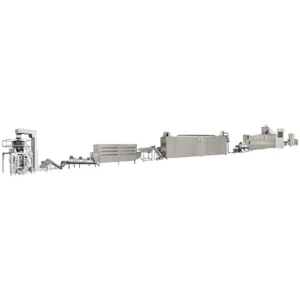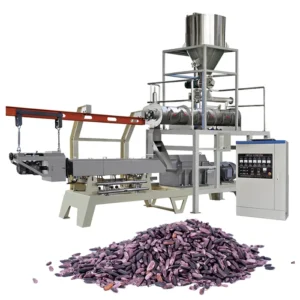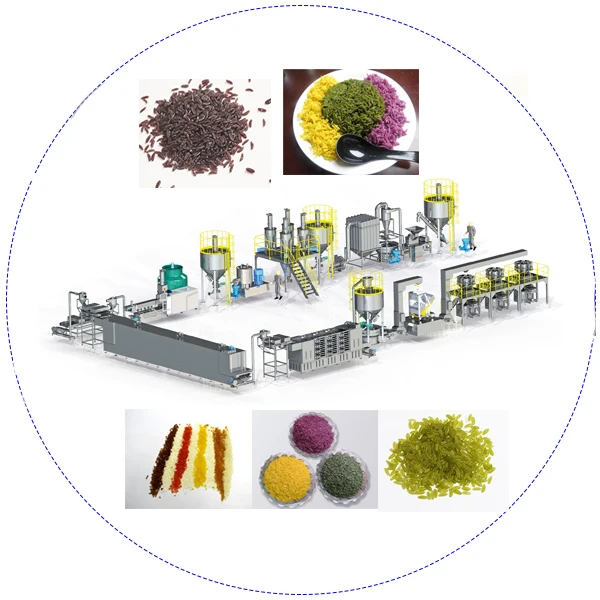
Line-Tested Equipment — Every station in our Fortified and Artificial Rice Processing Line full equipment range is matched to your raw material formulation through in-house trial runs before shipment.
Technical Specifications
| Parameter | Value |
|---|---|
| Product Type | Fortified and Artificial Rice Processing Line |
| Available Models | MT65 / MT70 / MT85 / MT75 / MT95 |
| Extruder Type | Twin-screw |
| Installed Power | 85 kW (MT65) / 120 kW (MT70) / 235 kW (MT85) / 180 kW (MT75) / 260 kW (MT95) |
| Power Consumption | 60 kW (MT65) / 85 kW (MT70) / 165 kW (MT85) / 135 kW (MT75) / 195 kW (MT95) |
| Overall Dimensions (L×W×H) | 28×1.2×2.2 m (MT65) / 30×1.5×2.2 m (MT70) / 34×3.5×4.3 m (MT85) / 32×3.5×4.3 m (MT75) / 36×3.5×4.3 m (MT95) |
| Output Capacity | 80–100 kg/h (MT65) / 100–120 kg/h (MT70) / 200–300 kg/h (MT85) / 300–500 kg/h (MT75) / 800–1000 kg/h (MT95) (basis to be confirmed with actual formulation) |
| Feeding System | Single or double screw feeding selectable based on material characteristics |
| Dryer Heating Source | Electric or gas |
| Control System | Frequency speed controlling with high automation (PLC / MCC to be confirmed) |
| Lubrication | Automatic lubricating and cooling system |
| Line Stations | Mixing → Extruding → Vibrating → Low Temperature Drying → Cooling → High Temperature Roasting → Cooling → Packing |
| Basic Materials | Broken rice, rice, corn, millet, wheat, oats, buckwheat, bean, starch, vitamin and mineral additives |
| Standards | CE certified, ISO certified |
Application Suitability
| Application | Material or Output |
|---|---|
| Fortified rice kernel production | Broken rice and rice bran blended with added vitamins and minerals |
| Artificial rice reconstitution | Corn, millet, wheat, oat, and buckwheat blends reshaped into rice-like kernels |
| Nutritional powder processing | Grain-based formulations fortified with micronutrient premixes |
| Reconstituted grain products | Starch-based doughs with bean and oat inclusions |
| Institutional nutrition supply | Fortified rice kernels meeting programme specifications for school feeding and relief distribution |
What "Rated Capacity" Leaves Out About Rice Extrusion
Output numbers mean nothing until they are proven on your exact blend of broken rice, fiber, and premix.
I learned this the hard way on a South Asian project. The Fortified and Artificial Rice Processing Line full equipment range we quoted ran beautifully in our testing workshop on standard rice flour — consistent shape, proper gelatinisation, smooth discharge. Then the customer’s actual recipe arrived on site, loaded with coarse millet fiber and a heavy mineral premix. Expansion collapsed, gelatinisation dropped, and we spent nearly two weeks re-tuning screw speed, barrel temperature, and die geometry. Since that job, every capacity figure we quote is tied to a documented trial run on the buyer’s real raw material, not a generic laboratory sample. [NEED_CITE: starch gelatinisation behavior under varying fiber and premix loading]
Matching Each Station to Your Throughput Target
A complete Fortified and Artificial Rice Processing Line full equipment range must keep every station balanced. If the extruder pushes material faster than the low-temperature dryer can reduce moisture, kernels crack or stick together before they reach the roasting stage. Our line sequence — mixing, extruding, vibrating, low-temperature drying, cooling, high-temperature roasting, final cooling, and packing — is sized so that each station’s capacity aligns with the selected twin-screw model. The vibrating conveyor spreads product evenly across the dryer belt, and the cooling section stabilises kernel temperature before roasting, preventing surface scorch.
Screw Feeding Configuration and Material Behaviour
The choice between single-screw and double-screw feeding is not cosmetic. When processing broken rice with fine vitamin powder, a single-screw feeder may deliver unevenly because the premix segregates in the hopper. Double-screw feeding forces a consistent volumetric ratio into the barrel, which is critical when nutrient content must meet programme specifications. The automatic lubricating and cooling system on the extruder barrel supports continuous operation without thermal drift, keeping gelatinisation uniform across long production runs. [NEED_CITE: twin-screw feeding mechanisms for premixed nutritional formulations]
Reading the Specification Sheet for Production Reality
The installed power and power consumption figures differ across the MT65 through MT95 models because each twin-screw configuration requires different motor sizing to handle varying throughput and material viscosity. Overall dimensions grow from a compact 28 m footprint at the MT65 level to 36 m at the MT95, reflecting longer barrel assemblies and wider dryer belts needed for higher output. Selectable electric or gas heating in the dryer section matters for markets where gas costs less per thermal unit than electricity. Frequency speed control across the line lets operators adjust screw RPM and belt speed independently, which is essential when switching between a pure rice formula and a high-fiber blend that demands slower throughput to maintain kernel integrity.
The Hidden Cost of Misconfigured Downstream Equipment
Buyers often focus negotiation energy on the extruder and treat the dryer, cooler, and packing station as secondary. When a dryer is undersized for the extruder output, the moisture gradient inside each kernel stays uneven. Kernels that feel dry on the surface trap internal moisture, and they fracture during roasting or crack in storage. A cooler that cannot match the roasting discharge rate forces the entire line to slow down, wasting the extruder’s rated capacity and compressing production schedules. [NEED_CITE: moisture gradient effects on extruded grain kernel shelf stability]
Why Procurement Through This Catalogue Differs
Every machine in the Fortified and Artificial Rice Processing Line full equipment range is sourced from one supplier, so throughput calculations are done across all stations rather than guessed between vendors. Screw configuration and die geometry are specified against the buyer’s raw material sample, not copied from a generic build. Our in-house testing workshop runs trial production on customer-supplied formulations before shipment, generating a documented report that becomes the commissioning baseline. Pre-sales engineering covers line layout and utility planning, and on-site installation includes operator training on the frequency speed controls and automatic lubrication system. Spare wear parts — screws, dies, dryer belt sections — are listed with recommended first-replacement intervals so buyers can plan procurement before the first changeover.
Documentation & Verification
- Machine specification sheet with screw and die configuration matched to your grain and premix blend
- Line layout drawing showing throughput match across mixing, extrusion, drying, and packing stations
- Electrical schematic with voltage and frequency confirmation for your local grid standard
- Factory trial run report documenting kernel shape, moisture content, and gelatinisation on your raw material
- Operation and maintenance manual covering frequency speed adjustment and automatic lubrication service intervals
- Wear parts list specifying screws, dies, and dryer belt sections with recommended replacement schedules
Installation, Commissioning & Support
- Foundation layout provided for the MT85’s 34 m line length, including dryer and roaster support points
- Power supply specification confirming installed kW requirement per model, with dedicated circuit planning for the extruder main drive
- Field assembly sequence documented so the vibrating conveyor and drying oven align correctly after transit
- First-run parameter setting covering screw speed, barrel zone temperatures, and dryer belt velocity on your formulation
- Operator training on frequency speed control adjustments and automatic lubrication system monitoring
- Spare screw and die sets shipped with initial order, with reorder lead times documented in the maintenance manual
Preparing Your Equipment Inquiry
To size a Fortified and Artificial Rice Processing Line full equipment range accurately, we need your raw material breakdown — the ratio of broken rice, millet, oat, or other grains, plus the type and loading rate of your vitamin-mineral premix. Share your target output per shift and the electrical voltage and frequency at your facility. If you have existing upstream milling or downstream packing equipment, tell us the interface points so the line layout accounts for them. Sending a sample of your actual blended material lets us run a trial in our testing workshop and confirm kernel quality before any machine goes into production.
Frequently Asked Questions
Q: How is output capacity verified for my specific fortified rice formulation?
A: We run a trial in our testing workshop using your actual raw material blend, including grain ratios and premix loading. The trial report documents throughput, kernel shape, moisture, and gelatinisation at specific screw speeds and barrel temperatures. Those figures become the capacity baseline in your quotation, not a generic catalogue number.
Q: How are dryer and cooling stations matched to each extruder model?
A: Each dryer belt width and cooling conveyor length is calculated against the selected twin-screw model’s output range. We verify that low-temperature drying, post-dry cooling, high-temperature roasting, and final cooling can handle the extruder discharge rate without creating a bottleneck at any station in the sequence.
Q: What voltage, frequency, and control language options are available?
A: Electrical specifications are confirmed during the proposal stage based on your facility’s local grid standard. Frequency speed controls can be configured for your market’s voltage and frequency, and the control interface language is set to match your operator team before shipment.
Q: What footprint and utility requirements should I plan for?
A: Overall dimensions range from 28×1.2×2.2 m for the MT65 configuration up to 36×3.5×4.3 m for the MT95. Installed power and utility connections for each model are documented in the line layout proposal, including dedicated circuit requirements for the extruder main drive and dryer heating elements.
Q: Which spare wear parts should I order with the initial line?
A: The recommended first-order spares include twin-screw sections, die plates matched to your kernel shape, and dryer belt replacement sections. The maintenance manual provides a wear parts list with part numbers and a recommended first-replacement schedule based on production hours, so you can plan procurement before components reach end of life.