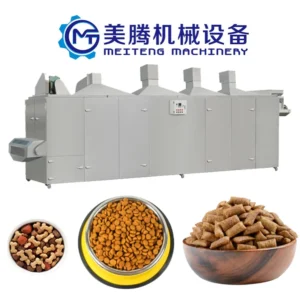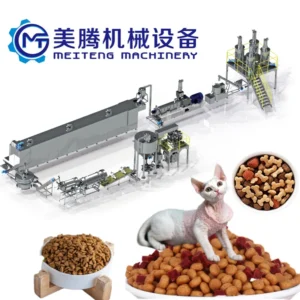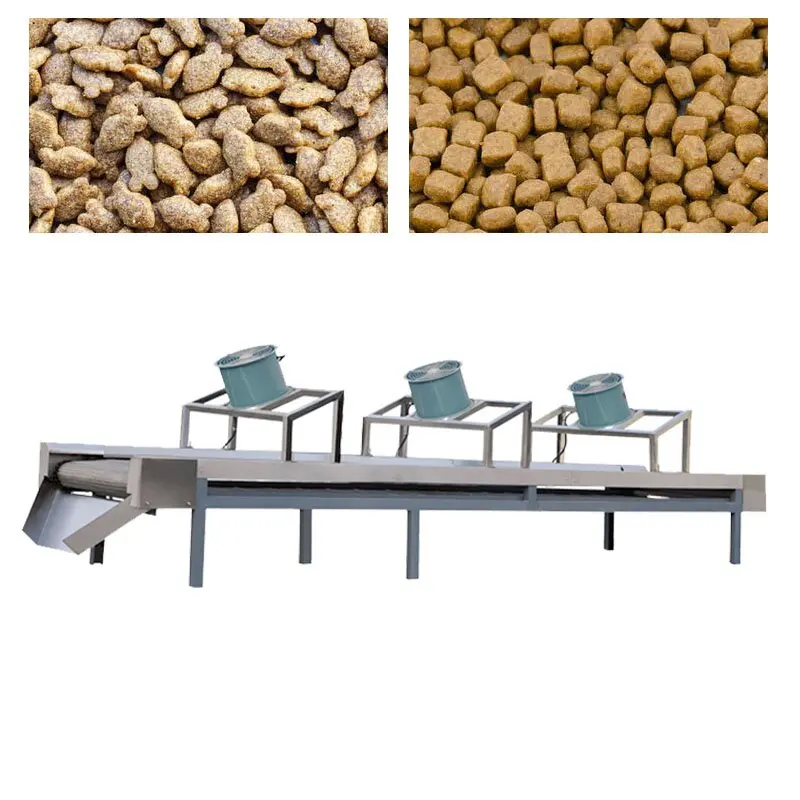
Complete Station Matching — throughput at every stage is balanced from mixer to packer based on your raw material formulation and target kibble density, preventing bottlenecks that generic line builds create.
Technical Specifications
| Parameter | Value |
|---|---|
| Product Type | Twin Screw Pet Food Extrusion Production Line |
| Screw Type | Twin Screw |
| Output Capacity | up to 3 tons per hour (basis not stated in source — confirm raw material formulation, moisture content, kibble size and density target) |
| Applications Supported | dry dog food, cat food, fish feed |
| Process Documentation | process flow drawing included |
| Control System | available with PLC or MCC control (configuration to be confirmed) |
| Voltage & Frequency | configurable to target market electrical standard (to be confirmed) |
| Warranty | 1 year |
Application Suitability
| Application | Material or Output |
|---|---|
| Dry kibble production | corn, meat meal, wheat, soy-based formulations for dog and cat food |
| Aquatic feed extrusion | floating and sinking fish feed from grain and protein concentrates |
| Multi-protein pet diets | formulations incorporating poultry meal, fish meal, and plant proteins |
| Specialty kibble formats | varied shapes and sizes through interchangeable die plates |
Why "Rated Capacity" Means Nothing Without Your Formulation
A pet food making machine full equipment range is only as productive as its weakest matched station.
I spent years on workshop floors watching extrusion lines underperform, and the pattern is always the same. A buyer signs a contract based on a headline output number, but that figure was derived from a standard corn starch test — not the high-fiber, high-meat-meal recipe their brand requires. When the actual formulation hits the barrel, viscosity changes, die pressure spikes, and throughput drops noticeably. The dryer downstream was sized for the original number, so it either runs half-empty or cannot handle the moisture load. Stations fall out of balance, and the line never reaches the contracted volume during real production [NEED_CITE: extrusion throughput dependency on raw material formulation].
How Each Station Fits the Extrusion Platform
Evaluating a pet food making machine full equipment range starts with understanding where every unit sits in the process flow. The mixer prepares a homogeneous blend before material enters the extruder barrel. The twin-screw extruder handles shear, heat, and moisture injection to gelatinize starch and shape the kibble through the die. Downstream, the dryer removes surface and internal moisture to reach shelf-stable levels, while the coating drum applies fats and palatants that define the final product appeal.
Matching Dryer and Coating Capacity to the Extruder
An extruder pushing dense, high-moisture kibble demands a dryer with sufficient bed area and residence time — undersizing it means product leaves with excess moisture and fails shelf-life testing. Similarly, the coating drum must accommodate the throughput volume while delivering even fat distribution. When these stations are selected independently rather than calculated as a system, the extruder spends time idle waiting for downstream to catch up. This is why reviewing the full equipment catalogue before committing to a layout matters — you can verify that each station’s rated handling volume aligns with your target output [NEED_CITE: throughput balancing across extrusion line stations].
Reading the Specs That Actually Matter
The twin-screw configuration is central because it handles a broader range of ingredient particle sizes and fat contents than a single-screw setup, giving producers flexibility when switching between dog food and cat food formulations. The output capacity reaching up to 3 tons per hour is only achievable when the raw material formulation, moisture content, and kibble density target fall within the extruder’s designed operating window — always request capacity verification against your specific recipe. The availability of PLC or MCC control determines how precisely barrel temperature zones and screw speed can be managed across production runs, directly affecting batch-to-batch consistency. Die configuration dictates kibble shape and expansion ratio, and this must be matched to your product specification rather than left as a generic fitment.
The Cost of Skipping Configuration Verification
I once saw a Middle East installation where the line was specified on nominal capacity alone. The buyer’s recipe had high fiber content, and the screw combination had not been adjusted for it. On-site output fell sharply, and the die clogged repeatedly within the first week. The extruder was working against a formulation it was never configured to handle, and the entire downstream sequence — dryer, cooler, coating — ran below designed capacity because the front end could not feed it. Correcting the screw profile and die specification after installation cost far more in downtime and engineering travel than a pre-shipment trial run would have [NEED_CITE: cost impact of post-installation reconfiguration on extrusion lines].
What This Equipment Range Covers
The line spans every station from batching through packing under a single equipment supply, so throughput calculations are matched across all units rather than assembled from mismatched vendors. Screw configuration and die design are specified to your raw material profile and kibble density target, not copied from a generic template. An in-house testing workshop runs your actual formulation before shipment, producing a trial run report that confirms achievable throughput and product texture. The platform covers dry pet food and aquatic feed applications, meaning producers serving both markets can standardize on one equipment family. Electrical schematics, voltage, and control language are confirmed before production starts, so commissioning proceeds without delays caused by mismatched power supply or untranslated interfaces.
Documentation & Verification
- Line layout and capacity calculation matched to your raw material and target kibble density
- Screw and die configuration record specific to your ingredient profile
- Trial run report on your formulation from the in-house testing workshop
- Electrical schematic with confirmed voltage, frequency, and control language
- CE declaration of conformity and ISO certificate for import compliance
- Operation and maintenance manual with wear parts list
Installation, Commissioning & Support
- Foundation and utility planning based on the confirmed line layout and extruder footprint
- Dedicated power circuit sizing matched to the extruder motor rating and total line load
- Assembled dispatch with station-by-station positioning guided by the layout drawing
- First-run parameter setting on your raw material with screw speed and barrel temperature profiling
- Operator training covering die changes, screw cleaning, and coating drum adjustment
- Wear parts inventory including screws and dies documented with replacement intervals
Before You Request a Quote
To specify this pet food making machine full equipment range accurately, provide your complete ingredient list with approximate ratios, target kibble size and density, and daily production volume. Confirm your facility’s available floor space and ceiling height so the layout can be configured for your building. Specify your local voltage, frequency, and preferred control language to avoid commissioning delays. If you have existing upstream or downstream equipment that the new line must integrate with, include those specifications so interface points can be planned correctly.
Frequently Asked Questions
Q: How is the stated output capacity verified against my specific raw material and kibble size?
A: The capacity figure is confirmed through a trial run in the testing workshop using your actual formulation. We document achievable throughput, kibble density, and expansion ratio in a written report before shipment, so the number in your contract reflects your recipe — not a generic benchmark.
Q: Which stations are correctly sized to avoid bottlenecking the extruder?
A: Dryer bed area, coating drum volume, and cooler conveyor length are all calculated against the extruder’s verified output on your formulation. This prevents situations where downstream stations cannot keep pace, forcing the extruder to run below its capable throughput during continuous production.
Q: What voltage, frequency, and control system options are available for my target market?
A: Electrical specifications are confirmed during the proposal stage to match your local supply standard. Control systems are available with PLC or MCC configuration, and interface language is set before production begins so operators can navigate menus without translation barriers during commissioning.
Q: Can I review the full machine catalogue and station layout before committing?
A: Yes. The equipment range covers every station from mixing to packing, and a detailed line layout drawing is provided during the proposal phase. This lets you verify each machine’s position, footprint, and role within the production flow before the order is finalized.