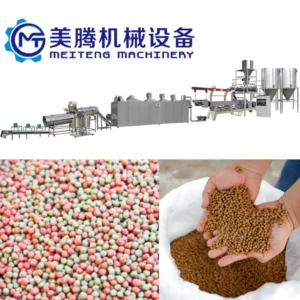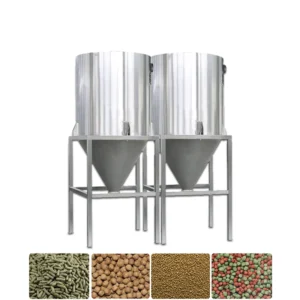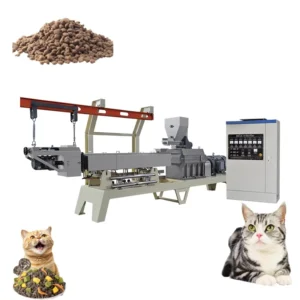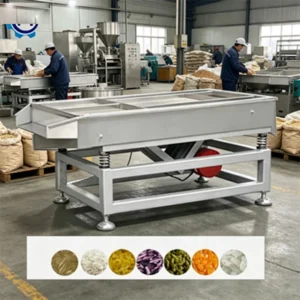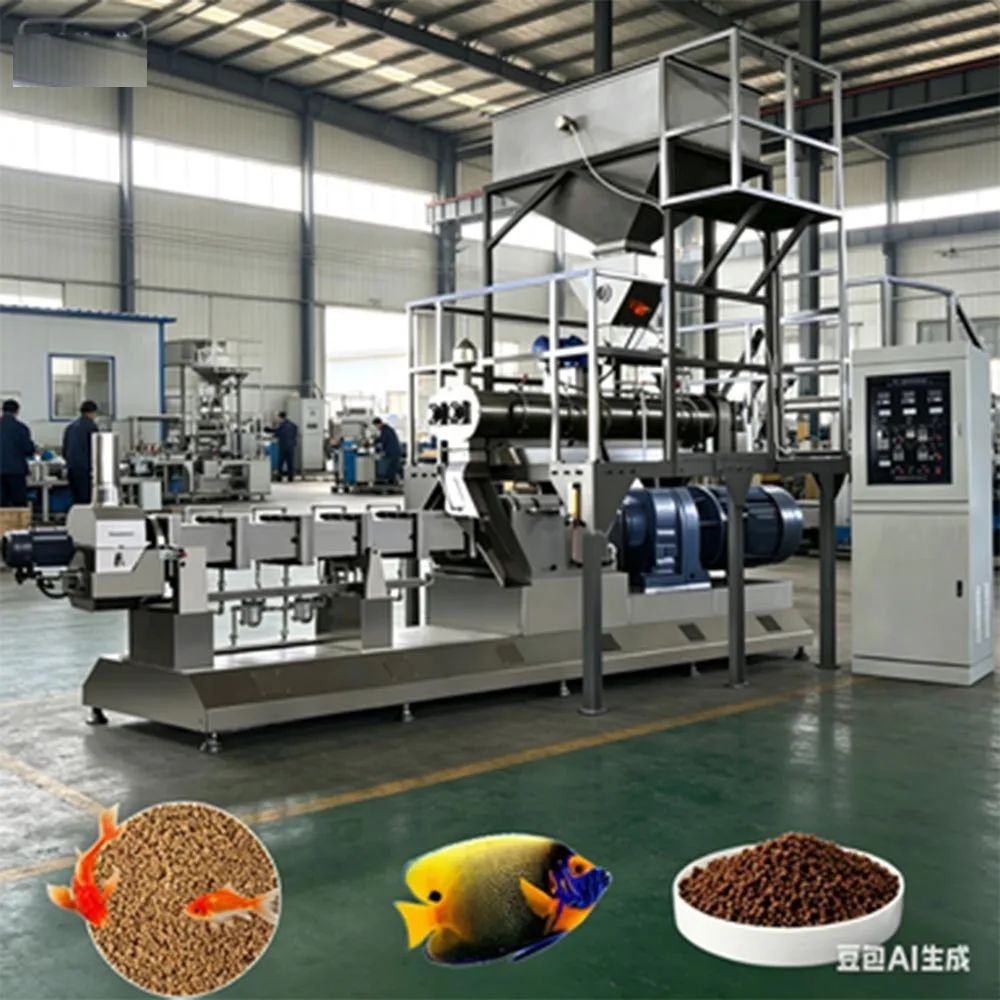
Balanced Station Throughput — Every feeding, mixing, extruding, and pelletizing unit in this aquatic line is sized to the same output target so no single station bottlenecks the plant.
Technical Specifications
| Parameter | Value |
|---|---|
| Product Type | Twin Screw Extrusion Fish Feed Production Line |
| Output Capacity | 500 kg/h (basis not stated in source — confirm raw material formula / moisture content / pellet diameter) |
| Screw Type | Twin Screw |
| Pellet Diameter Range | 0.5 mm – 12 mm (adjustable via die plate change) |
| Structure Material | Stainless Steel (main contact parts, corrosion-resistant) |
| Control System | Simple control panel (PLC / MCC available on request) |
| Line Stations Integrated | Feeding, mixing, extruding, pelletizing |
| Operation Mode | Fully automatic, continuous production |
| Downstream Stations | Dryer, cooler, coating drum, packing — to be confirmed per project scope |
| Power / Voltage & Frequency | Configurable to destination market (to be confirmed before production) |
Application Suitability
| Application | Material or Output |
|---|---|
| Floating fish feed for tilapia and catfish | Starch-rich formula with fish meal, soybean meal, and vitamin premix; pellet 2–6 mm |
| Sinking shrimp feed | High-protein blend with fish meal and binding agents; pellet 0.5–2 mm |
| Juvenile to grow-out aquatic feed | Same extrusion platform, die plate swapped to cover 0.5–12 mm range |
| Specialty aquaculture pellets | Modified starch or gelatinised binder formulas for slow-release nutrient profiles |
Why "500 kg/h" Means Nothing Without the Formula Behind It
A rated capacity figure only tells you what the extruder can push through under a specific set of conditions — raw material blend, moisture level, pellet diameter, and target bulk density. Always ask which formula and pellet size were used when the 500 kg/h figure was established. [NEED_CITE: extrusion capacity testing standards for aquatic feed]
In my experience setting up lines in Shandong workshops, I have watched the same twin screw fish feed production line full equipment range deliver very different throughputs depending on whether the customer was running a lean corn-based formula or a high-fat fish meal blend. Fat content above a certain threshold suppresses expansion and increases back-pressure, which drags output well below the nameplate number. Buyers who sign contracts on a single capacity figure without locking in the test formula often discover the gap during commissioning. That mismatch is the most common reason I see for disputes after installation [NEED_CITE: buyer-supplier dispute causes in feed machinery procurement].
How Each Station Fits the Full Equipment Range
This twin screw fish feed production line full equipment range is structured around four core stations — volumetric feeding, ribbon mixing, twin-screw extrusion, and die-face pelletizing. Each station is selected so that its maximum throughput aligns with the extruder barrel capacity, preventing the situation where the mixer batch cycle is slower than the extruder draw rate or the pelletizer cannot keep up with extrudate output.
The feeding station uses a screw feeder with variable-speed drive to meter raw material into the mixer at a rate matched to the extruder screw speed. Downstream, the pelletizer cuts extrudate at the die face with a rotating knife assembly whose speed is synchronised to the extruder motor, ensuring consistent pellet length across the 0.5–12 mm diameter range. This end-to-end matching is what separates a balanced line from one where operators constantly chase rate adjustments.
Corrosion Resistance Where It Counts in Aquatic Feed
Aquatic feed formulas carry higher moisture and salt content than most dry pet food blends, and the combination accelerates wear on carbon steel surfaces. Main contact parts on this line — barrel liners, screw elements, die plates, and the pelletizer cutting chamber — are built from stainless steel to withstand continuous exposure to these conditions.
The barrel sections use replaceable bimetallic or stainless liners that slide into the outer housing, so when wear does occur you swap the liner rather than replacing the entire barrel segment [NEED_CITE: barrel liner replacement intervals in high-moisture extrusion]. The die plate is likewise a standalone consumable: operators pull it during die changes to switch pellet diameter without dismantling the cutting assembly. For producers running both floating and sinking formulas on the same twin screw fish feed production line full equipment range, this modular wear-part approach keeps changeover time short and replacement cost contained.
What the Pellet Diameter Range Actually Requires
Covering 0.5 mm to 12 mm on a single extrusion platform demands more than swapping a die plate. At the small end — sub-2 mm shrimp feed — the screw elements must generate enough shear to fully gelatinise starch in a very short barrel residence time, while the pelletizer knife speed must be high enough to cut cleanly without crushing the narrow extrudate strand. At the large end — 8–12 mm grow-out pellets — the die orifices are wide enough that back-pressure drops, so barrel temperature profiles and screw pitch must compensate to maintain extrudate density.
The twin-screw configuration here allows operators to reconfigure screw elements along the shaft — adjusting the ratio of conveying, kneading, and reverse-flight sections — to match the shear and residence requirements of each diameter band. This flexibility means a single twin screw fish feed production line full equipment range can serve multiple aquatic species without purchasing a second extruder, provided the screw element inventory covers the necessary configurations.
The Hidden Cost of an Unmatched Dryer
An extruder running at full capacity produces a continuous stream of high-moisture pellets that must be dried to a stable shelf-life moisture level before bagging. If the dryer is undersized relative to extruder output, pellets accumulate in the transfer conveyor, cooling unevenly and developing surface cracks that create excessive fines during handling and transport. Operators then slow the extruder to match the dryer, and the line’s effective output falls below what was contracted.
Equally problematic is an oversized dryer that runs below its designed load: energy consumption per kilogram of finished product climbs, and the longer dwell time can over-dry pellets, making them brittle. Both scenarios trace back to a line that was quoted station-by-station rather than engineered as a balanced system. I have seen buyers accept a twin screw fish feed production line full equipment range without verifying dryer capacity, only to realise during commissioning that they needed a second pass through the dryer to hit specification [NEED_CITE: post-installation line balancing for feed plants].
What Sets This Equipment Range Apart
Every station — feeder, mixer, extruder, pelletizer — is specified and supplied by one source, so throughput calculations carry through the entire layout rather than relying on third-party equipment whose actual rate you cannot verify before integration. Screw element configuration and die design are selected against your specific raw material formula and target pellet density, not pulled from a generic build sheet.
An in-house testing workshop allows trial runs on your actual raw material before the line ships, so pellet density, expansion ratio, and surface quality are confirmed while there is still time to adjust screw elements or barrel zones. The line supports downstream integration with drying, cooling, coating, and packing stations from the same supplier, keeping the entire project under a single accountability chain. Pre-sales consultation covers layout and utility planning, and on-site commissioning includes operator training on die changes and screw element reconfiguration.
Documentation & Verification
- Line layout drawing showing station positions and throughput match across feeding, mixing, extruding, and pelletizing
- Screw and die configuration record specifying element arrangement and orifice diameter for your target pellet size
- Factory trial run report on your raw material formula documenting actual output, pellet density, and expansion ratio
- Electrical schematic with voltage, frequency, and control language confirmed for the destination market
- Wear parts list covering screw elements, barrel liners, and die plates with replacement lead times noted
Installation, Commissioning & Support
- Foundation plan accounts for extruder weight and vibration isolation; confirm slab load rating before equipment arrival
- Dedicated power circuit sized to the extruder main motor; voltage and frequency verified against local supply before wiring
- Stations arrive in modular sections for sequential assembly along the production hall; overhead clearance must accommodate the extruder barrel height
- First-run commissioning includes barrel zone temperature calibration and pelletizer knife-speed synchronisation to your formula
- Operator training covers die plate changeover procedure across the 0.5–12 mm pellet diameter range
- Spare screw elements and barrel liners stocked against the configuration record; replacement schedule established at handover
Before You Request a Quote
To size every station correctly, share your raw material formula — including protein, fat, starch, and moisture percentages — along with the target pellet diameter and whether the finished product must float or sink. Specify your workshop’s available floor space and ceiling height so the layout can be drawn to fit. Confirm your local voltage, phase, and frequency, as well as the preferred control panel language, so the electrical build matches your site from day one.
Frequently Asked Questions
Q: What is the full station list of this fish feed production line, and which stations are optional?
A: The core lineup includes a volumetric feeder, ribbon mixer, twin-screw extruder, and die-face pelletizer. Downstream stations — dryer, cooler, flavouring or fat-coating drum, and packing system — are added based on your production scope. Each optional station is throughput-matched to the extruder so the line runs without bottlenecks.
Q: How is the 500 kg/h output capacity defined?
A: That figure depends on raw material formula, moisture content, pellet diameter, and target bulk density. Before quotation, we run a trial on your actual formula in our testing workshop and document the measured output. The trial report becomes part of your contract file so both parties agree on the basis for the capacity claim.
Q: What voltage, frequency, and control language options are available?
A: The control panel is configured to your site’s electrical supply — voltage, phase, and frequency — confirmed during the specification stage. Panel language and HMI labels are set to the operator’s preferred language. These details are locked in before production starts to avoid commissioning delays.
Q: How are upstream batching and downstream drying, coating, and packing stations matched?
A: Throughput at every station is calculated from the extruder’s verified output on your formula. The mixer batch cycle, dryer belt speed and dwell time, coating drum rotation rate, and packing scale speed are all sized so no station forces the extruder to slow down.
Q: Which wear parts are stocked, and what is the lead time for replacements?
A: Screw elements, barrel liners, and die plates are listed in your wear parts document with part numbers and typical lead times. We keep standard configurations in stock and can machine custom die plates to your pellet diameter specification. A recommended first-order quantity is included in the quotation.