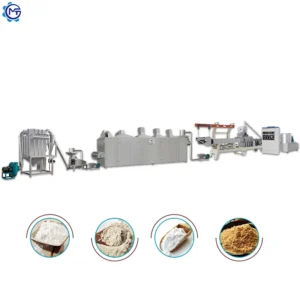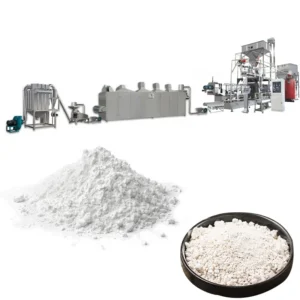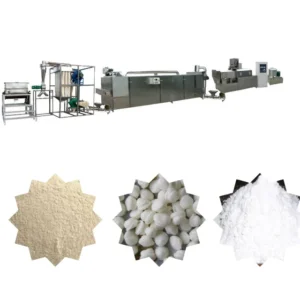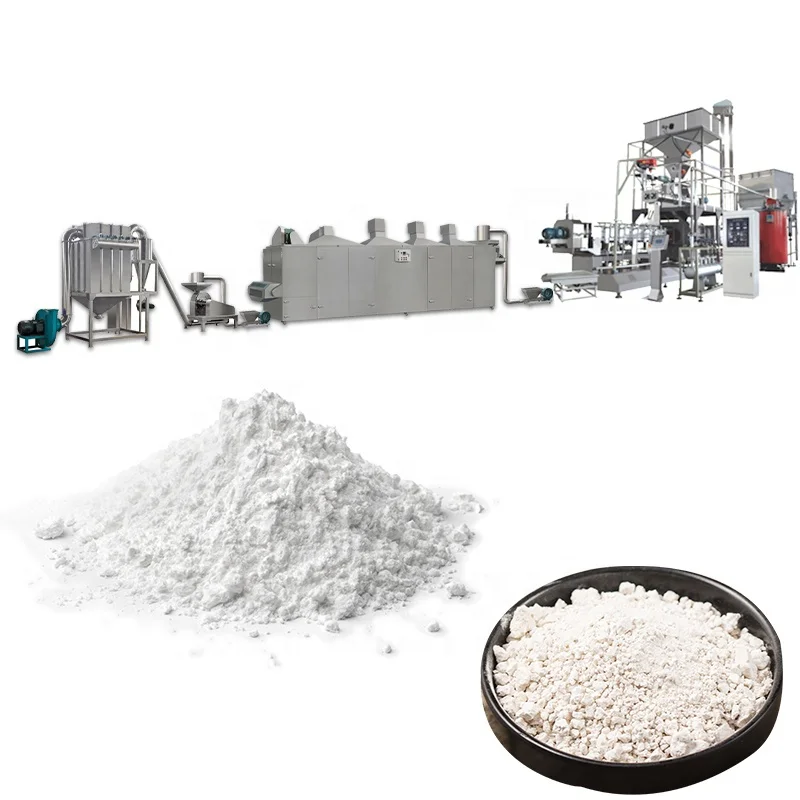
Matched throughput across every station — every mixer, extruder, dryer and grinder in the modified starch line is sized to the same duty point, so no single machine bottlenecks the rest.
Technical Specifications
| Parameter | Value |
|---|---|
| Product Type | Twin-Screw Extruder for Modified Starch Processing Line |
| Models Available | MT65, MT70, MT85 |
| MT65 Installed Power | 72 kW |
| MT65 Power Consumption | 50 kW |
| MT65 Output Capacity | 140–160 kg/h (basis not stated in source — confirm raw material type, moisture content and target starch modification) |
| MT65 Overall Dimensions | 2200 × 1000 × 2300 mm |
| MT70 Installed Power | 92 kW |
| MT70 Power Consumption | 65 kW |
| MT70 Output Capacity | 240–260 kg/h (basis not stated in source — confirm raw material type, moisture content and target starch modification) |
| MT70 Overall Dimensions | 2600 × 1000 × 2300 mm |
| MT85 Installed Power | 108 kW |
| MT85 Power Consumption | 75 kW |
| MT85 Output Capacity | 500–600 kg/h (basis not stated in source — confirm raw material type, moisture content and target starch modification) |
| MT85 Overall Dimensions | 4500 × 1000 × 2600 mm |
| Screw Type | Twin-screw, co-rotating, sectional modules |
| Barrel & Screw Structure | Modular sectional design, configurable for starch property modification |
| Extruder Systems | Feeding, extruding, cutting, heating, conveying, cooling |
| Raw Material Particle Size | 60–80 mesh |
| Mixer Construction | Stainless steel contact parts, food-grade, handle-opened discharge with safety interlock |
| Screw Conveyor Motor | 1.1 kW |
| Screw Conveyor Capacity | 0–150 kg/h (basis to be confirmed based on material bulk density) |
| Control System | PLC and MCC, configurable |
| Voltage & Frequency | Configurable per destination market |
| Line Flow | Mixing → Extrusion → Drying → Grinding → Blending → Packing |
| Assembly State | Complete line from batching to packing |
| Certification | CE, ISO |
| Warranty | 24 months, lifetime service |
Application Suitability
| Application | Material or Output |
|---|---|
| Industrial adhesives and wallpaper paste | Pregelatinized starch from corn or rice flour at 60–80 mesh |
| Oil drilling fluid additives | Modified starch with controlled viscosity and cold-water solubility |
| Paper and textile sizing agents | Denatured starch processed for specific film-forming properties |
| Construction material additives | Modified starch for mortar and gypsum board formulations |
| Food-grade thickeners and stabilizers | Modified starch for bakery, dairy, beverage and frozen food applications |
| Confectionery gelling and polishing agents | Starch with adjusted gelatinization and gel strength |
What "Nominal Capacity" Leaves Out in a Modified Starch Processing Line Equipment Purchase
The number on the quote only matters if it was measured on your actual feedstock.
An extruder rated at a given throughput on pure corn starch may behave entirely differently when the raw material contains calcium carbonate filler, cross-linking reagents or high-fiber fractions. I once spent two weeks in a South Asian plant reworking screw elements and barrel temperature zones because the trial run back at the factory used clean starch while the customer’s actual recipe was loaded with inorganic filler for wallpaper adhesive production. The gelatinization degree collapsed on first startup [NEED_CITE: starch gelatinization behavior under filler loading]. A modified starch processing line equipment package should always be validated on the buyer’s specific formulation before it leaves the factory floor.
Six Coordinated Systems Inside One Extruder Frame
The MT65, MT70 and MT85 units each integrate six functional systems — feeding, extruding, cutting, heating, conveying and cooling — into a single coordinated frame. Rather than sourcing each subsystem from a different vendor and hoping the interfaces align, the modified starch processing line equipment arrives with these systems balanced to the same throughput target. The feeding system meters raw material at a rate matched to the screw profile, while the heating and cooling systems maintain the barrel temperature curve required for the specific starch modification being produced.
Modular Barrel and Screw Geometry for Starch Modification
The co-rotating twin-screw design uses sectional barrel modules and configurable screw elements. This means the same extruder can be reconfigured to produce pregelatinized starch with high cold-water swelling, denatured starch with reduced viscosity, or chemically modified starch requiring specific residence time and shear profiles. When a buyer shifts production from food-grade thickeners to industrial adhesive starch, the screw combination and die design are adjusted rather than replaced entirely [NEED_CITE: twin-screw modular screw element configurations].
Reading the Specs That Actually Matter
The installed power figures — 72 kW for the MT65, 92 kW for the MT70 and 108 kW for the MT85 — indicate the thermal and mechanical energy available for starch gelatinization inside the barrel. Higher installed power allows more aggressive shear and temperature profiles, which is necessary when processing starch blends with high filler content or when targeting deep molecular modification. The overall dimensions directly determine the floor space and ceiling clearance needed at the installation site. The raw material particle size requirement of 60–80 mesh is critical: coarser particles will not gelatinize uniformly inside the barrel, while excessively fine powder can cause feeding bridging in the hopper. The stainless steel mixer with food-grade contact parts and safety-interlocked discharge ensures batch consistency before material ever reaches the extruder throat.
The Hidden Cost of a Mismatched Dryer or Grinder
If the dryer downstream of the extruder cannot remove moisture at the same rate the extruder produces it, wet starch accumulates on the cooling conveyor and degrades before it reaches the grinder. I have seen entire batches of pregelatinized starch clump into unusable lumps because the dryer was sized for a different output level. Similarly, a grinder rated for a coarser mesh than the target specification will recirculate oversize particles back into the blending station, creating a feedback loop of off-spec product [NEED_CITE: moisture content targets for pregelatinized starch stability]. These bottlenecks are invisible on paper when each machine is quoted separately.
Why Source the Full Equipment Range From One Manufacturer
Every station in the modified starch processing line — from the flour mixer through the screw conveyor, extruder, cooling conveyor, dryer, grinder, blender and packing station — is supplied and matched by Meiteng. Throughput calculations are documented at each station so the buyer can verify that no single machine restricts the rest. The screw configuration and die design are specified to the buyer’s raw material and target modification type, not copied from a generic build. An in-house testing workshop allows trial runs on the customer’s actual feedstock before shipment, catching formulation surprises early. Electrical schematics and voltage specifications are confirmed against the destination market before production begins. The PLC and MCC control system is configured to the operator language required at the installation site.
Documentation & Verification
- Line layout and capacity calculation showing throughput at every station
- Screw and die configuration record matched to target starch modification type
- Trial run report on buyer’s actual raw material conducted before shipment
- Electrical schematic with confirmed voltage and frequency for destination site
- CE declaration of conformity and ISO certificate included with shipment
- Operation and maintenance manual with wear parts list
Installation, Commissioning & Support
- Foundation plan accounts for MT85 overall dimensions of 4500 × 1000 × 2600 mm
- Dedicated electrical circuit sized for installed power up to 108 kW confirmed before arrival
- Modular barrel sections arrive assembled; screw elements inspected and verified on site
- First startup includes temperature curve tuning to match buyer’s specific starch formulation
- Operator training covers screw combination changes for switching between starch modification types
- Recommended spare wear parts list covers screw segments, dies and barrel liners
What to Include in Your Inquiry
Provide the specific starch source and any additives or fillers in your formulation, along with the target modification type — pregelatinized, denatured or chemically modified. Confirm your local voltage, frequency and preferred control language so the modified starch processing line equipment can be configured correctly before production. Share your available floor space and ceiling height so the line layout can be designed around your actual building dimensions rather than an idealized floor plan.
Frequently Asked Questions
Q: How is output capacity verified on my specific starch formulation?
A: Every line undergoes a trial run in the testing workshop using the buyer’s actual raw material, not a generic benchmark starch. The resulting trial report documents achievable throughput, gelatinization degree and product quality on that specific formulation before the equipment ships.
Q: Which downstream stations are included and how is throughput balanced?
A: The line includes mixer, screw conveyor, extruder, cooling conveyor, dryer, grinder, blender and packing station. Each station is sized so its capacity matches the extruder output, preventing bottlenecks or material accumulation between machines.
Q: What voltage and control options are available for my market?
A: Voltage and frequency are confirmed per destination market before production. The PLC and MCC control system can be configured to the operator language required at the installation site to avoid commissioning delays.
Q: Can the same extruder produce different types of modified starch?
A: The modular sectional barrel and screw design allows reconfiguration of screw elements and die geometry. This enables production of pregelatinized, denatured or chemically modified starch on the same MT65, MT70 or MT85 unit by adjusting the screw combination.
Q: What spare wear parts should I order with the initial shipment?
A: A recommended first-order list includes screw segments, die plates and barrel liners specific to your configuration. This ensures replacement parts are available when the first wear interval arrives rather than waiting for international shipping.