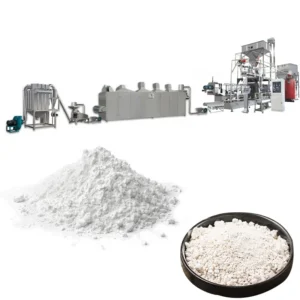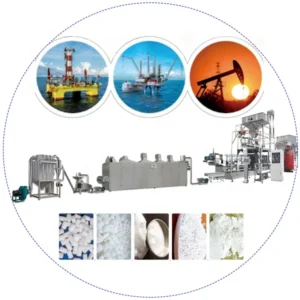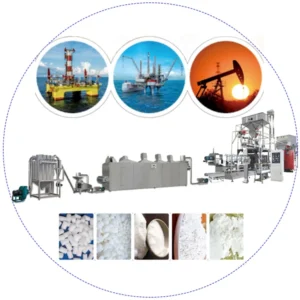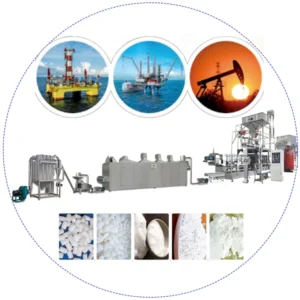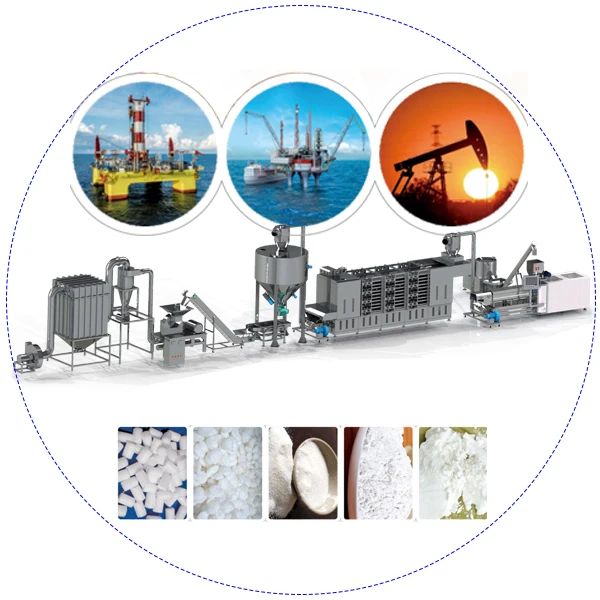
Integrated Throughput Matching — Every station from the 4.0 kW mixer through the final grinder is balanced so the twin-screw extruder never waits on downstream drying or conditioning capacity.
Technical Specifications
| Parameter | Value |
|---|---|
| Product Type | Modified Starch Production Line |
| Extruder Type | Twin-screw extruder |
| Capacity Range | 80–500 kg/h (basis not stated in source — confirm raw material type and moisture content) |
| Main Motor Power (Extruder) | ~100 kW (electric heating) / 50–60 kW (gas or diesel heating) |
| Mixer Motor | 4.0 kW |
| Screw Conveyor Motor | 1.1 kW |
| Voltage & Frequency | 380 V / 50 Hz (three-phase), 220 V / 50 Hz (single-phase); custom voltage available per destination country |
| Raw Materials | Wheat flour, corn starch, potato starch |
| Frame Material | Stainless steel 201 |
| Contact Parts Material | Food-grade stainless steel 304 |
| Energy Options | Electricity, gas, diesel, or steam |
| Barrel Construction | 45 steel screws, high-temperature and high-pressure processing |
| Die Configuration | Interchangeable dies for different product forms |
| Line Process Flow | Mixer → Screw Conveyor → Twin-screw Extruder → Shift → Air Conveyor → Dryer → Air Conveyor → Conditioning → Conveyor → Grinder |
| Assembly State | Complete line with supporting equipment |
| Warranty | 1 year with lifetime technical guidance support |
| Certification | CE |
Application Suitability
| Application | Material or Output |
|---|---|
| Pregelatinized starch for instant food and bakery | Corn starch, wheat flour |
| Modified starch for sauce and dressing thickening | Potato starch, corn starch |
| Industrial modified starch for paper manufacturing | Wheat flour, corn starch |
| Functional starch ingredients for nutritional products | Corn starch, potato starch |
| Starch denaturation for specialty adhesive applications | Wheat flour, corn starch |
What "80–500 kg/h" Actually Depends On for Starch Extrusion
Capacity on a modified starch production line equipment manufacturer’s datasheet only holds when the raw material, moisture content, and target gelatinization degree match the test conditions.
I once stood next to a pregelatinized starch line where the buyer quoted corn starch capacity but ran cassava starch on arrival. The gelatinization temperature window shifted, the die face gummed up within the first hour, and output dropped to roughly half the nameplate figure. Starch sources vary widely in amylose-to-amylopectin ratio, and each one demands a different screw profile and barrel temperature sequence. When a modified starch production line equipment manufacturer provides a capacity range without stating the test material and moisture baseline, that number is a starting point for negotiation — not a production guarantee [NEED_CITE: starch gelatinization temperature variance across botanical sources].
Screw Geometry and Starch Shear Control
The twin-screw extruder on this line uses 45 steel screw elements built to withstand the high-temperature, high-pressure environment that starch gelatinization requires. The screw configuration determines how much mechanical shear the starch granules experience before they exit the die. For pregelatinized starch destined for instant food applications, the screws must deliver enough shear to rupture granule structure fully without degrading the polymer chains that give the finished powder its viscosity. A modified starch production line equipment manufacturer that specifies screw element arrangement to the buyer’s target product avoids the common failure mode where output looks correct but functional properties fall outside specification.
Barrel Temperature Sequencing Across Starch Types
Different starch sources gelatinize at different temperatures — corn starch, wheat flour, and potato starch each have a distinct onset and peak. The barrel zones on this extruder are heated independently, allowing the operator to build a temperature ramp that matches the raw material loaded into the mixer. When the line switches from corn starch to potato starch, the barrel profile must change accordingly or the material will either under-gelatinize and leave raw granules in the output, or over-shear and produce a degraded paste that blocks the die. This is the reason trial runs on the buyer’s own raw material in the testing workshop matter before the line ships [NEED_CITE: barrel temperature profiling in twin-screw starch processing].
Motor Rating, Heating Source, and Utility Planning
The extruder main motor draws approximately 100 kW under electric heating or between 50 and 60 kW when gas or diesel heating is selected. This split matters during plant utility planning because the electrical service entrance must be sized for the higher draw if electric heating is chosen. The 4.0 kW mixer motor and 1.1 kW screw conveyor motor add to the total connected load. Buyers in regions with unstable three-phase supply should confirm whether 380 V / 50 Hz matches their local grid or whether a transformer and custom voltage configuration are needed before the line enters production [NEED_CITE: industrial voltage and frequency standards by export market].
Reading the Specification Sheet Against Your Actual Conditions
The capacity range listed for this modified starch production line equipment manufacturer’s system is 80–500 kg/h, but that figure carries no stated basis for raw material type or moisture content. In practice, corn starch at a given moisture level may gelatinize and convey through the dryer at a different rate than wheat flour or potato starch. The stainless steel 304 contact parts ensure food-grade compliance across all three materials, yet the throughput at the grinder station depends entirely on how fast the upstream dryer removes moisture to the target level. Buyers should request a capacity calculation document that names their specific starch source and incoming moisture percentage rather than accepting a generic range.
The Hidden Cost of Mismatched Downstream Stations
When the dryer or conditioning unit cannot keep pace with the extruder output, wet starch accumulates in the air conveyor and the entire line must slow down. I have seen operators reduce extruder feed rate to match a dryer that was sized for a different product density, effectively running a high-capacity extruder at half its potential. The line process flow on this system runs from mixer through twin-screw extruder, shift, air conveyor, dryer, conditioning, conveyor, and grinder — each station must be throughput-matched to the extruder’s actual output on the buyer’s starch type, not to a nominal catalog number [NEED_CITE: throughput balancing in continuous starch processing lines].
Why Sourcing the Full Line from One Supplier Matters Here
The complete line from batching through grinding comes under a single supplier, which means throughput is matched across every station rather than assembled from separate vendors who each quote their own machine in isolation. Screw configuration and die design are specified to the buyer’s raw material and target starch functionality before the extruder enters production. The in-house testing workshop allows trial runs on the buyer’s actual starch before shipment, catching gelatinization mismatches before they appear on the factory floor. Pre-sales consultation covers line layout, utility planning, and phased installation, while ongoing maintenance support includes wear parts supply for screw elements and dies. Food-grade stainless steel 304 contact materials throughout the line meet hygiene expectations in both food and industrial starch markets.
Documentation & Verification
- Line layout and capacity calculation showing throughput matched from mixer through grinder for your starch type
- Screw and die configuration record matched to your target gelatinization degree
- Trial run report on your specific corn, wheat, or potato starch before dispatch
- Electrical schematic with voltage and frequency confirmation for your destination country
- CE declaration of conformity and factory test record for the complete line
Installation, Commissioning & Support
- Foundation and floor space planning based on the full line footprint from mixer to grinder
- Three-phase 380 V / 50 Hz supply verification with custom voltage options confirmed before production
- Extruder barrel heating system commissioning with energy source set to electricity, gas, diesel, or steam
- First-run parameter tuning on your raw starch material including barrel temperature profile and screw speed
- Operator training covering die changeover, dryer temperature adjustment, and grinder screen selection
- Wear parts list covering 45 steel screw elements and interchangeable dies with reorder lead times
What to Include in Your Inquiry
To receive a line configuration that matches your actual production conditions, provide the specific starch source you plan to run, the incoming moisture content, and the target gelatinization or modification degree for your end product. Include your local voltage and frequency, the available energy source at your plant, and whether you need the control interface in a specific language. If you have existing upstream batching or downstream packing equipment, note the connection points so the modified starch production line equipment manufacturer can size the interface conveyors correctly.
Frequently Asked Questions
Q: How is line capacity verified on the buyer’s specific starch raw material and moisture content?
A: Before the line ships, the buyer sends a sample of their actual corn, wheat, or potato starch to the in-house testing workshop. A trial run is conducted using the proposed screw configuration and barrel temperature profile, and the output rate, gelatinization degree, and moisture after drying are recorded. The resulting trial run report becomes the baseline capacity reference for that specific material.
Q: What screw configuration and die design is matched to pregelatinized versus chemically modified starch?
A: Pregelatinized starch requires screw elements that deliver sufficient shear to fully rupture granule structure at the target barrel temperature, while chemically modified starch may need gentler conveying to preserve reagent contact time. The die opening is selected to control expansion and density of the extrudate before it enters the dryer. Each configuration is documented in the screw and die record before production begins.
Q: How is dryer and conditioning capacity matched to extruder output to prevent line bottleneck?
A: The supplier calculates dryer residence time and thermal capacity based on the moisture removal requirement for the specific starch type running through the extruder. If the extruder outputs material at a higher moisture level due to the starch source, the dryer must be sized with additional thermal headroom. Conditioning capacity is then matched to the dried output rate to ensure continuous flow into the grinder.
Q: What voltage, frequency, and control language options are confirmed before production?
A: The standard configuration is 380 V / 50 Hz three-phase with 220 V / 50 Hz single-phase for auxiliary circuits, but custom voltage is available for the destination country. The electrical schematic and voltage confirmation document are reviewed with the buyer before the extruder enters production. Control interface language is agreed upon during the specification confirmation stage to avoid commissioning delays on site.