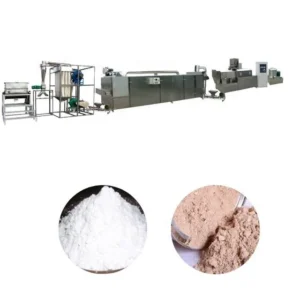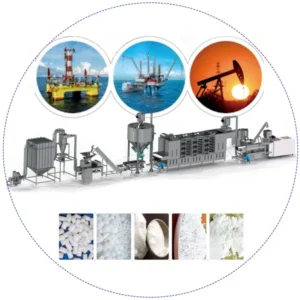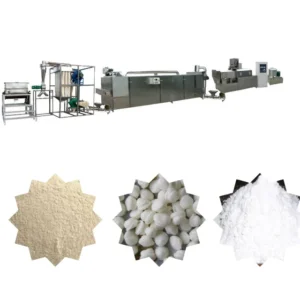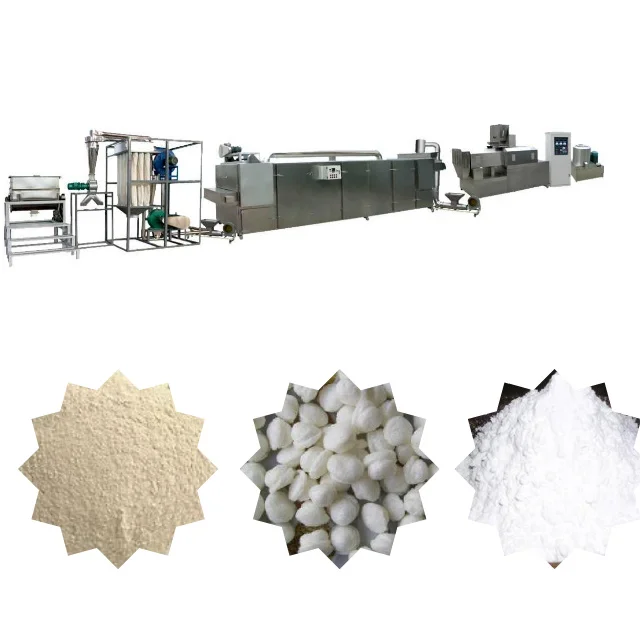
Balanced Throughput Design — every station from blending to packing is sized to the extruder output so no single machine silently caps your modified starch line.
Technical Specifications
| Parameter | Value |
|---|---|
| Product Type | Modified Starch Processing Line |
| Models Available | MT85 / MT100 / MT110 / MT135 |
| Screw Type | Twin-screw extruder with changeable barrel and screw configuration |
| Capacity Range | 100–1500 kg/h (basis not stated in source — confirm raw material type, moisture content, and target modification degree) |
| Installed Power | 90 kW (MT85) / 180 kW (MT100) / 200 kW (MT110) / 240 kW (MT135) |
| Real Power Consumption | 63 kW (MT85) / 120 kW (MT100) / 150 kW (MT110) / 165 kW (MT135) |
| Processing Flow | Material preparation → Blending → Mixing → Extruding → Drying → Grinding → Packing |
| Heating Source Options | Electric / Steam / Gas (drying station) |
| Control System | Automated PLC and MCC control with frequency speed regulation |
| Automation Features | Automatic lubricating and cooling system |
| Contact Materials | Stainless steel 304 on food-contact surfaces |
| Grinding Fineness | Less than 10 mm |
| Discharge Method | Bottom butterfly valve (grinding station) |
| Assembly State | Complete line with batching, extrusion, drying, grinding, and packing stations |
| OEM/ODM | Available with custom factory layout and production line drawing |
Application Suitability
| Application | Material or Output |
|---|---|
| Pre-gelatinized starch for food processing | Corn starch, tapioca starch, potato starch |
| Modified starch for textile sizing | Corn starch with target viscosity profile |
| Modified starch for paper coating | Tapioca or potato starch with controlled gelatinisation degree |
| Industrial starch for oil drilling fluids | Corn starch processed to specified cold-water swelling properties |
| Modified starch for construction additives | Potato or corn starch with adjusted pregelatinisation parameters |
What Buyers Miss When They Only Compare Extruder Models
A modified starch line is only as fast as its weakest downstream station.
I spent years in the testing workshop before moving into line planning, and the most common failure I watched unfold was not the extruder itself — it was the dryer two stations downstream. Buyers would compare Modified Starch Processing Equipment full range catalogues by extruder motor power and barrel diameter, then wonder why actual output never reached the quoted figure. The dryer lacked the residence time to handle the moisture load, or the grinder could not keep up with the extruded sheet volume. That mismatch sits quietly on the factory floor, costing throughput every shift [NEED_CITE: throughput loss from station mismatch in starch processing lines].
Matching Every Station to Your Starch Grade
Different modification targets demand different thermal and mechanical profiles across the entire line. A tapioca starch destined for high-viscosity food applications requires a gentler extrusion shear profile and a longer drying cycle than a corn starch processed for textile sizing. When the dryer is specified around a generic residence time rather than the actual moisture content leaving the extruder die, the downstream grinder receives material that is either too brittle or too tacky, and the packing station sees inconsistent bulk density.
Drying Source Selection and Local Utility Reality
The drying station accepts electric, steam, or gas heating. This choice is not cosmetic — it determines your per-kilogram energy cost and your compliance path with local emissions rules. I once worked on a project where the buyer’s municipality restricted gas-fired dryers inside food-grade zones, forcing a late-stage redesign to electric heating that shifted the entire power distribution plan. Confirming the heating source before the line layout is finalized avoids rework that delays commissioning by weeks [NEED_CITE: industrial dryer emission regulations by region].
Reading the Specs That Actually Matter
The twin-screw configuration is the heart of modified starch production because it controls shear intensity, residence time, and gelatinisation degree simultaneously. The changeable barrel and screw arrangement means the same MT-series extruder can run pregelatinized starch at one configuration and chemically modified starch at another — but only if the configuration record is built around the buyer’s actual raw material, not copied from a generic reference build. Installed power ranges from 90 kW on the MT85 to 240 kW on the MT135, while real consumption sits at roughly 65–70% of that figure, which matters for sizing your transformer and switchgear. Stainless steel 304 contact surfaces on the grinding and downstream stations meet food-grade hygiene requirements without the cost of higher alloy grades. The automated PLC with frequency speed regulation holds extruder screw speed stable across batches, which is what keeps gelatinisation degree consistent when ambient temperature shifts between seasons.
The Hidden Cost of Skipping a Raw Material Trial
Every starch source — corn, tapioca, potato — behaves differently under heat and shear. A screw profile tuned for corn starch will under-gelatinise tapioca, leaving a gritty texture that fails viscosity specs at the customer’s lab. I learned this the hard way on a Middle East project where the buyer sent purchase specifications for corn starch but was actually running cassava starch on arrival. The line produced, but the gelatinisation degree never reached the target, and output dropped sharply because the material spent longer in the barrel trying to cook through. That project could have been solved with a three-day trial run before shipment [NEED_CITE: raw material variability in starch extrusion processing].
Why Source the Full Range from One Supplier
The extruder, dryer, grinder, and packing station are designed as a matched set, so throughput calculations are validated across every station rather than assembled from separate vendor quotes. Screw and die configuration is specified to the buyer’s raw material and target modification grade, not pulled from a standard library. The in-house testing workshop allows trial runs on the buyer’s actual starch before the line ships, catching mismatches that would otherwise surface during commissioning. Electrical schematics are confirmed for the destination market’s voltage and frequency before production begins. Ongoing maintenance support covers wear parts like screw elements and die plates that are the first consumables to need replacement.
Documentation & Verification
- Line layout and capacity calculation showing throughput balance across extruder, dryer, and grinder
- Screw and die configuration record matched to corn, tapioca, or potato starch and target modification
- Machine specification sheet with confirmed voltage, frequency, and PLC language for destination market
- Trial run report on buyer’s raw material conducted in the testing workshop before shipment
- CE declaration of conformity and ISO certificate included in shipping documentation
Installation, Commissioning & Support
- Foundation plan accounts for extruder vibration isolation and dryer thermal expansion clearances
- Power distribution sized to real consumption figures from 63 kW to 165 kW depending on model
- Line ships in modular sections for container loading and on-site reassembly
- First-run parameter setting covers barrel temperature profile and screw speed for buyer’s starch grade
- Operator training includes screw configuration changeover procedure for different modification targets
- Wear parts list identifies screw elements and die plates with recommended replacement intervals
Before You Send an Inquiry
Tell us which starch source you will run — corn, tapioca, potato, or a blend — and what modification or gelatinisation degree your end market requires. Share your target hourly output, workshop dimensions, and ceiling height so we can draft a layout. Confirm the local voltage, frequency, and whether your facility has access to steam or gas for the drying station. If you already have upstream batching or downstream packing equipment, let us know so the line interfaces cleanly.
Frequently Asked Questions
Q: How is the capacity of each model verified for modified starch?
A: Capacity figures depend on raw material type, incoming moisture, and target modification degree. We run trial batches on the buyer’s actual starch in our testing workshop before confirming throughput. The 100–1500 kg/h range covers all models but must be validated against your specific corn, tapioca, or potato starch and desired gelatinisation level.
Q: What is included versus what must be sourced separately?
A: The complete line covers batching, blending, extrusion, drying, grinding, and packing stations with PLC control. Buyers typically provide raw material storage silos, compressed air supply, and final product warehousing. If you already own a packing system, individual upstream stations can be supplied to integrate with your existing equipment.
Q: How do I match the extruder model to my output requirement?
A: Model selection depends on target modification degree and raw material behaviour, not just kilogram-per-hour targets. Higher modification degrees require longer residence time, which reduces effective throughput on a given model. We recommend sharing your product specification sheet so the correct model and screw configuration can be selected.
Q: Can individual stations be ordered to upgrade an existing line?
A: Yes. Dryers, grinders, and packing stations are available as standalone units. We need your current extruder model, actual output rate, and the moisture content of material entering the downstream station to size the replacement equipment correctly and avoid creating a new bottleneck.