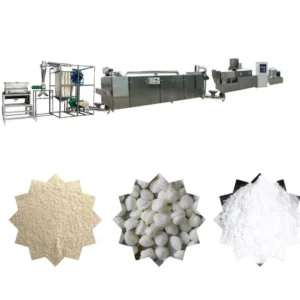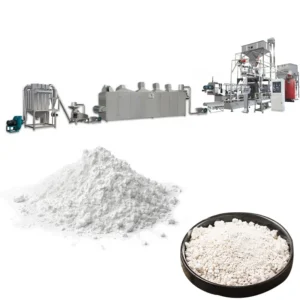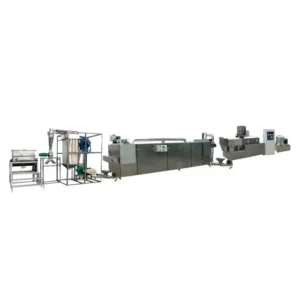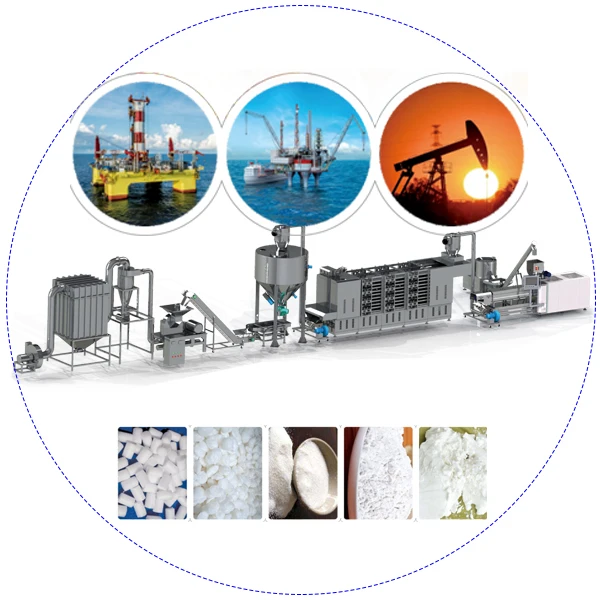
Throughput-matched line design — Every station from the batching system to the pulse grinder is calculated against the same modified starch formulation to prevent bottlenecks that generic builds create.
Technical Specifications
| Parameter | Value |
|---|---|
| Product Type | Twin Screw Extrusion Modified Starch Processing Line |
| Screw Type | Twin screw |
| Power Range | 45–200 kW |
| Capacity Range | 100–1500 kg/h (basis not stated in source — confirm raw material type, moisture content and degree of modification) |
| Weight Range | 1000–5000 kg (source value — verify against specific model configuration) |
| Voltage | 220–440V, tri-phase (50Hz / 60Hz customizable) |
| Control System | PLC and MCC control |
| Contact Materials | 304 stainless steel on product-contact parts; PVC on select conveyors |
| Line Stations | Mixing and batching → Twin screw extruder → Cooling and air-drying conveyor → Pulse grinder → Packing |
| Fuel / Heating Options | Gas / diesel / electricity / steam (to be confirmed at quotation) |
| Assembly State | Complete line, factory-tested before shipment |
| Testing | In-house testing workshop for trial runs on customer raw material |
| Standards | CE (since 2014), ISO certified |
Application Suitability
| Application | Material or Output |
|---|---|
| Food-grade modified starch | Corn flour, potato starch and grain flours processed for thickening, binding and stabilising roles in food manufacturing |
| Industrial pregelatinised starch | Corn and tapioca starch modified for oil drilling fluid viscosity and paper making surface sizing |
| Fortified and blended nutritional powder | Rice flour and soybean flour carrying additive-enriched modification for infant formula and dietary supplement blending lines |
Why Nominal Capacity Numbers Mislead Modified Starch Buyers
A quoted output figure means nothing until it is verified on your specific starch formulation and moisture level.
Buyers evaluating a modified starch processing line equipment range often receive a single capacity number tied to a standard corn starch benchmark. The problem surfaces when the actual raw material is cassava or potato starch, which carries different gelatinisation temperatures, shear sensitivity and moisture absorption rates. I once watched a line stall for four days because the screw configuration was set for corn while the plant was running cassava — the torque alarm tripped within the first hour and the entire screw set had to be reconfigured. Every MT line runs a trial on the buyer’s actual starch formulation in our testing workshop before it ships, so the capacity figure you receive is tied to your material, not a catalogue assumption [NEED_CITE: raw material variability in starch extrusion].
Matching the Screw Profile to Your Starch Type
Twin screw extrusion gives operators control over shear intensity, residence time and barrel temperature staging — all variables that directly determine the degree of starch modification. The screw configuration and die design are specified to the buyer’s raw material and target modification level rather than copied from a generic build. Corn starch, rice flour, soybean flour and potato starch each demand different compression ratios and kneading block arrangements to achieve the correct gelatinisation without degrading the polymer chain.
The Role of Post-Extrusion Cooling and Grinding
Once the extrudate leaves the die, surface moisture must be removed quickly to prevent clumping before grinding. The cooling and air-drying conveyor uses a wind-knife blow mouth configuration that strips surface moisture without altering the modification achieved inside the barrel. Downstream, the pulse grinder with cyclone discharge and integrated dust collector controls particle size distribution and keeps the milling area clean — a detail that matters when producing food-grade or pharmaceutical-grade starch powders where contamination thresholds are strict [NEED_CITE: particle size standards for food-grade modified starch].
Reading the Power and Capacity Specifications
The 45–200 kW power range reflects the different extruder sizes available across the line configurations, not a single machine. A buyer producing pregelatinised starch for oil drilling at lower volumes will use a smaller barrel diameter and lower motor rating than a plant running food-grade corn starch modification at higher throughputs. Voltage spans 220–440V tri-phase with frequency confirmed before production, so a facility running on 60Hz in Southeast Asia receives a motor and drive package matched to that supply rather than a 50Hz default. The capacity range of 100–1500 kg/h carries a critical caveat: it must be validated against the buyer’s raw material type, moisture content and target modification degree during the pre-shipment trial run.
The Hidden Cost of Mismatched Station Throughput
Assembling a starch line from separate vendors often results in an extruder that outpaces the dryer or a grinder that cannot keep up with the cooling conveyor. The consequence is material backing up at one station while another idles, cutting real output well below the quoted number. Buyers also encounter problems when the voltage and control language are assumed rather than confirmed — I have seen commissioning delayed because the PLC interface was in a language the local operators could not read, and rewiring a control cabinet on-site is neither quick nor cheap [NEED_CITE: commissioning delays from voltage mismatch in food processing plants].
Why Buyers Source This Line From a Single Supplier
Every station in the modified starch processing line equipment range — batching, extrusion, cooling, grinding, packing — is throughput-calculated together, eliminating the gap that opens when equipment arrives from different factories. The screw configuration and die design are documented specifically for the buyer’s raw material and target product, not pulled from a template. An in-house testing workshop runs the buyer’s actual starch formulation before dispatch, producing a trial run report that travels with the shipment. PLC and MCC control systems are built with the buyer’s voltage, frequency and preferred control language confirmed before the wiring stage. Pre-sales consultation extends through engineer design, on-site installation, commissioning and ongoing maintenance with documented wear parts lists.
Documentation & Verification
- Line layout and capacity calculation matched to each station’s throughput on your starch formulation
- Screw and die configuration record documenting the build selected for your raw material
- Trial run report on customer raw material generated in the testing workshop before shipment
- Electrical schematic and voltage confirmation sheet aligned to your plant supply
- CE declaration of conformity and ISO certificate for customs and regulatory clearance
- Operation and maintenance manual with wear parts list specific to your line configuration
Installation, Commissioning & Support
- Foundation plan accounts for the 1000–5000 kg line weight and extruder vibration isolation requirements
- Dedicated power circuit sized for the 45–200 kW extruder motor and downstream grinder load
- Factory-assembled stations arrive labelled for sequential installation per the supplied layout drawing
- First-run parameter setting covers barrel temperature profile, screw speed and die pressure on your starch material
- Operator training addresses PLC navigation, alarm response and screw configuration changeover procedures
- Wear parts list specifies replacement screws, dies and grinder screens with recommended reorder intervals
What to Include With Your Inquiry
Send your target starch type, whether corn, cassava, potato or a blend, along with the degree of modification and any additive incorporation requirements. Specify your plant’s voltage, frequency and the control language your operators need. Let us know your available floor space and ceiling height so the line layout fits your building before the quotation is drafted.
Frequently Asked Questions
Q: How is line capacity verified on my specific starch raw material and modification formula?
A: Before shipment, we run your actual starch formulation — including any additives — through the twin screw extruder in our testing workshop. The trial run records throughput, torque, barrel temperature profile and product quality against your specification. A trial run report is generated and shipped with the line so the capacity figure you receive reflects your material, not a generic benchmark.
Q: What voltage, frequency and control language options are available for my target market?
A: The line supports 220–440V tri-phase at either 50Hz or 60Hz. Motor ratings, transformer sizing and drive components are selected after your plant’s electrical supply is confirmed. The PLC and MCC interface language is set to your operators’ preference before the control cabinet is wired, preventing commissioning delays caused by unreadable screens.
Q: How are screw configuration and die design selected for different starch types and modification levels?
A: Corn, cassava, potato and rice starches each gelatinise at different temperatures and shear levels. We specify the kneading block arrangement, compression ratio and die geometry based on your raw material analysis and target modification degree. The configuration record is documented and included in your shipment documentation for future reference and reorder.
Q: Which fuel and heating sources can be configured for the extrusion and drying stations?
A: Barrel heating and any downstream drying stations can be configured for gas, diesel, electricity or steam depending on your plant’s utility availability and cost structure. The fuel choice is confirmed at the quotation stage so that burners, heat exchangers and control loops are matched before fabrication begins.
Q: What spare wear parts are included, and how are replacement screws and dies supplied?
A: The initial shipment includes a wear parts list specific to your line configuration, covering screws, dies and grinder screens. Replacement components are manufactured to the same configuration record used in your original build, ensuring dimensional and performance consistency when the first changeover is due.