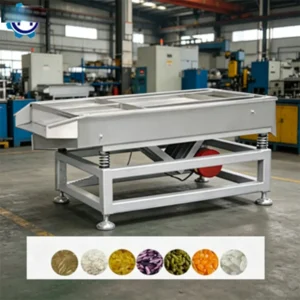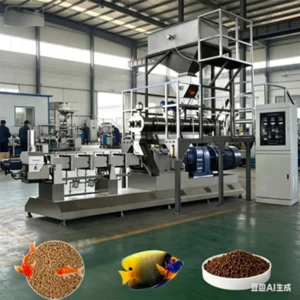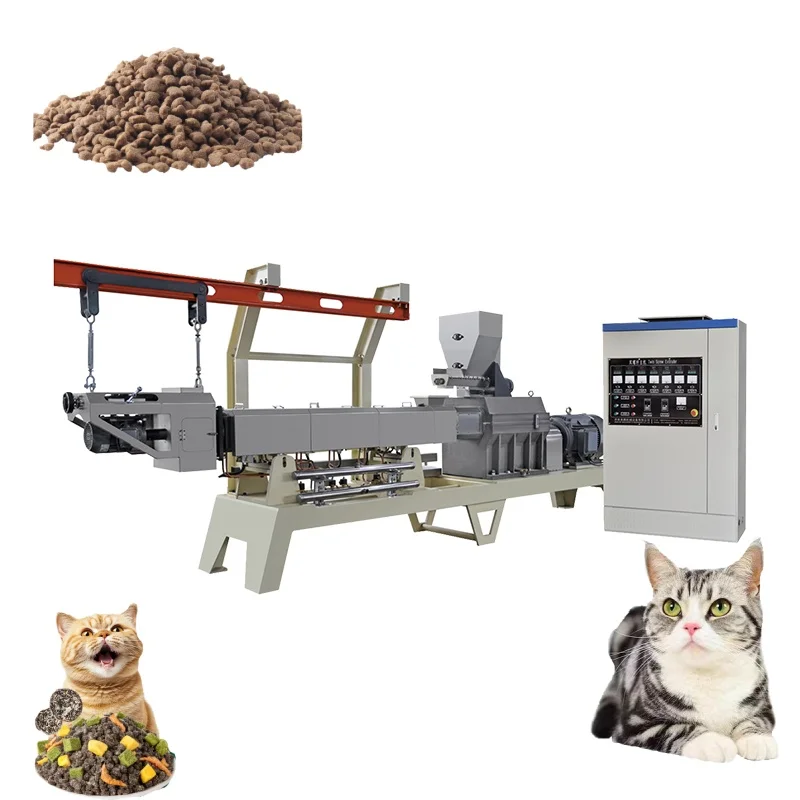
Integrated line stations matched end-to-end — every mixer, extruder, dryer and coater in this catalogue is selected so throughput aligns at each transfer point, preventing wet kibble pile-ups that stall production.
Technical Specifications
| Parameter | Value |
|---|---|
| Product Type | Twin Screw Pet Food Extrusion Line |
| Output Capacity | up to 3 tons per hour (basis not stated in source — confirm raw material, moisture, kibble size and density) |
| Applications | Dry pet food (dog and cat kibble), aquatic feed (fish feed) |
| Warranty | 1-year |
| Process Documentation | Fish feed process drawing included |
| Screw Type | To be confirmed (single or twin screw) |
| Control System | To be confirmed (PLC / MCC options) |
| Voltage & Frequency | To be confirmed for target market |
| Line Stations | To be confirmed (mixer, extruder, dryer, coating, packing) |
Application Suitability
| Application | Material or Output |
|---|---|
| Dry dog and cat kibble production | Corn, meat meal, grain blends, vitamin premix |
| Floating and sinking aquatic feed | Fish meal, soy protein, starch binders |
| Premium pet food lines | Multi-protein recipes with fat coating requirements |
| Aquaculture feed manufacturing | Pellet and extruded formats for catfish, tilapia, shrimp |
What "Up to 3 Tons per Hour" Really Means for Your Pet Food Making Machine Full Equipment Range
Capacity is only meaningful when tied to your specific raw material recipe, moisture content, and target kibble density.
I have watched a pet food producer sign for an extruder rated at a headline number, only to find the dryer downstream could not keep pace once their actual high-fat recipe hit the line. Wet kibble backed up at the transfer chute within the first shift. When you survey a pet food making machine full equipment range, the number that matters is the matched throughput across every station — mixer discharge rate, extruder output at your recipe, dryer residence time, and coating drum cycle. [NEED_CITE: throughput matching principles in continuous food processing lines]
Surveying Every Station Before You Specify
When buyers evaluate a pet food making machine full equipment range, the extruder often takes all the attention. Yet the dryer determines whether you ship product or scrap it, and the coating drum decides palatability. Each station in this catalogue is listed with its individual capacity envelope so you can compare models side by side before committing to a layout.
How Station Sequencing Affects Your Floor Plan
The order and spacing between stations dictates material flow and operator access. A mixer feeding an extruder needs a surge bin to prevent starvation during batch changeovers. A coating drum placed too far from the dryer outlet loses heat, reducing fat absorption uniformity. Mapping every station from this range onto your available floor space ensures conveyors run straight and maintenance doors stay accessible. [NEED_CITE: food factory layout and material flow design standards]
Reading the Specs That Actually Matter
Screw configuration determines how aggressively raw material is sheared and cooked; a high-moisture meat-heavy recipe needs a different screw profile than a corn-dominant formula. Die design sets kibble geometry and expansion ratio — a dense sinking aquatic pellet requires a completely different die plate than a light, crunchy dog kibble. Control system choice between PLC and MCC affects whether operators can store recipe parameters digitally or must adjust each station manually at every batch change. Voltage and frequency must match the local grid before any motor is energized; a 50 Hz motor running on 60 Hz supply spins faster, altering extruder screw speed and dryer fan flow simultaneously.
The Cost of Picking Stations in Isolation
Selecting an extruder without confirming dryer capacity is the most common mismatch I encounter. The extruder pushes out product faster than the dryer can remove moisture, and partially dried kibble enters the coating drum where fat seals in that residual water. The result is mold complaints from distributors within weeks. A similar bottleneck appears when the coating drum finishes faster than the cooler can bring kibble to packing temperature, leaving warm product in bags where condensation forms during storage. [NEED_CITE: moisture migration and shelf life failure in extruded pet food]
Why Source the Full Range from One Supplier
Every station listed here can be matched against the others for throughput alignment before a line layout is drawn. Screw and die configurations are specified to your raw material rather than copied from a generic build. In-house trial runs on your actual recipe confirm expansion, density, and coating absorption before equipment leaves the factory. Electrical schematics confirm voltage, frequency, and control language for your market before production begins. Wear parts lists for each station are supplied so screw segments, die plates, and dryer belts are available when the first replacement falls due.
Documentation & Verification
- Machine specification sheet per station confirming motor power, footprint, and utility draw
- Line layout drawing showing throughput calculation at every transfer point
- Screw and die configuration record matched to your raw material and kibble density target
- Electrical schematic with voltage and frequency locked to your local grid standard
- Factory trial run report produced on your recipe before dispatch
Installation, Commissioning & Support
- Foundation requirements and floor loading confirmed per station weight in the layout package
- Dedicated electrical circuits sized to the total connected load of extruder, dryer, and coating motors
- Stations shipped partially assembled with matched flange connections to reduce on-site fitting time
- First-run parameter setting covering barrel temperature zones, screw speed, and dryer belt rate
- Operator training on recipe changeover procedures including screw segment swaps and die plate changes
- Wear parts inventory list covering screw segments, die plates, dryer belt sections, and coating drum paddles
What to Prepare Before You Request a Quote
To configure the right combination of stations from this pet food making machine full equipment range, share your raw material formulation with moisture percentages, target daily output in finished weight, and the kibble shapes and densities your market expects. Include your local voltage and frequency, preferred control language for the operator interface, and any existing upstream or downstream equipment the new stations must connect to.
Frequently Asked Questions
Q: How do I match extruder capacity with dryer and coating drum throughput?
A: Start with your recipe moisture content and target finished moisture. The extruder output at that recipe sets the minimum dryer evaporation rate. The coating drum cycle time must then align with the dryer discharge rate so kibble never queues between stations. Request a throughput calculation for each station based on your specific formula.
Q: What voltage and control-language options are available for each station?
A: Each machine in the range can be configured for the voltage and frequency standard in your market. PLC and MCC control options are available, with operator interface language set before production. Confirm your local grid specifications early so motor nameplates and transformer sizing match from day one.
Q: Which screw and die configurations suit different kibble formats?
A: Screw segment arrangement controls shear intensity and residence time, matched to whether your recipe is grain-heavy or meat-heavy. Die plate geometry sets kibble shape and expansion ratio — dense sinking aquatic pellets and light crunchy dog kibble each need dedicated die designs. Configuration is finalized after a trial run on your raw material.
Q: Can I order individual stations instead of a complete line?
A: Individual stations from the catalogue can be supplied to integrate with your existing equipment. Provide the interface specifications — conveyor height, transfer chute dimensions, and control signal protocol — so the new station connects without modifying your current machines.
Q: What spare wear parts should I stock for the first year?
A: A recommended first-year spares list is provided with each quotation, typically covering screw segments, die plates, extruder barrel liners, dryer belt sections, and coating drum paddle scrapers. Stocking these before commissioning prevents unplanned downtime when the first wear cycle arrives.