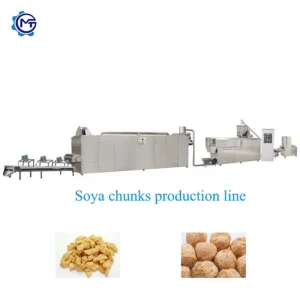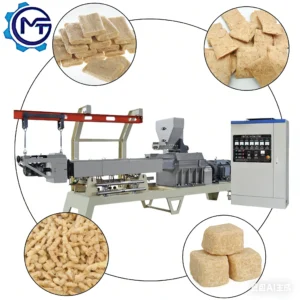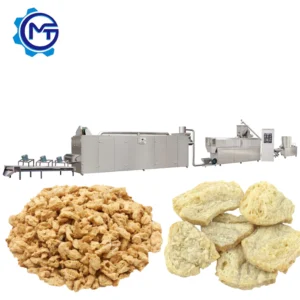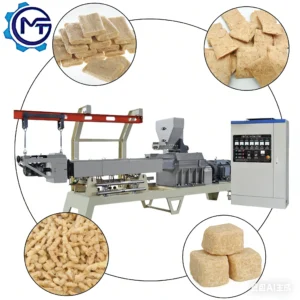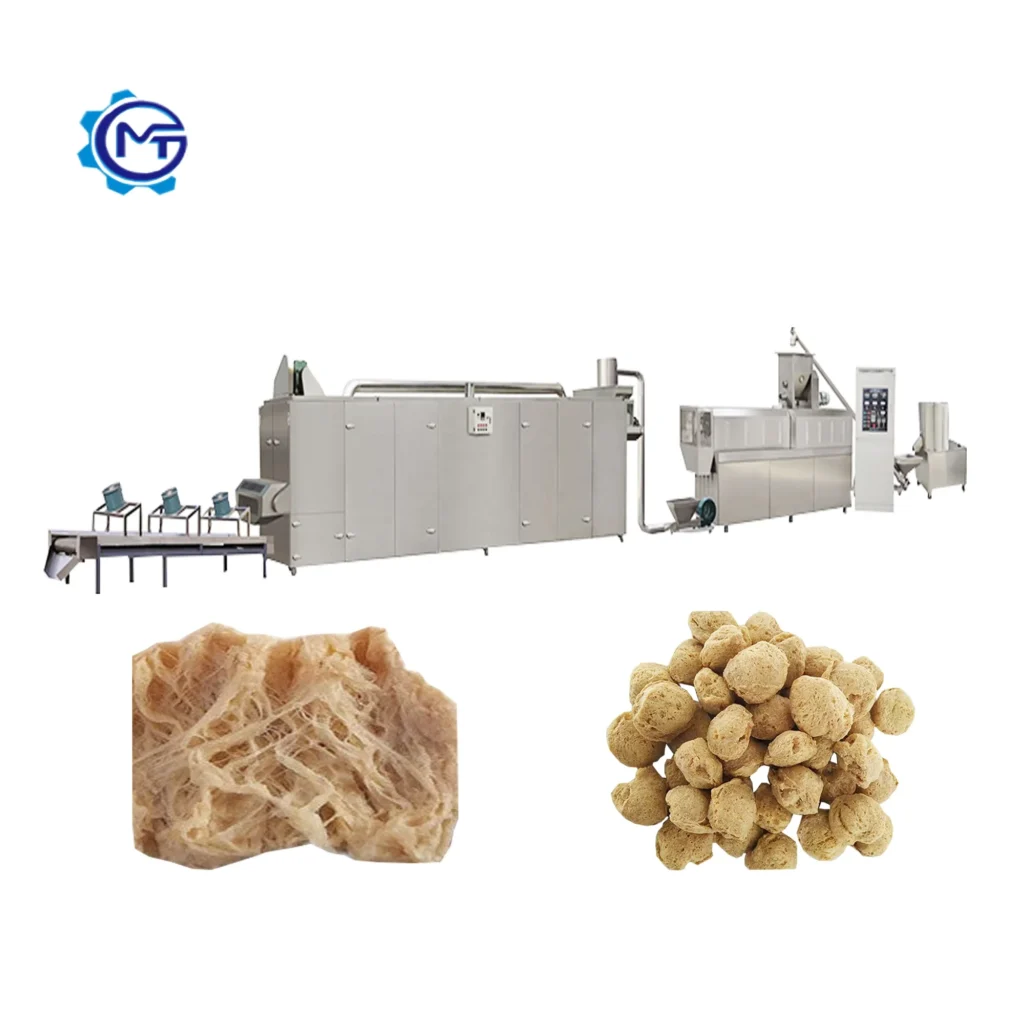
Matched throughput across stations — Every mixer, extruder, roaster and cooler in this line is sized against your specific protein formulation before build, so no single machine chokes the chain.
Technical Specifications
| Parameter | Value |
|---|---|
| Product Type | Texturized Vegetable Protein Extrusion Line |
| Extruder Models Available | MT65 / MT70 / MT85 |
| Screw Type | Twin-screw |
| Installed Power | 85 kW (MT65) / 120 kW (MT70) / 195 kW (MT85) |
| Actual Power Consumption | 65 kW (MT65) / 90 kW (MT70) / 165 kW (MT85) |
| Output Capacity (MT65) | 150–200 kg/h (basis not stated in source — confirm raw material and moisture content) |
| Output Capacity (MT70) | 200–300 kg/h (basis not stated in source — confirm raw material and moisture content) |
| Output Capacity (MT85) | 600–800 kg/h (basis not stated in source — confirm raw material and moisture content) |
| Overall Dimensions (MT65) | 18000 × 1300 × 2300 mm |
| Overall Dimensions (MT70) | 20000 × 1500 × 2400 mm |
| Overall Dimensions (MT85) | 24000 × 3500 × 4300 mm |
| Mixer Tank Volume | 150 kg |
| Mixer Rotary Speed | 385 rpm |
| Mixer Mixing Time | 10 min per batch |
| Mixer Power | 4 kW |
| Mixer Dimensions | 1000 × 630 × 1100 mm |
| Roaster Effective Belt Length | 3.5 m |
| Roaster Belt Motor Power | 0.55 kW |
| Roaster Far Infrared Heater Power | 3.9 kW × 24 |
| Roaster Gas Consumption | 6.8 m³/h |
| Roaster Dimensions | 4500 × 1500 × 1600 mm |
| Material Contact Parts | Stainless steel (food-grade) |
| Assembly State | Complete line, pre-assembled modules |
| Certification | CE |
Application Suitability
| Application | Material or Output |
|---|---|
| Texturized vegetable protein (TVP) production | Low-temperature soybean meal, peanut meal |
| Plant-based meat alternative manufacturing | Soy and pea protein blends for ham, sausage, canned food |
| Ingredient supply for prepared-food producers | High-protein fibrous structures for fast food and quick-frozen products |
| Small to mid-scale enterprise TVP entry | Modest initial investment with scalable extruder model selection |
What "Rated Output" Hides About Protein Extrusion Lines
A capacity number without a named raw material and moisture content is a guess, not a guarantee.
I have watched buyers commit to a plant based meat processing equipment manufacturer based on a headline throughput figure, only to find on commissioning day that their actual pea-to-soy protein ratio demands a different screw profile, longer barrel residence time, and more drying belt length than the line was built to deliver. The extruder runs, but the downstream dryer cannot keep up, and the cooler receives product still holding too much moisture. Throughput collapses to a fraction of what was quoted [NEED_CITE: twin-screw extrusion throughput dependency on raw material formulation]. The bottleneck is never in the machine that was sold — it is always in the station that was not sized for the buyer’s real recipe.
How Protein Molecules Become Fibrous Texture
Twin-screw extrusion subjects spherical protein molecules to high temperature, high pressure and intense shear inside the barrel, breaking their globular structure and reorganizing them into aligned chain formations. As the material exits the die, the sudden pressure drop causes expansion while the aligned chains set into a fibrous, meat-like matrix. The screw configuration — element arrangement, pitch, and kneading block count — is what determines whether the output tears like chicken breast or crumbles like wet cardboard. A plant based meat processing equipment manufacturer that ships a generic screw build is handing you a machine that may need complete reconfiguration before it produces sellable TVP.
Why the Dryer and Cooler Decide Your Real Output
The extruder gets the attention, but it is the roaster and cooling conveyor that govern whether you can run continuously or must stop and wait. A 3.5-meter effective belt length on the roaster with 24 far-infrared heater elements provides the dwell time needed to reduce moisture in high-protein extrudate without case-hardening the surface. If the belt is too short for the extruder’s output, product piles up or exits under-dried, and the cooling machine downstream receives material still above safe packing temperature [NEED_CITE: moisture reduction targets for texturized protein before packing]. Sizing every station to the same mass-flow rate eliminates the stops and restarts that quietly destroy shift output.
Reading the Specs That Actually Matter
The installed power versus actual power consumption gap — 85 kW versus 65 kW on the MT65 — tells you the motors are not running at stall load during normal operation, which extends contactor and bearing life. Mixer rotary speed at 385 rpm with a 10-minute batch cycle on a 150 kg tank means protein powders and minor ingredients reach a homogeneous blend before entering the extruder; uneven premixing shows up as density variation in the finished TVP. Food-grade stainless steel across all contact parts prevents iron-catalyzed lipid oxidation in residual fats within soybean and peanut meal, preserving shelf life [NEED_CITE: food-contact material standards for protein processing]. The three extruder models — MT65, MT70, MT85 — span output tiers so a buyer can match initial investment to market demand without overbuilding the factory floor.
When the Wrong Configuration Reaches Your Factory
Commissioning delays are the first visible cost: if voltage, frequency, and control-panel language were not confirmed before production, the electrical cabinet may need rewiring or component swaps before the first test run [NEED_CITE: voltage and frequency standards by export market]. The hidden cost arrives weeks later when the screw and die set, copied from a generic build, produces TVP with the wrong bite density for your target sausage or canned-food application. You then spend raw material, labor, and market credibility on reformulation trials that should have happened in the supplier’s testing workshop before the machines left the factory floor.
Why Buyers Keep This Line Under One Supplier
Every station from the powder mixer through the cooling conveyor is built in-house, so throughput calculations use actual machine curves rather than catalog estimates from separate vendors. Screw configuration and die design are specified against the buyer’s raw material sample, not borrowed from a standard library. An in-house testing workshop runs the buyer’s exact formulation before shipment, generating a trial report that confirms texture, density, and moisture at each station. Pre-assembled modules reduce on-site welding and alignment work during installation. Documentation — from electrical schematics to wear-parts lists — references a single build, so maintenance queries resolve against one drawing set instead of several vendor manuals.
Documentation & Verification
- Line layout and capacity calculation matched to your soybean or peanut meal formulation and target moisture
- Screw and die configuration record tied to your required TVP fiber density and bite texture
- Factory trial run report on your actual raw material before dispatch
- Electrical schematic confirming voltage, frequency, and control language for your facility
- Wear parts list identifying screw elements, dies, and mixer blades with replacement intervals
Installation, Commissioning & Support
- Foundation must accommodate line lengths up to 24 m and module weights distributed across pre-assembled frames
- Dedicated power circuit sized for the selected extruder’s installed power rating, up to 195 kW on the MT85
- Pre-assembled modules arrive with station-to-station conveyors requiring on-site alignment and belt tensioning
- First-run parameter setting covers barrel temperature zones, screw speed, and roaster belt dwell time
- Operator training addresses screw element replacement and die changeover for different TVP formats
- Spare screw elements, die plates, and mixer blades stocked against the wear parts list provided at delivery
What We Need to Quote Accurately
Send the exact protein source and ratio — soybean meal, peanut meal, pea protein, or any blend — along with target moisture content and the fibrous texture your end product requires. Confirm your daily output goal, factory floor dimensions, and ceiling height so the layout fits the available footprint. Specify local voltage, frequency, and preferred control-panel language to avoid rewiring at commissioning. If you want a trial run on your own raw material before shipment, say so in the inquiry and ship a representative sample to the testing workshop.
Frequently Asked Questions
Q: How is line capacity verified against my specific raw material formulation?
A: We run your exact protein blend and moisture content through the twin-screw extruder in our testing workshop before production begins. The trial report records throughput, product density, and fiber texture at each station. Capacity figures are then confirmed against your real formulation, not a generic benchmark, so the quoted output reflects what the line will actually produce on your factory floor.
Q: Which extruder model fits my target output and factory space?
A: The MT65 suits smaller enterprises with modest daily targets and limited floor length. The MT70 covers mid-range volumes, while the MT85 addresses higher-throughput plants. Selection depends on your confirmed raw material, moisture content, and required shift hours — we match model to actual mass-flow demand rather than a nominal catalog figure.
Q: Are dryer and cooler capacities matched to the extruder?
A: Every station is sized to the same mass-flow rate calculated from your raw material and target moisture. The roaster belt length and heater count, along with cooler capacity, are chosen so that extrudate exits at safe packing moisture without bottling up upstream. No station is allowed to govern the line’s real output below the quoted rate.
Q: Can I run a trial with my own raw material before the line ships?
A: Yes. Our in-house testing workshop accepts your raw material sample and runs the full extrusion, drying, and cooling sequence. You receive a trial report documenting screw configuration, barrel temperature profile, product texture, and measured throughput. Product development is completed before the machines leave the factory, not after installation at your site.
Q: What voltage and control-language options are available?
A: Voltage, frequency, and control-panel language are confirmed during the specification stage before production starts. The electrical schematic reflects your facility’s supply standards so that commissioning proceeds without rewiring or component replacement. This confirmation step prevents the delays that commonly arise when export equipment arrives with mismatched electrical configurations.