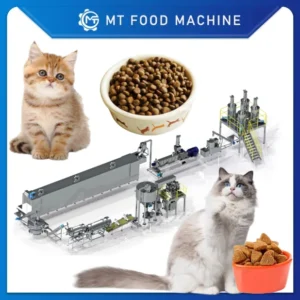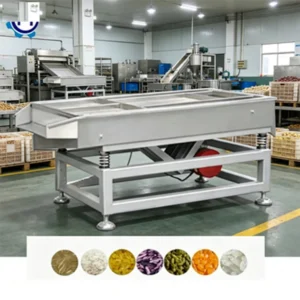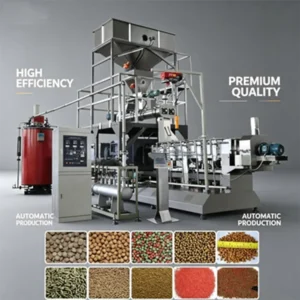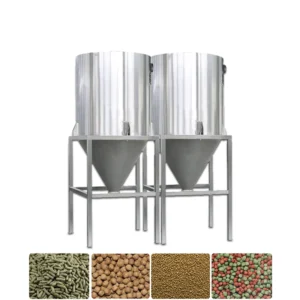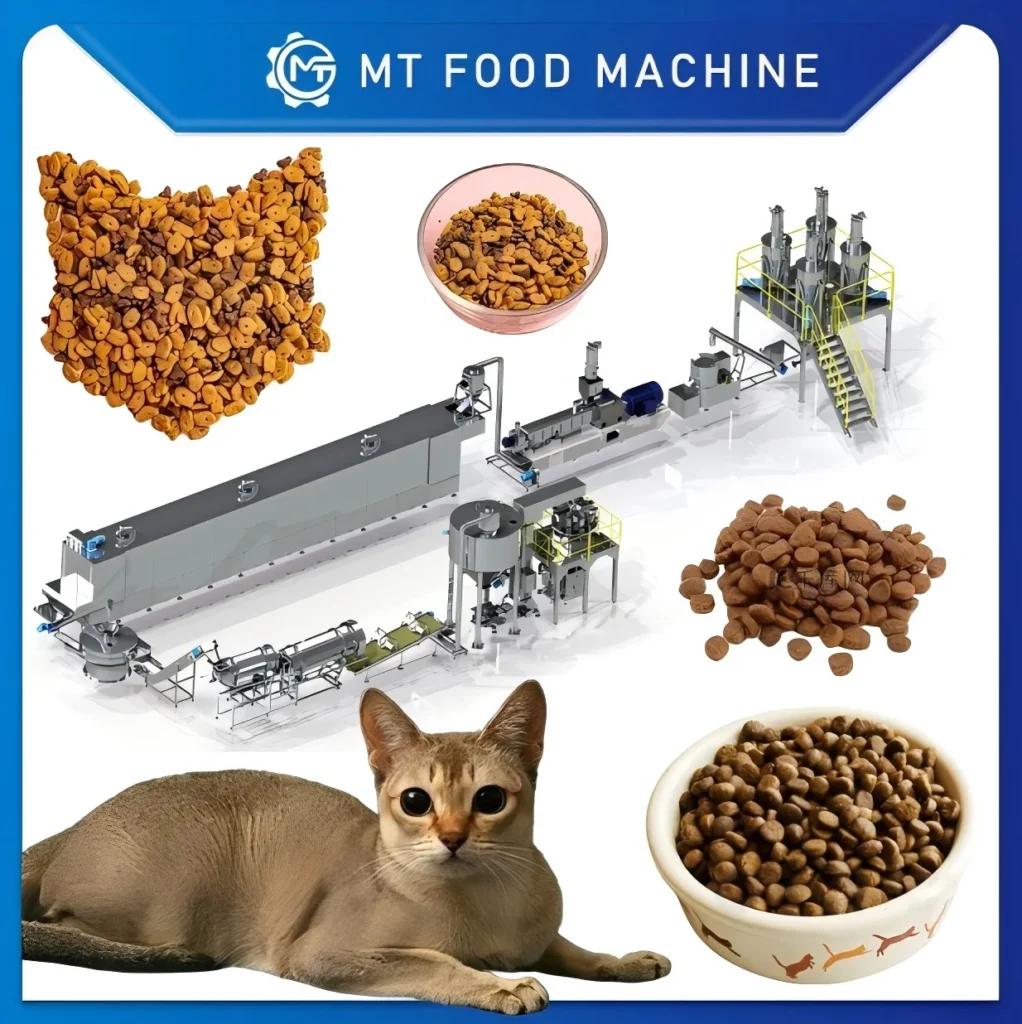
Throughput matching across every station — we verify mixer, extruder, dryer and coating drum capacities against your actual formulation before any equipment leaves our Jinan workshop.
Technical Specifications
| Parameter | Value |
|---|---|
| Product Type | Pet Food Extrusion Production Line |
| Output Capacity | 100-200 kg/h (basis not stated in source — confirm raw material formulation, moisture content, kibble size) |
| Control System | PLC controlled, full automation |
| Supported Formats | Dry kibble, semi-moist, treats |
| Target Species | Multi-species (cat focus) |
| Energy Design | Energy saving configuration |
| Certification | CE, ISO |
Application Suitability
| Application | Material or Output |
|---|---|
| Dry kibble production for cats | Corn, poultry meal, fish meal, vitamin premix blends |
| Semi-moist pet food | High-moisture meat slurries, humectant-added formulations |
| Extruded pet treats | Starch-based doughs, protein concentrates |
| Multi-species dry food | Variable protein-to-starch ratios across dog and cat recipes |
What "100-200 kg/h" Actually Means for Your Recipe
A nominal capacity figure is meaningless until it is tested against your specific raw material blend.
I learned this the hard way early in my career. A Middle East customer ordered a twin-screw line rated at a certain output, but his high-protein cat food formula had a viscosity that cut actual throughput nearly in half. The extruder simply could not convey that dense, sticky mass at the quoted rate. Since then, I refuse to finalize any pet food making machine full equipment range proposal without first running the buyer’s own ingredients through our testing workshop. If the numbers do not align with the formulation you plan to use in your factory, the proposal gets rewritten — not the other way around [NEED_CITE: raw material viscosity impact on extruder throughput].
Surveying the Complete Equipment Catalogue
When buyers evaluate a pet food making machine full equipment range, the extruder tends to dominate the conversation. Yet the dryer, coating drum and cooler each impose their own throughput ceiling. A line where the extruder can push product faster than the dryer can remove moisture will accumulate wet kibble on the belt, creating a sanitation bottleneck that no amount of PLC tuning can solve.
Matching Every Station to Your Target Output
The correct approach starts with your daily production target and works backward through each station. Mixer batch size must feed the extruder at a steady interval. Extruder output must match dryer residence time. Coating drum speed must keep pace without flooding the seasoning system. Only when every node in the chain is balanced does the pet food making machine full equipment range deliver the throughput on paper [NEED_CITE: throughput balancing methodology in food processing lines].
Reading the Specs That Matter Most
The PLC control system is the operational backbone of this line. For a facility producing dry kibble in the morning and switching to semi-moist treats in the afternoon, programmable recipe profiles store barrel temperature zones, screw speed and moisture injection rates so operators recall them with a single screen tap rather than recalibrating by hand. Full automation across conveying and dosing reduces the manual labor footprint on the floor, which matters when you are running multi-species recipes that demand frequent changeovers. The energy saving design lowers utility draw across heating zones and drive motors, an operating cost that compounds over thousands of production hours.
The Hidden Cost of Unmatched Supporting Equipment
Selecting an extruder in isolation and bolting on third-party dryers or coating drums later is a common misstep. When the dryer is undersized, kibble exits with residual moisture above shelf-stable thresholds, inviting mold growth in sealed bags. An undersized coating drum cannot distribute fat and palatant evenly, leaving some kibble pieces under-flavored and triggering rejection at the packing station. These mismatches surface only after the line is installed and running, when re-engineering is expensive and production schedules are already slipping [NEED_CITE: consequences of unbalanced food processing line configurations].
Why Source This Line From Jinan
Every station from batching through packing comes from one supplier, so throughput calculations are reconciled internally before the proposal reaches your desk. Screw configuration and die geometry are specified to your raw material and target kibble density rather than copied from a generic build. Our in-house testing workshop runs your actual ingredients before shipment, generating a trial report that becomes part of your documentation package. Twin-screw expertise spans pet food, aquatic feed, snack and cereal applications, so cross-contamination of knowledge from adjacent food extrusion categories informs the screw profile we recommend. Pre-sales consultation extends through on-site installation, commissioning, operator training and ongoing maintenance support.
Documentation & Verification
- Line layout drawing with capacity calculation for each station matched to your recipe
- Machine specification sheet listing model, motor power and footprint per unit
- Screw and die configuration record tailored to your raw material and kibble density target
- Electrical schematic confirming voltage, frequency and control language for your market
- Trial run report generated on your raw material in our Jinan testing workshop
- CE declaration of conformity and ISO certificate for customs and regulatory filing
Installation, Commissioning & Support
- Foundation plan detailing floor load per station based on overall line dimensions and weight
- Dedicated circuit specification matching PLC control system and extruder motor power draw
- Modular station delivery allowing phased unloading where workshop door clearance is limited
- First-run parameter logging across barrel zones and screw speed to establish baseline recipe profiles
- Operator training covering PLC screen navigation, recipe recall and emergency stop sequences
- Wear parts list specifying screw elements, die plates and seals with reorder part numbers
- Scheduled maintenance calendar aligned to dryer bearing inspection and coating drum liner replacement
What We Need to Build Your Proposal
To configure the right pet food making machine full equipment range for your facility, share your target formulation including protein sources, starch base and moisture content. Tell us your daily production target in kilograms and the kibble size range you intend to produce. Provide your workshop floor dimensions and ceiling height, along with the local voltage and frequency standard so we can specify motors and control panels accordingly. If you already operate upstream mixers or downstream packing machines, let us know their throughput so we match the new line to your existing equipment.
Frequently Asked Questions
Q: What equipment stations are included in the full line and how is throughput matched between them?
A: The line can include batching, mixing, extrusion, drying, coating, cooling and packing stations. Throughput at each station is calculated against your raw material formulation and target kibble size, then reconciled so no single unit creates a bottleneck. A capacity calculation document accompanies every proposal.
Q: How do I choose between single-screw and twin-screw extruder configurations for my pet food recipe?
A: Single-screw extruders handle simpler starch-dominant recipes well, while twin-screw configurations manage high-protein, high-fat or high-moisture formulations with better mixing and conveyance. We recommend the screw type after reviewing your ingredient list and running a trial on your raw material.
Q: What is the footprint and utility requirement of the complete equipment lineup?
A: Footprint depends on which stations you include and the dryer length required for your moisture target. Utility requirements cover electrical supply matched to your local voltage and frequency, steam or thermal oil for the dryer, and compressed air for pneumatic gates. A layout drawing is provided before order confirmation.
Q: How does the PLC control system support recipe changeover between dry kibble, semi-moist, and treats?
A: The PLC stores temperature profiles, screw speed, feed rate and moisture injection parameters for each recipe. Operators recall a saved profile on the touch screen, and the system adjusts setpoints across barrel zones automatically, reducing manual recalibration and maintaining batch-to-batch consistency.
Q: What spare wear parts are included and how are replacements sourced?
A: Each shipment includes a wear parts kit covering screw elements, die plates and shaft seals sized to your configuration. The documentation package lists every part number. Replacement orders are fulfilled from our Jinan workshop and shipped directly, typically within a standard lead time.